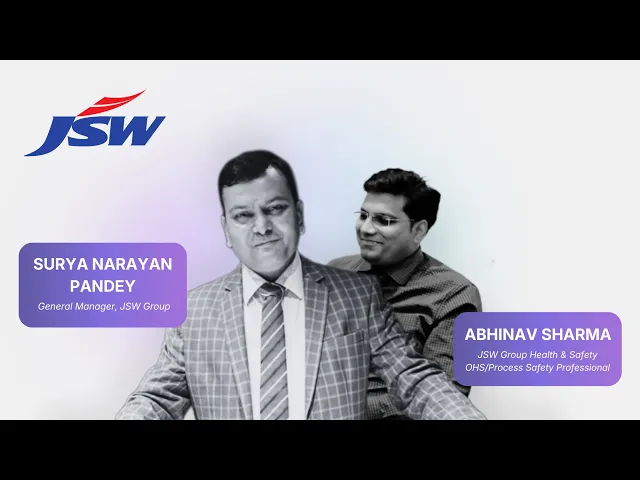
Episode 4
18:49 min
How JSW Achieved Mass XR Adoption
How JSW Achieved Mass XR Adoption
This episode dives into how JSW is using VR to train workers on dangerous, complex activities like lancing operations, explosive handling, and working at 40 to 50 meter heights. You’ll hear how the program scaled to 1,200 workers in six months, why frontline workers learn faster in VR, and how digital dashboards now track assessment performance across plants.
Host

Ashwin Jaishanker
Co-Founder & CEO,
AutoVRse
Guests
Abhinav Sharma
JSW Group Health & Safety OHS/Process Safety Professional
Surya Narayan Pandey
General Manager,
JSW Group
General Manager, JSW Group
Highlights from the conversation
Highlights from the conversation
Highlights from the conversation
Ashwin Jaishanker
When we talk about safety training in heavy industry, the risks are very real. How do you approach training for activities where even small mistakes can be dangerous?
Ashwin Jaishanker
When we talk about safety training in heavy industry, the risks are very real. How do you approach training for activities where even small mistakes can be dangerous?
Surya Narayan Pandey
That is always the biggest challenge. Many of the activities we deal with involve explosives, lancing operations, and working at significant heights. You cannot recreate these situations in real life just for training, because the risk is too high.
Surya Narayan Pandey
That is always the biggest challenge. Many of the activities we deal with involve explosives, lancing operations, and working at significant heights. You cannot recreate these situations in real life just for training, because the risk is too high.
Surya Narayan Pandey
Traditional training methods explain procedures, but they do not help workers truly understand what can go wrong. Without experiencing the scenario, people often underestimate the risk involved.
Surya Narayan Pandey
Traditional training methods explain procedures, but they do not help workers truly understand what can go wrong. Without experiencing the scenario, people often underestimate the risk involved.
Ashwin Jaishanker
So there is a gap between knowing the process and understanding the consequences.
Ashwin Jaishanker
So there is a gap between knowing the process and understanding the consequences.
Abhinav Sharma
Exactly. That gap is where most incidents happen. When people only read instructions or watch videos, the learning does not always translate to real behaviour on the shop floor.
Abhinav Sharma
Exactly. That gap is where most incidents happen. When people only read instructions or watch videos, the learning does not always translate to real behaviour on the shop floor.
Abhinav Sharma
We were looking for a way to bridge that gap, where people could learn by experiencing situations rather than just hearing about them.
Abhinav Sharma
We were looking for a way to bridge that gap, where people could learn by experiencing situations rather than just hearing about them.
Ashwin Jaishanker
This is where VR started coming into the picture.
Ashwin Jaishanker
This is where VR started coming into the picture.
Surya Narayan Pandey
Yes. VR allows workers to experience hazardous situations in a safe environment. They can see the outcome of incorrect actions without being exposed to real danger.
Surya Narayan Pandey
Yes. VR allows workers to experience hazardous situations in a safe environment. They can see the outcome of incorrect actions without being exposed to real danger.
Surya Narayan Pandey
When workers go through these scenarios, the learning becomes personal. They remember it because they have lived through it, even if it is virtual.
Surya Narayan Pandey
When workers go through these scenarios, the learning becomes personal. They remember it because they have lived through it, even if it is virtual.
Ashwin Jaishanker
How did people respond when VR training was first introduced?
Ashwin Jaishanker
How did people respond when VR training was first introduced?
Abhinav Sharma
Initially, there was curiosity. But very quickly, we saw strong engagement. Workers were attentive, and supervisors noticed that concepts were being understood much faster.
Abhinav Sharma
Initially, there was curiosity. But very quickly, we saw strong engagement. Workers were attentive, and supervisors noticed that concepts were being understood much faster.
Ashwin Jaishanker
And this did not stay limited to a single location.
Ashwin Jaishanker
And this did not stay limited to a single location.
Surya Narayan Pandey
No, it expanded rapidly. Once teams experienced VR training, there was a strong demand to bring it to other plants and to cover more safety scenarios.
Surya Narayan Pandey
No, it expanded rapidly. Once teams experienced VR training, there was a strong demand to bring it to other plants and to cover more safety scenarios.
Surya Narayan Pandey
Workers started discussing the training among themselves, which rarely happens with traditional safety programs.
Surya Narayan Pandey
Workers started discussing the training among themselves, which rarely happens with traditional safety programs.
Ashwin Jaishanker
Scaling something like this across plants is not easy. How did you manage that?
Ashwin Jaishanker
Scaling something like this across plants is not easy. How did you manage that?
Abhinav Sharma
We focused on building structured modules that could be reused across locations. Within six months, we trained over twelve hundred workers across multiple plants.
Abhinav Sharma
We focused on building structured modules that could be reused across locations. Within six months, we trained over twelve hundred workers across multiple plants.
Abhinav Sharma
Once plant managers saw the impact on understanding and behaviour, they actively asked for more modules.
Abhinav Sharma
Once plant managers saw the impact on understanding and behaviour, they actively asked for more modules.
Ashwin Jaishanker
Beyond engagement, how did you measure whether the training was actually working?
Ashwin Jaishanker
Beyond engagement, how did you measure whether the training was actually working?
Surya Narayan Pandey
Assessment was very important for us. We looked at how workers performed before and after training, and we could clearly see improvement in awareness and decision making.
Surya Narayan Pandey
Assessment was very important for us. We looked at how workers performed before and after training, and we could clearly see improvement in awareness and decision making.
Surya Narayan Pandey
The ability to identify gaps helped us refine the training continuously instead of treating it as a one time activity.
Surya Narayan Pandey
The ability to identify gaps helped us refine the training continuously instead of treating it as a one time activity.
Ashwin Jaishanker
That feedback loop seems critical for long term success.
Ashwin Jaishanker
That feedback loop seems critical for long term success.
Abhinav Sharma
Absolutely. VR is not something we see as a one off initiative. It has become part of how we think about safety training and skill development.
Abhinav Sharma
Absolutely. VR is not something we see as a one off initiative. It has become part of how we think about safety training and skill development.
Abhinav Sharma
As we continue to add more modules, the goal is to keep improving safety outcomes by making training more practical and more relatable for workers.
Abhinav Sharma
As we continue to add more modules, the goal is to keep improving safety outcomes by making training more practical and more relatable for workers.
Catch the best moments
on YouTube Shorts
Catch the best moments
on YouTube Shorts
Catch the best moments
on YouTube Shorts
Checkout more from
Now VR Talking
Checkout more from
Now VR Talking
Checkout more from
Now VR Talking
Profile
© 2025 Autovrse. All Rights Reserved.
Profile
© 2025 Autovrse. All Rights Reserved.