Back to Blog List

How AR VR Applications Are Transforming Industrial Operations and Workforce Training

How AR VR Applications Are Transforming Industrial Operations and Workforce Training

Industrial companies face rising expectations for better output, safer work environments, and faster employee development.

AR VR applications are moving past the trial phase and becoming essential to how businesses operate, train staff, and scale. This blog covers how they are changing industrial operations and training, the problems they solve, which industries benefit most, and what to consider before deploying at scale.

Why Are AR VR Applications Becoming Essential for Industrial Teams?

Industrial environments are growing more complex to operate. Regulatory requirements are tightening, skilled workers are in shorter supply, and traditional tools such as manuals, classroom sessions can no longer keep pace with rapid process changes or the demands of safe operations.

Augmented reality (AR) and virtual reality (VR) close that gap. They layer digital information onto how people work and train; enabling employees to learn faster and perform tasks with greater precision.

With augmented reality in business, employees get contextual instructions exactly when and where they need them. Augmented reality training and extended reality applications also deliver immersive simulations that prepare employees for situations too dangerous, costly, or rare to practise in person. Together, these tools help industrial teams reduce errors, accelerate development, and maintain safer working environments.

AR and VR applications are becoming vital to modern industrial operations. They directly connect learning, performance, and operational consistency in ways that legacy systems cannot match. 

For a clearer look at how each technology differs and when to use which, see our guide on AR vs VR.

What Problems Do AR VR Applications Solve in Industrial Environments?

Industrial teams face persistent challenges around productivity, workforce safety, and knowledge transfer. These problems stem from process complexity, inconsistent working practices, and limited access to expert guidance at the point of work.

AR VR applications address these issues directly by embedding real-time digital guidance into how work is performed and how people are trained.

Reducing Human Error in Repetitive Processes

Repetitive industrial tasks such as assembly, inspection, maintenance are highly susceptible to human error, particularly under time pressure or fatigue. AR and VR reduce mistakes by delivering clear visual instructions, confirming task completion, and triggering alerts when steps are missed.

Augmented overlays ensure workers follow the correct sequence, torque values, or inspection criteria without relying on memory. Companies that use augmented reality for guided workflows report fewer errors and less rework with more consistent output across shifts and locations.

Improving Worker Safety Through Immersive Training

Safety training is one of the strongest use cases for AR VR applications in industrial settings. VR in manufacturing enables employees to practise hazardous tasks such as confined space entry, equipment lockout, emergency response without any real-world risk. These simulations build capability in ways that classroom training cannot replicate.

Research shows that immersive learners complete training up to four times faster than classroom participants (Source). By exposing workers to realistic risk scenarios before entering live environments, AR VR applications significantly reduce accident rates and strengthen compliance outcomes.

Eliminating Downtime Through Real-Time Remote Insight

When equipment fails, resolution delays often stem from on-site teams lacking access to expert guidance. AR VR applications bridge that gap through real-time remote support, allowing specialists to walk field workers through repairs as they happen.

Digital overlays and real-time annotations help shorten repair times. For more virtual reality examples in maintenance and operations, these approaches cut production stoppages and eliminate delays from travel or approval bottlenecks. In equipment-intensive industries, even small reductions in downtime translate to significant cost savings.

This method cuts down on production stops and gets rid of hold-ups from travel or long approval processes. In industries that depend on a lot of equipment, even a little less downtime can save a lot of money.

Accelerating Knowledge Transfer Across Workforces

Many industrial organisations face an accelerating loss of institutional knowledge as experienced workers retire or change roles. AR VR applications can capture expert workflows and embed that knowledge directly into training modules and operational guides.

VR simulations preserve complex tacit knowledge that is difficult to capture in text-based SOPs. 

VR training makes learning practical by helping new hires reach competency faster. This is especially valuable for global operations where consistency across sites is critical.

Together, these AR VR applications make industrial environments safer, more consistent, and more resilient.
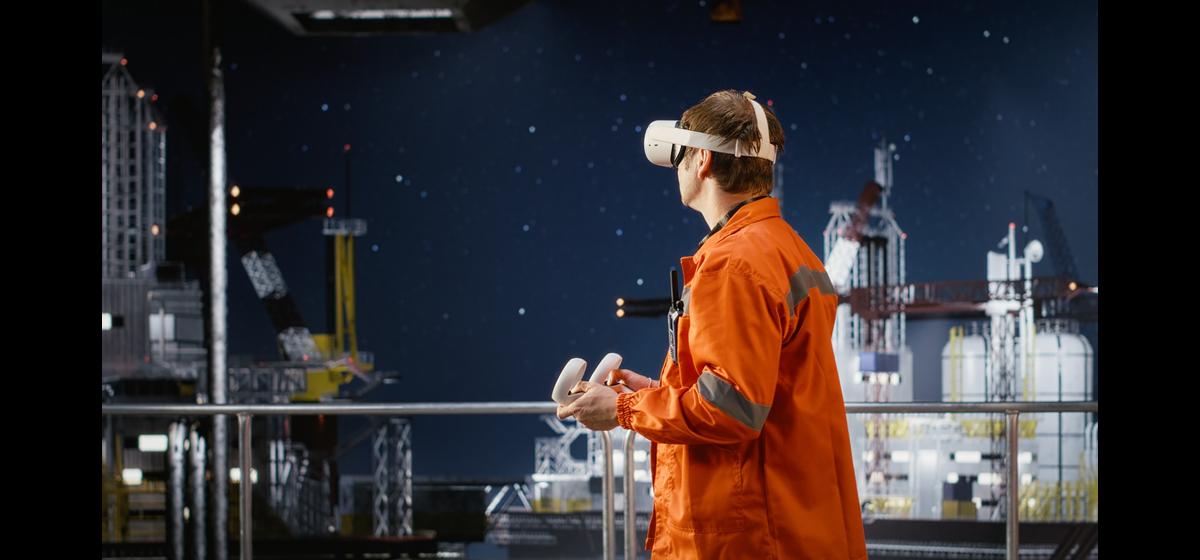

How AR VR Applications Enhance Daily Industrial Operations?

Training is a major driver of AR VR adoption but these tools are equally valuable in live operational environments. Industrial teams use immersive technology to guide task execution, monitor assets, and optimize performance in real time.

While AR VR applications solve critical industrial challenges, their impact becomes clearer when viewed across two core areas: how work is performed, and how workers are trained. In practice, these technologies support daily operations through real-time execution support, while also enabling workforce development through immersive, scalable training environments.

AR for Real-Time Work Instructions and Digital Overlays

Augmented Reality in business plays a crucial role in daily task execution by overlaying digital instructions directly onto physical equipment and environments. While keeping workers hands-free, AR headsets and mobile devices display prompts, checklists, and warnings. This capability is especially effective for complex assembly, quality inspections, and maintenance procedures.

Firms employing augmented reality for work instructions have seen better initial execution and less need for printed guides. Digital interfaces make sure workers use the most current standard operating procedures, even when processes change.

VR for High-Fidelity Simulations and Task Rehearsal

Virtual Reality in Manufacturing enables teams to practice difficult jobs before actually performing them. Realistic simulations let workers get familiar with how to use equipment, make changes, or handle shutdowns when things go wrong, all in a safe setting. This method lowers the risk of mistakes when doing the actual work and helps people feel sure of themselves when doing important tasks.

AR VR applications can help with pre-certifying and checking employee skills. This makes sure workers are ready before they use live systems, which cuts down on mistakes.

Digital Twins for Continuous Operational Insight

Digital twins extend AR VR applications beyond guidance and training by creating live virtual replicas of physical assets and processes. These models integrate real-time sensor data, historical performance records, and AI to provide ongoing operational intelligence. Operators can track system performance, anticipate failures, and refine workflows through intuitive interfaces.

By connecting digital twins with extended reality applications, industrial teams gain a unified view of how operations are performing thereby enabling faster decisions and proactive maintenance.

By connecting digital twins with extended reality applications, industrial teams get a common, easy-to-understand view of how things work. This helps them make quicker choices and keep equipment in good condition before problems happen.

As AR VR applications become embedded in daily operations, organizations move closer to predictive, data-driven execution models rather than reactive firefighting.

What Are the Most Impactful AR VR Applications in Workforce Training?

While operational enablement is growing, workforce training remains the most established use case for AR VR applications in industry. Industrial training programs must prepare workers for dangerous tasks, complex machinery, and rapidly evolving processes.

Immersive learning delivers results that conventional instruction methods cannot match at scale, consistently, and without exposing workers to real-world risk.

VR Safety Training for High-Risk Scenarios

VR safety training places employees in realistic, hazardous situations like fires, chemical spills, or equipment malfunctions. These virtual scenarios let workers practice repeatedly without real-world risk. This helps build confidence in their decisions and solidifies the right responses when under pressure.

Studies show that immersive safety training improves retention and reduces workplace incidents compared to lecture-based methods (Source). These gains have a direct influence on compliance and insurance outcomes. For a deeper look at what the evidence shows, see our guide to the benefits of VR training.

AR-Based On-the-Job Guidance

Augmented Reality and virtual reality examples in training commonly show AR guidance for tasks performed in real time. AR helps people learn as they work by giving them relevant cues when they are doing actual jobs. This approach lowers mental strain and keeps productivity high while training.

Augmented reality in business applications are particularly effective for jobs like maintenance, inspection, and field service, where being precise is very important.

Recreating Rare, Dangerous, or Costly Scenarios in VR

Uncommon industrial scenarios can lead to substantial problems. Teams can rehearse responses to events like emergency shutdowns or equipment failures through augmented and virtual reality apps, which simulate those events in digital spaces.

Virtual Reality in Manufacturing simulations make sure that edge cases are prepared for without any production disturbances or safety risks.

Improving Skill Retention Through Experiential Learning

Experiential learning is a core advantage of AR VR applications. Immersive training engages multiple senses and demands active participation, which further drives stronger knowledge retention than passive classroom instruction.

Research confirms that VR learners retain significantly more information than those trained through traditional methods (Source). The result is faster onboarding, fewer on-the-job errors, and higher productivity from day one.

Where Do AR VR Applications Create the Biggest Impact Across Industries?

AR VR applications deliver value across many sectors but some industries see disproportionately high returns due to the complexity and inherent risk of their operations.

Looking at specific industry applications shows how these technologies adapt to very different working environments while delivering consistent gains.

Manufacturing

Manufacturing leads adoption of AR VR applications for assembly, maintenance, quality assurance, and safety training. The application of VR in manufacturing includes simulating equipment use, walking through processes, and certifying employees for specific roles. 

Companies that use augmented reality report measurable reductions in errors and increases in production speed.

Pharmaceuticals

In pharmaceutical operations, AR VR applications support GMP compliance, cleanroom behaviour training, and equipment qualification. XR standardises training across sites while maintaining regulatory precision.

Virtual simulations lower contamination risk and reduce training time, making virtual reality in pharma one of the most effective tools available to compliance-driven teams.

Mining

Mining operations use AR VR applications for safety drills, equipment operation training, and emergency preparedness. Virtual Reality in Manufacturing principles extend to mining by simulating hazardous environments that are difficult to access safely.

Automotive

AR VR in automotive industry applications span design validation, production training, and service support. VR in the automotive industry supports assembly optimisation, while AR assists technicians with diagnostics and repairs - reducing time-to-market and improving service accuracy.

Across industries, AR VR applications deliver the highest impact where safety, precision, and scalability intersect.

How Do AI-Driven AR VR Applications Improve Industrial Efficiency?

AR VR applications solve real problems on their own, but when AI is added to the stack, the capabilities shift from static to adaptive. AI transforms immersive tools from fixed experiences into systems that learn, predict, and continuously improve.

Here is how AI integration enhances each core function of AR VR applications in industrial settings.

Intelligent Recognition for Automated Error Detection

Computer vision, driven by AI, gives AR and VR apps the power to understand objects, actions, and problems as they happen. These systems can spot incorrect steps, missing components, or unsafe behaviors. 

Because the feedback is instant, mistakes can be stopped before they cause bigger problems or accidents.

Predictive Maintenance Through AI-Enhanced Digital Twins

AI-driven digital twins analyze sensor data and historical trends to predict equipment failures. When combined with extended reality applications, maintenance teams visualize asset health and plan interventions proactively. 

This approach reduces unplanned downtime and extends asset life.

Adaptive Learning Paths in VR Training

VR training, powered by artificial intelligence, can be customized to fit each person's learning style. Virtual Reality in Manufacturing training programs use adaptive learning to focus on individual skill gaps, improving efficiency and engagement.

Automated Reporting from XR Interactions

AR VR applications capture detailed interaction data, including task completion times, error rates, and decision paths. AI analyzes this data to generate automated reports for compliance, performance management, and continuous improvement initiatives.

AI-powered augmented and virtual reality can assist businesses in shifting from reacting to problems to predicting them and improving how they operate.

How Do AR VR Applications Integrate with Existing Enterprise Systems?

For the successful use of AR and VR applications, smooth integration with company systems is needed. Instead of working alone, factories need tools that can fit into their current digital setups. 

Here’s a look at some of the key systems that you need to consider

Integration With PLM, MES, ERP, LIMS and QMS

AR VR applications integrate with PLM, MES, ERP, LIMS, and QMS platforms to ensure consistency and traceability. Training records, task validations, and inspection results flow directly into enterprise systems, supporting compliance and audit requirements.

Connecting AR VR With CAD and CAE Models

VR in Manufacturing leverages existing CAD and CAE models to create accurate simulations and overlays. This connection ensures training and operational guidance reflect real-world design specifications and updates.

Data Flow, Version Control and SOP Updates in Real Time

By integrating systems, AR/VR applications can always access the most current approved documents. Version control makes sure that shop floor staff doesn't see old instructions, which lowers the chance of compliance issues and mistakes.

When integrated correctly, augmented reality and virtual reality applications can act as parts of business systems, instead of just being separate tools.

What ROI Can Companies Expect from AR VR Applications?

The returns from AR VR applications span both training and operational outcomes. Benefits commonly include shorter training times, fewer errors, improved safety records, and reduced equipment downtime.

Research shows that immersive training can reduce costs by up to 52% at scale compared to traditional classroom delivery (Source) - clearly demonstrating the benefits of VR training at enterprise scale.

Operational ROI includes faster onboarding, improved quality metrics, and enhanced workforce readiness. For a comprehensive framework on measuring returns, see our VR training ROI analysis.

What Should Organizations Consider Before Deploying AR VR Applications?

Deploying AR VR applications successfully requires planning across technology, change management, and governance. Industry leaders must evaluate hardware, compliance, and data security before scaling.

Addressing these AR VR challenges early ensures sustainable deployment and protects the long-term value of immersive investments.

Hardware Compatibility and Environment Requirements

Device selection is critical in industrial environments. Factors including durability, comfort, field of view, and battery life all directly affect whether workers will actually use the technology.

For guidance on choosing the right hardware for your use case, our guide to the best VR headsets provides a practical starting point.

User Adoption and Training Readiness

Change management plays a key role in adoption. Employees require onboarding, clear value communication, and leadership support to integrate AR VR applications into daily workflows.

Content Accuracy and Regulatory Compliance

Training and operational content must align with regulatory standards and internal policies. Regular reviews and SME validation ensure accuracy and compliance.

Data Security and IP Protection

AR VR systems must comply with company security policies and industry standards. Proprietary processes, formulations, and engineering data must be protected across every device and network the platform touches.

Ensuring AR VR systems are securely integrated with existing business networks and access controls are properly enforced is essential before any sensitive data is loaded into an immersive environment.

Addressing these AR VR challenges ensures sustainable and scalable deployment of AR VR applications.

How Companies Can Successfully Implement AR VR Applications at Scale

Scaling AR VR applications successfully requires a structured, phased approach tied to clear operational goals. Companies that treat immersive technology as a strategic priority rather than a standalone pilot, consistently deliver stronger results.

Choosing the right implementation partner is equally important. Our guide on how to choose a VR vendor will help you evaluate options before committing.

Step 1: Identify the Highest-Impact Use Cases

Start where the problems are most visible - high safety incident rates, error-prone processes, or slow onboarding. These areas offer the clearest ROI and the fastest path to demonstrable results. Our overview of AR use cases is a useful starting point for identifying where to begin.

Step 2: Build and Validate XR Content

It is vital to remember that content validation should occur before the content is made widely available. This helps to prevent the spread of misinformation or confusing information. By taking the time to validate content, trust with the audience can be insured.

Step 3: Run Controlled Pilots with Key Teams

Pilots offer data on performance and feedback from users that guide improvements. Assessment based on metrics helps in making reliable scaling choices.

Step 4: Scale Across Sites with Enterprise Integration

Enterprise-wide rollout requires standardized content, centralized management, and system integration. Governance frameworks support consistency across locations.

Organizations that follow this approach successfully embed AR VR applications into core operations and training strategies.

Conclusion

AR VR applications have moved well beyond proof-of-concept. They are now embedded in how industrial organisations train their workforces, execute daily operations, and drive continuous improvement.

From reducing human error on the factory floor to preserving expert knowledge before it walks out the door, immersive technology delivers measurable impact where it matters most. 

The organisations seeing the strongest returns are those that deploy with a clear strategy, integrate with existing systems, and scale from targeted pilots to enterprise-wide programmes.

As augmented reality in business and virtual reality in manufacturing continue to mature, the competitive advantage will belong to teams that act now on building the infrastructure, content, and culture to make immersive tools a permanent part of how they operate.

Ready to deploy AR VR applications that deliver measurable outcomes?

Connect with AutoVRse to design and scale immersive solutions aligned with enterprise priorities.

FAQ

1. What is the difference between AR and VR for industrial use?

Augmented reality (AR) helps people in industry by adding digital information to what they see in the real world. This is very useful for giving help while someone is working and for managing live operations.  Virtual reality (VR) creates whole artificial environments that reproduce equipment, processes, or dangerous situations for training purposes. Instead of practicing on a real, expensive piece of machinery, a trainee can use any of the best VR headsets to interact with a virtual version.

1. What is the difference between AR and VR for industrial use?

Augmented reality (AR) helps people in industry by adding digital information to what they see in the real world. This is very useful for giving help while someone is working and for managing live operations.  Virtual reality (VR) creates whole artificial environments that reproduce equipment, processes, or dangerous situations for training purposes. Instead of practicing on a real, expensive piece of machinery, a trainee can use any of the best VR headsets to interact with a virtual version.

1. What is the difference between AR and VR for industrial use?

Augmented reality (AR) helps people in industry by adding digital information to what they see in the real world. This is very useful for giving help while someone is working and for managing live operations.  Virtual reality (VR) creates whole artificial environments that reproduce equipment, processes, or dangerous situations for training purposes. Instead of practicing on a real, expensive piece of machinery, a trainee can use any of the best VR headsets to interact with a virtual version.

2. How do AR VR applications improve safety?

2. How do AR VR applications improve safety?

2. How do AR VR applications improve safety?

3. Which industries get the highest ROI from AR VR?

3. Which industries get the highest ROI from AR VR?

3. Which industries get the highest ROI from AR VR?

4. Can AR VR integrate with existing tools?

4. Can AR VR integrate with existing tools?

4. Can AR VR integrate with existing tools?

Let’s talk about

Let’s talk about

Let’s talk about

your training

your training

your training

Talk to our team to learn how to implement VR training at scale

Talk to our team to learn how to implement VR training at scale

Talk to our team to learn how to implement VR training at scale