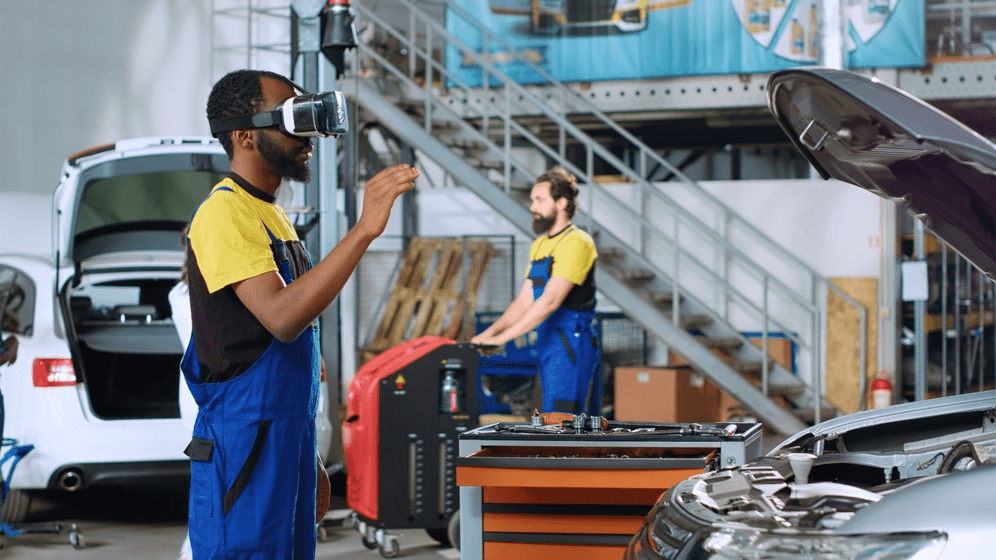
VR is reshaping how cars are designed, manufactured, and marketed. The role of VR in the automotive industry goes beyond design studios to training floors, customer showrooms, and even remote collaboration. This blog explores what VR in the automotive industry means, where it is being used today, the benefits it offers, challenges to adoption, and the future of extended reality in automotive innovation. To get a refresher on what is VR training, give our blog a read.
What is VR in the Automotive Industry?
The growing hype of VR in the automotive industry comes from the use of immersive simulations to enhance design, training, engineering, and customer experiences. Automotive VR uses headsets, haptic controllers, and software that aids collaboration to replace physical processes with digital ones. VR automotive applications allow for the simulation of tasks that would otherwise need physical prototypes or setups. Hence, organizations are combining virtual reality automotive training with VR prototypes and immersive showrooms.
Where VR is Transforming the Automotive Industry
The adoption of automotive VR is now prevalent across design, development, sales, and engineering. This highlights the advantages and the growing adoption of VR across the automotive industry.
Automotive Design & Prototyping
VR in the automotive design process is one of the most transformative applications of immersive technology. VR automotive solutions help teams work together, no matter where they are. They can look at car interiors, test dashboard ergonomics, and even simulate aerodynamics, all in a shared 3D space. This way of working cuts down on the time it takes to get a car to market. It also means fewer expensive design changes later.
Training & Safety Simulations
Modules for VR training for automotive technicians typically include topics such as electrical systems, work at heights, and fire drills. For instance, how VR safety training works is that workers can practice fixing electrical problems in a virtual car safely or rehearse emergency shutdowns during simulated fires. Studies comparing VR training vs traditional training show a retention rate of up to 80% with immersive training, compared to 20% with classroom learning (Source). By using VR automotive applications, manufacturers can create a safer work environment and lower downtime by preventing errors.
Dealership Showrooms & Customer Experience
Automotive VR applications have redefined how dealerships engage buyers. Virtual showrooms let people check out all kinds of cars without needing to see them physically. Someone can put on a headset, walk around a car model, change its colors, or try out different seat options quickly. Apart from being convenient, VR showrooms also enhance customer trust. Buyers can interact with vehicles at scale, sit virtually inside a car, and visualize add-ons or safety features in detail.
Marketing & Customer Engagement
To gain an edge, marketing teams in the car business are using extended reality in automotive industry campaigns. VR-powered brand experiences allow companies to showcase new models through interactive launches, immersive ads, and gamified content. Going beyond standard marketing, these campaigns aim to form emotional bonds with potential buyers. When customers engage interactively with products, recall and brand loyalty improve significantly.
Remote Collaboration & Engineering
In a globalized industry, engineering and design teams are often spread across continents. Real-world automotive VR applications let teams in Germany, the US, and South Korea enter the same digital prototype simultaneously. This highlights one of the strongest advantages of VR in automotive industry, seamless cross-functional collaboration. VR collaboration platforms also close the distance between engineering and manufacturing. For instance, a design team can test how a new car seat design will be installed on the assembly line and receive feedback from production engineers in real time.
Real-World Case Studies: Who’s Using VR in Automotive?
Various companies have integrated VR into their core operations. These examples of VR in the automotive industry show how immersive technology is already delivering impactful results.
Together, these applications demonstrate how VR in the automotive industry improves design quality, operational safety, and customer experience across the value chain.
Ford
Ford design teams made better use of immersive tech, adding mixed reality tools when working on vehicles such as the Ranger and Everest. Designers can now wear VR headsets to view auto models at full size and team up in 3D with coworkers located elsewhere. This lets them check designs in real time and cut back on the need for physical models. (Source).
Volkswagen
Volkswagen collaborated with Dassault Systèmes to implement a cloud-based 3DEXPERIENCE platform. This platform employs AI and virtual twins to simulate car design and engineering in a collaborative manner among VW, Audi, and Porsche brands. The virtual simulation system speeds up the testing and improvement of component and system designs before physical prototypes are made. This shows how digital twins are becoming a key part of today’s automotive VR processes (Source).
Audi
Audi was one of the first to use VR dealerships, letting customers check out all their models with headsets and play around with colors and features right away (Source). With a VR headset, anyone could immerse themselves in a virtual Audi showroom, getting up close and personal with every vehicle in the range. It was a serious attempt to personalize the customer experience and give people more control over their car buying decisions.
Kia
Kia uses VR in the automotive design process to allow engineers in different countries to work together on models, speeding up prototypes and cutting down on pricey redesigns (Source). It’s a smart way to work that saves time and money, improves cooperation, and ultimately helps them design better cars. It reflects a forward-thinking way to innovate in the competitive car industry.
Tata AutoComp
Tata AutoComp, one of India’s largest automotive component manufacturers, partnered with AutoVRse to implement VR training for high-risk manufacturing operations. Technicians used VR simulations to learn how to handle tools, follow safety steps, and fix problems. This didn't stop the production line. Because of this, new employees got up to speed faster, mistakes on the floor dropped, and workers learned in a safer environment.
Read our case study on how AutoVRse optimized automotive assembly training with Tata AutoComp.
Automotive VR isn't just a future possibility; it's already being used in existing workflows, as shown by these real-world examples.
Benefits of VR in Automotive
The advantages of VR in automotive industry adoption go beyond innovation. There are clear financial gains, such as lowered expenses and better workflows. VR also helps create safer work conditions and build stronger relationships with clients. Organizations that embrace automotive VR applications often get ahead of their competitors, with a quantifiable ROI within just a few years.
Cost savings on prototyping & training
One of the most tangible benefits of VR in the automotive industry is that it cuts down on prototyping costs. This means that during the automotive design process, businesses don't need to make lots of physical models. They can test and change designs digitally, which is much cheaper. Beyond design, manufacturers also save money on training. Virtual reality automotive training allows technicians to practice with virtual engines or wiring setups without hurting real, pricey equipment.
Faster design cycles & reduced time-to-market
Automotive VR applications speed up how products are developed by getting rid of step-by-step processes. Engineers and designers can collaborate in VR from day one, spotting potential issues before they impact production. In a business where delays can cost millions each month, quicker design times are very important. By adding in-depth reviews at each step, companies can cut back on fixing mistakes, lower hold-ups, and get cars from the drawing board to the market faster.
Enhanced safety + lower human error
Virtual reality automotive training is invaluable for building safer workplaces. Technicians can build confidence by practicing in simulated risky situations without facing real dangers. Because the VR modules can be repeated, workers can learn the best ways to do their jobs, which lowers the chance of mistakes in factories. Studies on the benefits of VR training show that using immersive training instead of lectures can noticeably lower the number of accidents at work. For industries that depend more and more on doing things exactly right, safer practices can lead to lower costs and better adherence to regulations.
Better customer satisfaction & stronger brand image
Customer-facing VR automotive applications have been equally impactful. Virtual showrooms allow buyers to customize vehicles and try them out in an interactive way, which can increase satisfaction and speed up sales. Immersive marketing campaigns, driven by extended reality in automotive industry strategies, help brands stand out in crowded markets. Since customer experience is so important in the car business, virtual reality engagements can really improve a brand’s image.
The operational and commercial advantages of VR adoption in the automotive industry can be seen at every stage—from cutting down on operational costs to improving customer loyalty.
Challenges to Watch Out For
While the role of VR in the automotive industry continues to expand, organizations must address several challenges before adoption at scale. High upfront costs remain the most cited barrier. Automotive VR uses specialised headsets, content development, and integration with existing design or training platforms. Strategies like leveraging off-the-shelf VR content and focusing initially on critical workflows can reduce initial costs. Another challenge lies in workforce adoption. Companies must include structured VR onboarding programs and change management initiatives to ensure widespread acceptance. Keeping content up to date is also key. Automotive design evolves rapidly, and VR content can become outdated if not refreshed regularly. Finally, organizations must think about spatial requirements for VR deployments, bandwidth restrictions, and IT infrastructure readiness. By proactively tackling these obstacles, automotive companies can scale VR training programs.
The Road Ahead: Future VR Trends in Automotive
The future of VR in the automotive industry will likely be moulded by artificial intelligence, WebXR, and cloud computing. These improvements should make VR more adaptable, data-centred, and user-friendly, creating new opportunities for automakers.
AI + VR Personalization in Design and Marketing
Artificial intelligence is increasingly being combined with VR automotive applications to personalize experiences. In the design phase, AI can analyze multiple variations and suggest the best options considering efficiency and aesthetics, which designers can immediately visualize in VR. AI also helps personalize the buying experience, so each customer sees choices that fit what they like, such as seat comfort and entertainment features.
WebXR
WebXR has the potential to change automotive VR applications by giving access to rich media through web browsers (Source). This is why it has gained so much traction and will continue to do so. WebXR reduces friction and makes VR content available to anyone with the right device. This is helpful for dealerships and marketing since customers can look at cars online without going to a showroom. With the increasing developments in VR, WebXR will become a more widely used option for scalable and lightweight automotive VR deployments.
Cloud Rendering for Scalable VR
High-fidelity VR used to need strong computers and cables. Cloud rendering shifts the processing to remote servers. This allows lightweight, wireless headsets to show photorealistic car simulations. Cloud rendering is already being used to move heavy 3D vehicle models to remote servers. This allows lightweight, wireless VR headsets to show realistic-looking cars without needing powerful local graphics cards. As cloud infrastructure grows, rendering complex vehicle models on demand will become the new normal.
VR analytics for Data-Driven Product Design
Data will play an integral role in the next phase of extended reality in automotive industry adoption. VR analytics can track how designers, technicians, and customers use virtual models, noting their focus areas, points of confusion, and task performance. This information then informs design improvements, helping to create data-driven products that align well with customer needs.
In the future, VR may get smarter and be easier to access and use in the automotive industry. This can make a big difference for firms that are ready to use it.
Conclusion
The role of VR in the automotive industry is expanding rapidly—from reimagining vehicle design to revolutionizing workforce training and customer experiences. Automotive VR applications have already proven their worth through cost savings, reduced time-to-market, and safer operations. With future trends like AI integration, WebXR, cloud rendering, and advanced analytics, extended reality in the automotive industry will only deepen its influence.
Ready to explore automotive VR applications for your enterprise?
Contact AutoVRse to build scalable VR solutions tailored to your needs.