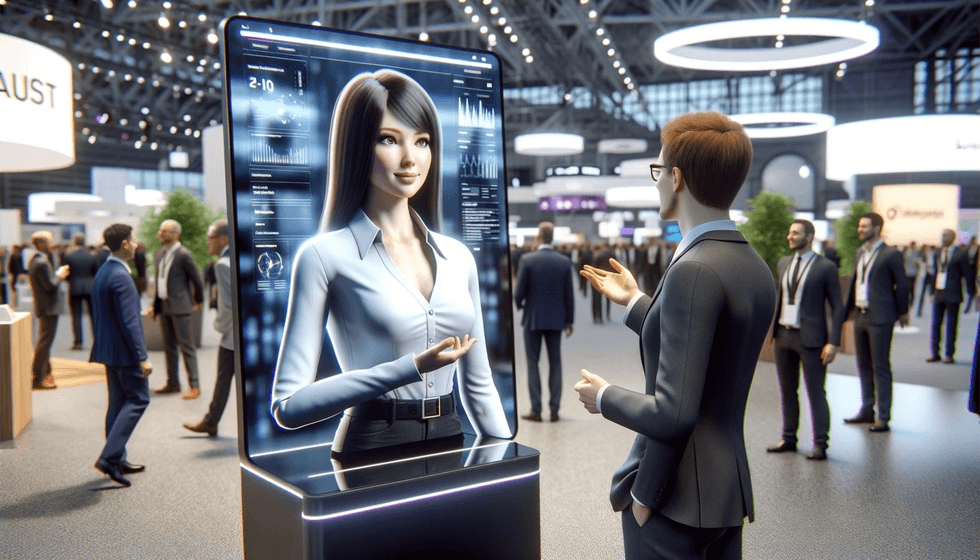
What are AI Avatars?
AI avatars are computer-generated characters driven by artificial intelligence that can hold conversations, respond to user actions, and behave dynamically within virtual environments. Unlike traditional scripted characters in VR simulations, where responses are pre-written and triggered by specific inputs, AI avatars use natural language processing, speech recognition, and behavioural models to respond naturally to what a user says or does, making each interaction different.
In enterprise applications, AI avatars are used to simulate colleagues, customers, patients, emergency responders, or supervisors in training scenarios. The goal is to give learners realistic practice with interpersonal situations that are difficult or expensive to rehearse in a classroom, such as situation handling in difficult conversations, high-pressure decisions, or rare but critical incidents.
How AI Avatars Work
AI Avatars blends the familiarity and knowledge of traditional pedagogical training and customer experience frameworks with animation and LLMs. By pairing animation with large language models, they can interpret inputs, adapt responses, and communicate in a way that feels both consistent and conversational.
The result is an interface that doesn’t just deliver information, but does so in a way that feels guided, responsive, and human-centered.
Natural Language Processing
The avatar listens to the user via speech recognition, interprets the meaning using a large language model (such as GPT-4 or a similar foundation model), and generates a contextually appropriate verbal response. This happens in near real-time, creating a back-and-forth that feels like a genuine conversation rather than selecting from a menu of options.
The language model can be prompted with detailed context about the avatar's role, emotional state, knowledge level, and communication style, allowing developers to build specific characters for specific training scenarios.
Behavioural AI and Emotion Simulation
More advanced AI avatars incorporate behavioural models that simulate emotional states such as frustration, confusion, satisfaction and adjust facial expressions, body language, and speech accordingly. A customer service training simulation might have an avatar that becomes progressively more agitated if the trainee handles the interaction poorly, and visibly calmer if they de-escalate effectively.
This emotional responsiveness is what makes the training feel consequential rather than abstract, which research consistently links to better knowledge retention and behaviour transfer.
Virtual Realism through XR
In VR environments, AI avatars are rendered as 3D characters with realistic appearance, movement, and animation. The combination of visual embodiment and intelligent speech creates a strong sense of social presence, the feeling that you're actually interacting with another person, which is the main psychological mechanism that makes VR soft skills training effective.
The visual realism of the avatar matters: more lifelike characters create stronger social presence, though developers must be careful to avoid the uncanny valley effect where near-realistic characters feel unsettling.
Applications in Enterprise Training
AI avatars are increasingly used in enterprise training to deliver consistent, scalable learning experiences across teams and locations. They can simulate real-world scenarios like customer interactions, compliance situations, or technical workflows while adapting in real time to each learner’s responses. This makes training more engaging, personalized, and measurable without requiring constant human interface.
Soft Skills and Communication Training
Difficult conversations, such as giving critical feedback, managing a workplace conflict, breaking bad news, and conducting a performance review, are exactly the situations most people want to avoid practising with a real colleague. AI avatars create a low-stakes environment to try, fail, and improve on these skillsets without social consequences.
Research from PwC and others has consistently shown that VR with realistic social simulations improves retention and behavioural confidence more effectively than classroom roleplay, primarily because the immersive context makes the emotional stakes feel real even though they aren't.
Customer Service and Sales Training
Retail and service industries use AI avatar simulations to train frontline staff on handling different customer types, complaint scenarios, and sales conversations. Trainees can work through dozens of varied interactions in a single session, with performance data captured automatically.
This produces much richer training data than supervised floor observation, and it scales cleanly; the same simulation can run across hundreds of employees simultaneously without requiring a trainer for each.
Healthcare and High-Stakes Communication
Medical training uses AI avatars to simulate patient consultations, including difficult conversations about diagnoses, treatment options, and end-of-life decisions. The avatar responds to how the clinician frames information, adjusts its emotional state accordingly, and provides a record of the conversation that supervisors can review. This gives trainee clinicians practice with some of the hardest conversations in their profession before they have them with real patients.
Limitations and Considerations
AI avatars are improving rapidly, but have real limitations. Response latency can disrupt the flow of conversation in immersive simulations; even a half-second delay breaks the feeling of natural dialogue. Highly specific domain knowledge requires careful prompt engineering to get reliable avatar behaviour. And building an avatar character that consistently behaves the way the training scenario requires, without going off-script in unhelpful ways, demands iteration and testing.
Privacy is also worth considering: conversations with AI avatars in enterprise training may contain sensitive or candid information from employees, and organisations need clear data governance policies for how training session data is stored and accessed.
The Future of AI Avatars in XR
As large language models get faster, more reliable, and cheaper to run, AI avatars will become standard components of enterprise VR training platforms. Expect to see avatars that adjust scenario difficulty based on demonstrated learner performance, give detailed verbal feedback at the end of a session, and maintain memory across multiple sessions to simulate ongoing relationships, for example, a manager avatar that remembers how you handled a difficult conversation with a frustrated user.
The trajectory the industry is moving toward is AI avatars that are genuinely hard to distinguish from scripted content in terms of consistency, while being far more flexible and personalised.
