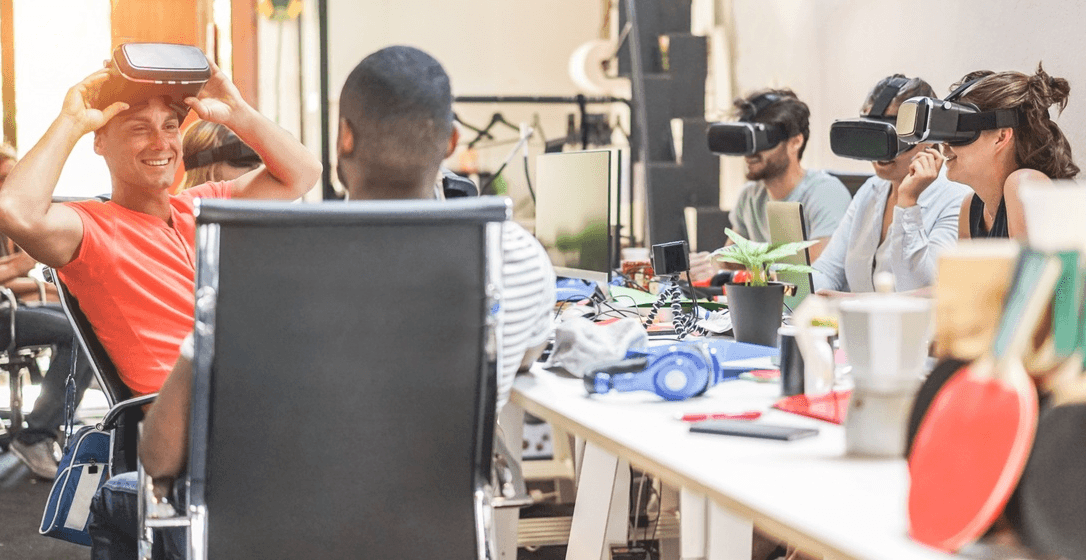
Workplace learning has moved beyond classrooms and basic online courses. Virtual Reality (VR) now provides a fresh approach to improving skills like communication and leadership. VR soft skill training combines technology with hands-on practice, letting workers practice real-world situations to improve empathy, handle conflicts, and give feedback. This piece will cover what VR soft skill training involves, the skills it helps build, how this type of learning improves outcomes, ways to put it into practice, and future trends for VR in workplace advancement.
What Is VR Soft Skill Training and Why It Matters
VR soft skill training uses headsets like Meta Quest 3 and simulation modules to involve staff in realistic talks and situations. Instead of classroom role-playing, people can practice key skills in very interactive settings. This change matters because studies suggest that immersive learning for soft skills leads to better retention, confidence, and behavior change compared to traditional methods (Source).
To address leadership shortages, and improve teamwork and inclusion, many organizations now use VR training for employees. Soft skills need real-world practice, not just books, and VR offers that in a way that's different from standard training.
As companies shift to hybrid and global models, VR soft skill training makes sure workers get reliable, quantifiable, and interesting growth chances.
Key Soft Skills Effectively Taught with VR
Developing soft skills has historically relied on in-person workshops and subjective assessments. VR transforms this process by replicating real-world scenarios in a risk-free setting, providing employees with hands-on, repeatable practice.
Difficult Conversations and Conflict Resolution
Conflict resolution is one of the most challenging workplace skills. VR enables employees to step into tense situations, such as resolving disagreements with colleagues or negotiating customer complaints, while receiving real-time feedback. VR conflict resolution training prepares teams to manage conflicts calmly and constructively. With guided simulations, employees can practice using the correct tone, body language, and wording. They also get instant feedback on how their responses change the conversation.
Giving Actionable Feedback
Managers often struggle to provide feedback that is clear, constructive, and empathetic. VR modules simulate performance review sessions or coaching conversations, enabling employees to practice tone, phrasing, and delivery. Practicing in VR builds confidence and reduces hesitation when addressing real employees.
Building Empathy Through Embodiment
A unique advantage of VR is embodiment - employees can experience situations from another person’s perspective. For example, a manager can embody a new hire receiving unclear instructions, or an employee can view interactions from a customer’s perspective. Such embodied simulations significantly increase empathy and emotional intelligence (Source).
Diversity, Equity, and Inclusion (DE&I) Training
Traditional DE&I training frequently struggles with learner involvement and achieving clear improvements. Virtual reality modules place students in situations where they can deal with topics like hidden bias while recruiting, or practice inclusive discussion. The method changes general ideas into real and lasting learning experiences.
Using VR can make learning soft skills more practical, which can help boost its acceptance at all levels in a company.
How VR Enhances Soft Skills Learning
VR unlike classroom learning, makes learners feel present and fully involved. Instead of simply listening to lectures, people engage with realistic simulations of workplace situations. This active involvement turns learning into a hands-on activity, which increases retention and changes behavior over time.
Immersive experiential learning and “presence”
VR simulations engage multiple senses - sight, sound, and spatial awareness, creating a strong feeling of presence. This immersive experience makes employees feel as though they are truly inside the situation, rather than simply learning about it. As a result, soft skills training becomes more impactful with employees retaining lessons more effectively and recalling how they felt and responded during the interaction, driving long-term behavior change.
Repetition and on-demand accessibility
To build soft skills, regular practice is important. VR platforms let people do simulations whenever they want, which cuts down on the need for trainers and set schedules. By deploying a scalable VR training platform, organizations can maintain consistency across global teams.
Data-driven feedback and performance insights
VR captures learner performance data through voice analysis, decision points, and behavioral cues. These insights provide measurable benchmarks for leadership growth, complementing qualitative feedback from trainers. Companies can link this data to broader initiatives such as VR training ROI analysis to demonstrate impact.
Safe practice of challenging scenarios
VR communication skills training offers a safe space for staff to practice difficult conversations. Imagine a manager preparing for a crucial presentation. They could present to a virtual audience but make a mistake without any actual repercussions on their team or career; they could then adjust their tone and content based on the audience's projected reaction.
With these features, VR training for employees elevates soft skill development into measurable, repeatable, and engaging practice.
Implementing VR Soft Skill Training in Your Organization
While implementing VR for soft skill training, it is important to ensure that there is alignment with what the organization wants to achieve and how employees need to grow. Planning well makes sure the simulations relate to actual problems at work, which makes the investment worthwhile. When VR is introduced in a smart way, it can greatly improve the learning system, leading to greater acceptance and results that can be measured.
Identifying training goals and critical soft skills
To begin, organizations should link particular soft skills—like empathy, giving feedback, or inclusive leadership—to specific business results. When objectives are clear, measuring success and justifying investment becomes simpler.
Choosing the right VR platforms and modules
The value of virtual reality employee training varies. Businesses should consider if pre-made or custom modules better fit their needs. Hence, knowing how to pick a VR vendor is essential to make the most of the VR training ensuring scalability, compatibility, and ROI.
Integrating VR with existing L&D programs
VR should add to, not take the place of, current learning methods. When VR is part of a mix that has seminars, guidance, and online tools, learning works best. As an example, VR leadership training can create greater participation.
Overcoming adoption challenges and employee engagement tips
Gaining employee support can be hard when introducing new tech. Companies can make this easier by showing its worth from the start through test programs and by keeping score of the results. VR training that's like a game, clear ROI numbers, and backing from leaders are helpful for getting people on board.
VR soft skill training, when properly planned, can become a part of a company's learning system.
Future Trends in VR Soft Skill Training
The future of VR soft skill training is being shaped by AI improvements, more ways to use it, and the needs of hybrid workplaces. With hybrid and remote work becoming normal, companies need ways to teach that can grow and be the same for everyone.
Advances in AI and analytics for personalized learning
In the near future, AI modules will change scenarios as they happen by studying speech, choices, and body language to give custom coaching. This combination of AI with immersive learning will create virtual reality for training employees that is more adaptable and personal.
Expanding use cases beyond traditional soft skills
VR is moving beyond conflict resolution and empathy-building to include advanced simulations such as crisis leadership, negotiation, and cross-cultural collaboration. This expansion aligns with enterprise-wide needs for agile and future-ready leaders.
Predictions for immersive learning in hybrid/remote workplaces
As hybrid work persists, VR will bridge the gap between distributed employees by delivering standardized, engaging, and scalable development. Unlike traditional training formats, VR training vs traditional training offers consistent experiences regardless of location. The next decade will see VR embedded as a core L&D strategy rather than an optional tool.
By adopting these innovations, organizations can future-proof their workforce development.
Ready to elevate workplace learning with VR soft skill training?
Connect with AutoVRse to design scalable, impactful, and measurable immersive programs.
