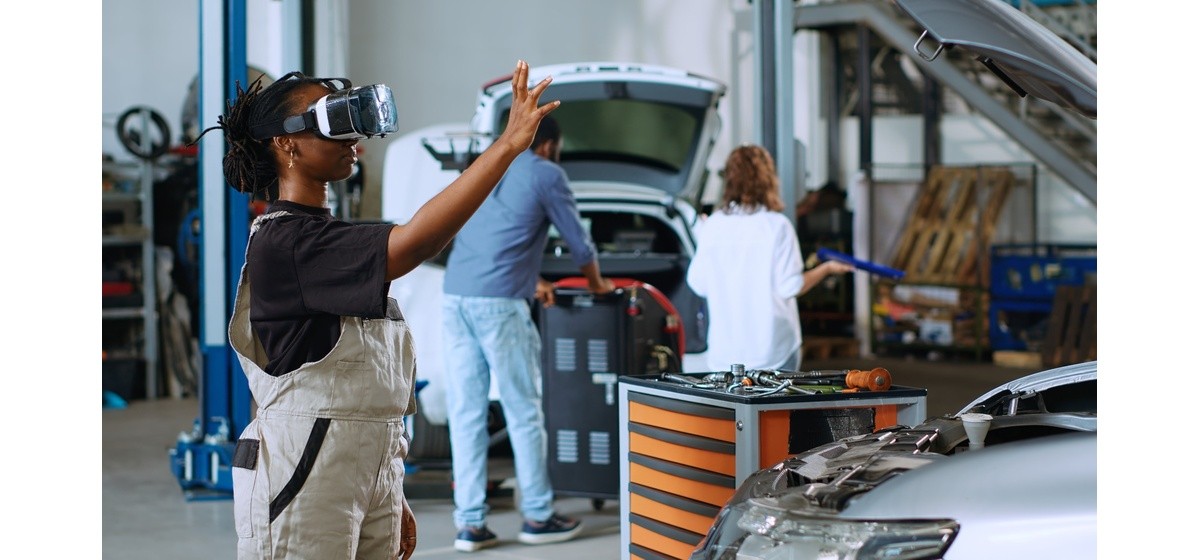
The automotive sector is undergoing a rapid shift driven by electrification, software-defined vehicles, and shorter development cycles. As cars get more complex to engineer and must be made faster, technologies like AR and VR are becoming common in everyday operations. This blog explores how AR VR applications in Automotive industry are reshaping automotive engineering, manufacturing, and workforce training, with a clear focus on practical and production-ready use cases.
Why the Automotive Industry Is Investing in AR VR Applications
Automotive OEMs and suppliers face continuous demands to release models quickly while upholding standards for safety, quality, and regulatory compliance. Conventional methods such as physical prototyping, classroom training, and paper-based work instructions find it hard to expand across international factories and varied production processes. These limitations are pushing automotive manufacturers to adopt enterprise-grade AR VR applications in Automotive industry.
AR VR in Automotive is gaining momentum because immersive technologies reduce dependency on physical assets while improving decision accuracy. Virtual validation, guided assembly, and simulation-based training allow teams to test, train, and iterate without interrupting live production, making it easier for decision-makers to evaluate the use of AR vs VR based on specific automotive workflows. As enterprise-grade automotive VR simulations mature, the focus has shifted from visual appeal to measurable improvements in speed, quality, and workforce readiness.
From engineering centers to shop floors, automotive organizations are investing in AR VR applications in Automotive industry to standardize processes, reduce errors, and accelerate skill development across distributed teams.
How AR VR Applications Improve Automotive Engineering and Production
Engineering and production functions sit at the heart of automotive value creation, making them prime candidates for immersive transformation. AR VR applications in Automotive industry assist with early design choices and actual production in factories. By linking digital designs to real-world processes, these tools bridge the gap between engineering plans and the reality during manufacturing.
AR for On-the-Line Guidance and Quality Checks
AR enables operators to see step-by-step digital instructions directly overlaid on physical components during assembly. AR-guided workflows reduce reliance on printed SOPs and eliminate frequent back-and-forth with supervisors, especially in high-mix production environments. These capabilities make automotive AR and VR deployments particularly effective for complex assemblies such as wiring harnesses, interior trims, and powertrain components.
Using AR for quality control lets workers spot missing parts, wrong torque orders, or alignment problems early on. By adding visual guides and checks into the process, car companies can cut down on fixing mistakes and get things right the first time on their production lines. These represent some of the most practical AR use cases in Automotive.
VR for Immersive Vehicle Simulation and Ergonomic Testing
Virtual reality in the automobile industry engineering teams allows designers to step inside full-scale vehicle models long before physical prototypes exist. Engineers can evaluate driver visibility, reach zones, ingress-egress comfort, and dashboard layouts in immersive environments that mirror real-world dimensions. This helps spot problems with how things feel to use early on, when it's cheaper to fix them.
VR-based vehicle simulation helps with safety and ease-of-use tests, cutting down on the need for many physical models. Situations like crashes, distracted driving, and interface tests can be done in a virtual setting. This speeds up the process of confirming designs while keeping high standards.
Mixed Reality for Overlaying CAD Models on Physical Assemblies
Mixed reality makes CAD data and physical parts work together by adding virtual models to real-world things. Engineers can then see tolerance and fit problems right where the parts will be used. This is helpful when first making something or using a new design. It can show when things are different than expected.
By aligning CAD data with real components, mixed reality reduces misinterpretation between design and production teams. AR VR applications in the automotive industry therefore act as a shared visual language that improves collaboration and speeds up issue resolution.
Together, these engineering and production use cases demonstrate how AR VR applications in the automotive industry move beyond visualization to deliver tangible operational value.
AR VR Applications That Are Transforming Automotive Training
Conventional automotive training often involves classroom instruction, observation, and restricted access to real equipment. These approaches have difficulty keeping up with changes in vehicle design, especially for electric and software-driven models. Augmented and virtual reality are changing how automotive staff learn, practice, and do important jobs.
VR-Based Safety and Emergency Response Training
VR provides realistic safety training without putting workers in harm's way. For example, those in car factories can practice responding to emergencies like battery fires or learn how to handle high voltage or work in small areas, all in a secure, virtual space. As automotive systems become more software-driven, automotive virtual reality training is emerging as a scalable way to upskill teams without disrupting production. Higher retention, stronger engagement, and improved decision-making are among the other documented benefits of VR training for safety-critical automotive roles (Source). These simulations also produce performance data, enabling automotive leaders to conduct a clear VR training ROI analysis to justify large-scale rollouts.
AR-Assisted On-the-Job Support for Technicians
Augmented reality training delivers real-time assistance to technicians during maintenance, inspection, and repair tasks. AR-enabled devices display contextual instructions, part identifiers, and diagnostic steps while technicians work on actual vehicles or equipment. This cuts down on the need for paper manuals and makes work faster, especially when tasks are new or not done often.
AR VR in Automotive training also supports remote expert collaboration, enabling senior engineers to guide technicians across locations without travel. As a result, automotive organizations improve uptime and knowledge transfer across service networks and plants.
By combining immersive simulations with contextual guidance, AR VR applications in Automotive industry create training ecosystems that extend beyond the classroom into daily operations.
Where AR VR Applications Deliver the Most Value Across Automotive Functions
The impact of immersive technologies varies by function, maturity level, and operational priorities. Automotive leaders achieve the highest returns when AR VR applications in the automotive industry align with specific workflow challenges rather than broad experimentation. Several functional areas consistently demonstrate strong value realization.
Vehicle Design and Concept Validation
Design teams use virtual reality in the automobile industry workflows to review full-scale vehicle concepts with cross-functional stakeholders. Virtual design reviews accelerate decision-making by allowing teams to assess aesthetics, packaging, and usability together. Early validation reduces late-stage design changes that often drive cost overruns.
Manufacturing and Assembly Operations
Manufacturing teams deploy Automotive AR and VR in line planning, operator training, and continuous improvement initiatives. Virtual layout simulations help planners optimize workstation ergonomics and material flow before physical installation. AR-guided assembly reduces learning curves for new operators while maintaining quality consistency.
Electric Vehicle and High-Voltage Systems Training
The creation of electric vehicles brings safety issues tied to high-voltage systems and batteries. Augmented and virtual reality tech in the automotive business lets workers learn how to safely handle, check, and deal with emergencies without exposure to live electrical systems. These programs help with compliance requirements while accelerating EV workforce readiness.
Remote Collaboration Across Global Teams
Global automotive programs require seamless collaboration across engineering centers, suppliers, and manufacturing plants. Immersive collaboration environments allow teams to review designs, troubleshoot issues, and align on changes without physical co-location. This capability reduces travel while maintaining decision clarity across time zones.
Across these functions, AR VR applications in Automotive industry deliver the most value when tightly integrated into existing engineering, manufacturing, and training workflows.
Real-World Examples of AR VR Applications in Automotive
Automotive OEMs and Tier 1 suppliers are already deploying immersive technologies at scale. AR-guided assembly has been used to reduce wiring installation errors, while VR-based design reviews have shortened vehicle development timelines. Service organizations leverage AR for remote diagnostics, improving first-time fix rates and customer satisfaction.
These real-world deployments show how the use of VR in the automotive industry is no longer limited to innovation labs, they rather serve as real-world virtual reality examples of how immersive tools deliver operational impact.
What Automotive Teams Should Consider Before Implementing AR VR Applications
For automotive companies to adopt immersive technologies in a good way, they need to think about more than just getting advanced technology. For e.g. evaluating the best VR headsets for industrial environments. These companies need to handle integration, data governance, and security, so that Augmented Reality and Virtual Reality apps in the automotive field give lasting value. Understanding how to choose VR vendor also becomes critical for enterprise deployments. If these elements are planned out carefully, it will stop deployments from breaking and keep sensitive engineering data safe.
CAD/PLM Integration and Data Accuracy
AR VR applications rely on precise and up-to-date CAD and PLM data to work effectively. Misaligned models can lead to incorrect guidance, undermining trust in immersive tools. Automotive teams should ensure seamless integration between design systems and AR VR platforms to maintain data consistency across the product lifecycle.
Data Security for Confidential Vehicle Programs
Automotive programs involve highly sensitive intellectual property, making data security a critical concern. AR VR in Automotive deployments must support secure device management, controlled access, and encrypted data flows. Addressing security early enables organizations to scale immersive solutions across suppliers and partners with confidence.
By addressing integration and security considerations upfront, automotive organizations position AR VR applications in the automotive industry for long-term success rather than isolated pilots.
Conclusion
AR VR applications in Automotive are redefining how vehicles are designed, built, and serviced. By using immersive engineering validation, guided assembly methods, and hands-on training, these methods contribute to notable progress in productivity, excellence, and employee competence. In light of the increasing difficulty of automotive systems, immersive tools give a flexible method to coordinate personnel, workflows, and outputs.
Looking to implement AR VR applications in Automotive workflows?
Speak with AutoVRse to explore immersive solutions built for real-world automotive operations.