What is 3DoF (3 Degrees of Freedom)?
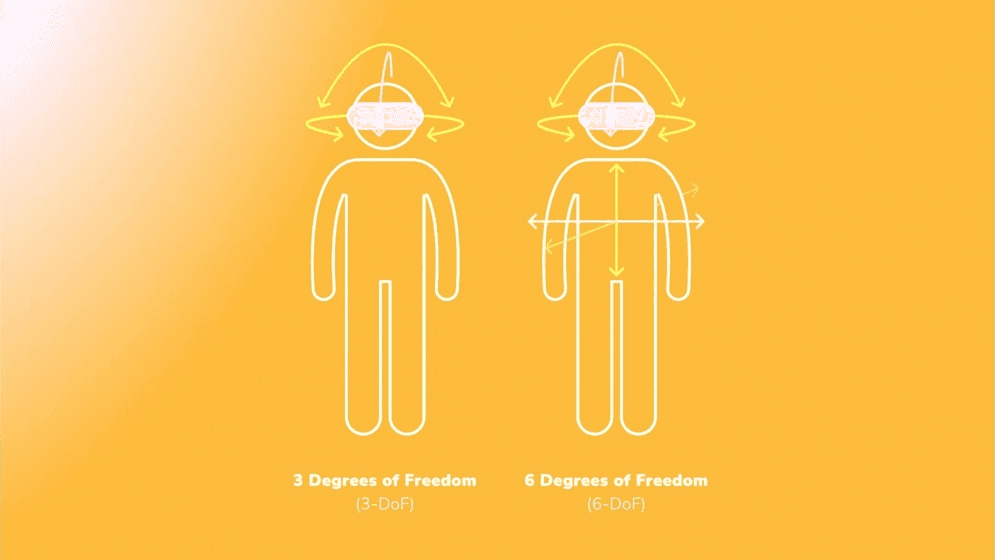
3DoF is a method for explaining motion in virtual reality. A 3DoF VR set monitors where your head is pointing, so you can look around, tilt, and move your head up and down in a virtual area. 3DoF tracks rotation alone, while 6DoF tracks movement in a space. 3DoF VR is an easier and cheaper entry point, especially for those new to virtual reality.
How 3DoF Works in VR
3DoF VR headsets monitor your head angle thanks to gyroscopes and accelerometers inside the device. These sensors monitor rotation across three axes. When the head moves, the view inside the virtual world changes. These headsets offer simple setup and portability because they don't require external cameras or extra equipment. Positional tracking is absent, limiting leaning or walking actions inside the VR environment, which detracts from immersion. A 3DoF setup makes a good, budget-friendly choice when full movement isn't needed.
Head Tracking in 3DoF VR
In 3DoF VR, head tracking includes mainly three types of movements: turning your head left and right (yaw), looking up and down (pitch), and tilting your head (roll). These movements are processed right away, which lets people explore 360-degree videos or VR this way. Since 3DoF focuses on orientation instead of position, it works well for content that is viewed while seated or standing still.
Comparing 3DoF and 6DoF VR Headsets
The key difference between 3DoF and 6DoF VR headsets is how much you can move around. A 6DoF headset tracks where you are and which way you're facing, so you can walk and interact with things in the virtual world. A 3DoF headset is more limited, but it takes up less space, needs less tech, and costs less (Source). So, 3DoF is still good when you want to feel like you're there without actually moving.
Examples of 3DoF VR Headsets
The Oculus Go, Samsung Gear VR, and Google Daydream View are some popular 3DoF VR headsets. They have helped make VR more common owing to their ease of access and lack of requiring pricey computers or a lot of space.
Applications of 3DoF VR Headsets
3DoF VR has use in fields where visual immersion is key, and physical interaction less so. The technology's affordability and ease of implementation lets organizations expand their VR capabilities in a cost-conscious manner.
Education and Training
Educational institutions use 3DoF VR for lectures, training, and presentations. 3DoF VR helps learners with focussing better on visual and oral content as they would only need to look around instead of dealing with complicated controls.
Entertainment and Media
3DoF VR headsets are used for watching 360-degree videos, concerts that are simulated, and virtual tours. People can also go through travel documentaries and film screenings that create an immersive experience, almost as if they were truly present, even without complete body tracking tech.
Healthcare and Therapy
Hospitals and health centres use 3DoF VR for meditation, relieving stress for patients and also to educate them. The visual immersion provided by 3DoF VR is often adequate to achieve positive therapeutic outcomes, removing the need for more complex, interactive technology.
Advantages and Limitations of 3DoF VR
The appeal of 3DoF VR lies in its simplicity and accessibility. But since it's more limited than 6DoF, it works best for certain things instead of everything in VR.
Advantages of 3DoF VR
Cost-effective entry into VR, lowering barriers for adoption
Lightweight and portable designs, ideal for classrooms and mobile use
Easy to set up with no need for external cameras or sensors
Limitations of 3DoF VR
It does not track your location, which limits how much you can move and interact with it.
It is less immersive than 6DoF systems, particularly for games or detailed simulations.
It works best for simple uses like watching videos or guided tours.
The Future of 3DoF in Virtual Reality
Due to the increasing need for more interactive training and simulations, 6DoF VR headsets are in higher demand from businesses. Yet, 3DoF headsets are still useful for mobile VR, budget-conscious markets, and education. Manufacturers are trying to make a mix of both by blending the simple design of 3DoF with some positional tracking for improved adaptability.
Even as the industry shifts to more complex headsets, 3DoF still has worth for groups that value cost-effectiveness, broad use, and content viewing. As VR hardware changes, 3DoF may stay the basic option, specifically in growing markets.
