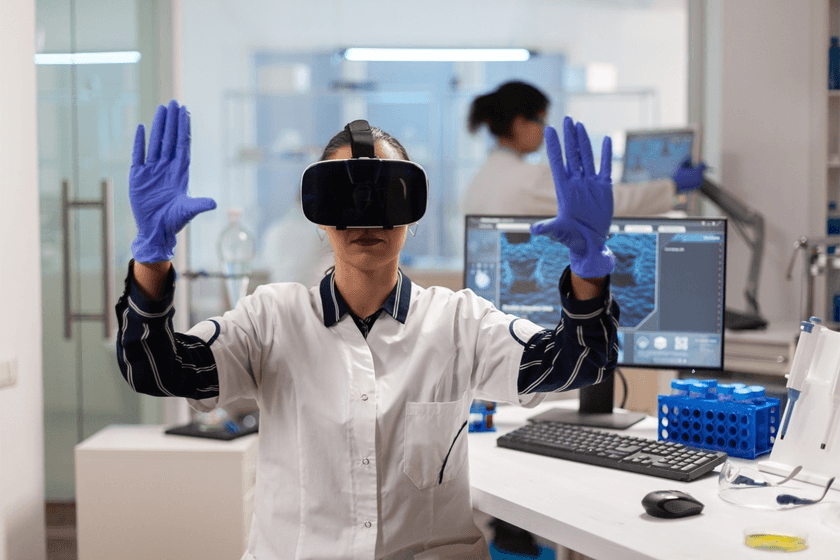
Extended Reality (XR) is no longer just an experiment; XR for R&D is becoming central to how research and development work is done today (Source). In fields like manufacturing, pharmaceuticals, mining, and automotive, R&D teams are using VR and AR to speed up prototyping, improve design precision, and lower risks. This blog shows how VR, AR, MR, and digital twins are changing industrial innovation and explains how to integrate immersive technology for R&D at scale.R&D teams constantly need to speed up innovation, shorten project times, and cut waste. XR is now a key tool for companies that want to update how they create products, imitate complicated processes, and avoid using so many physical prototypes. VR/AR gives R&D better ways to interact with models and use immersive tech to back up various tests. Businesses are getting fresh perspectives, boosting safety, and getting products ready for launch faster.XR gives companies real, measurable wins by letting teams jump into virtual spaces. They can play with prototypes at full size and see how things work before spending money on building anything. This is big for industrial R&D, mainly if a company works with risky stuff or costly machines.
Why XR Is Becoming Essential for Modern R&D Teams?
Many research and development teams are switching from mainly using physical prototypes to digital methods. They're now using simulations to help make choices early on. XR helps speed up engineering by using spatial design, improving teamwork, and cutting down on the need for expensive testing equipment. This switch to VR and AR in R&D is also happening because there are more teams working in different locations and using hybrid work models. These teams need to communicate in real-time and have interactive ways to work together. These upgrades allow teams to gain correct information way before they start building or using real machines.
Faster Product Development Cycles
XR tech lets research teams build and improve virtual prototypes quicker. Tasks that once took weeks now take days. Standard product creation can be slow since it involves building physical models, something that needs time, engineers, and lots of adjustments. VR allows researchers to quickly test different versions, speeding up product release. For instance, Automotive R&D teams use VR to see how things fit, check where parts should go, and copy putting things together early on. When researchers can check complex shapes and copy how people will use them virtually, it really opens things up.
By making this process faster, using immersive tech in research and development boosts how much work gets done and lets groups try new things more often.
Improved Accuracy in Design and Testing
XR tools let researchers check out models at their real size, giving them a clear feel for the space. Instead of looking at flat drawings or small CAD screens, teams can walk around life-size models and spot problems early on. In industrial R&D, XR helps find collisions, check if parts fit right, and run simulations for specific environments. It's all about finding those errors early to keep them from turning into costly issues later on. In fields like aerospace or heavy machinery, even small errors can cause things to break down or become unsafe. Using immersive tech makes sure these problems are taken care of early, which boosts how good and reliable the product is overall.
Enhanced Collaboration Between Distributed Teams
With global supply chains and international research sites common today, XR lets researchers’ team up in virtual spaces wherever they're located. For example, engineering teams in different countries can review prototypes, share input, and work together on the same virtual model at the same time.
Unlike video calls, XR spaces include spatial awareness, shared notes, and synced controls, which keep everyone on the same page as decisions are made. Teams can review designs remotely, mimic user actions, and assess performance scenarios as a group.
Reduction of Prototyping and Testing Costs
Creating physical prototypes eats up resources like materials, manpower, and time. Before, each version meant reworking, rebuilding, and repeated testing. Using XR in research and development really lowers these costs by letting teams check design, how parts fit, and if things work as they should, but in a virtual space. For example, companies building industrial machines can check spacing, how things interact, and assembly steps in a virtual setting for much less money. When you mix this with digital twin tech, these simulations also let you guess how things will perform in the long run without equipment getting beat up.
Risk-Free Testing of Complex or Hazardous Scenarios
Industries with hazardous work environments count on XR simulations to trial scenarios that are too dangerous to recreate in real life. For instance, mining research teams use VR to see how gear works deep underground. Energy companies also use it to mock up failures that take place under high stress. VR-based research permits teams to inspect extreme temps, small spaces, chem reactions, and broken machines without risking people or equipment. These safe tests let companies build designs that are both safer and tougher.
Core XR Technologies Driving R&D Innovation
XR in industrial R&D isn't about using just one tech. It's about combining VR, AR, MR, and digital twins. Each one helps at different stages of making a product, improving how easy things are to use, how well you can see them, and how thoroughly you can test them. Using immersive tech in R&D makes models easier to understand. This is helpful when checking ergonomics, how easy something is to put together, or how it works with its surroundings. VR and AR can also make design reviews better by adding live data and ways to interact with the design in 3D.
As more companies adopt the technology, they're building hybrid systems that combine virtual simulations and physical tests, which speeds up their processes.
Virtual Reality for Prototyping and Simulation
VR for research and development is a key tool because it allows engineers to work with completely immersive settings. VR headsets allow teams to evaluate scale, conduct virtual walkthroughs, test ergonomics, and inspect spatial interactions with precision. Researchers can perform physics-based simulations, analyze stress levels on components, and recreate operational workflows. VR also supports high-stakes testing, which traditionally requires specialized labs or controlled environments. VR becomes vital for research and development in industries that handle heavy machinery, factory automation, or high-compliance products. These VR-driven simulations follow similar patterns to those seen in VR in manufacturing.
Augmented Reality for Real-Time Guidance and Iteration
AR lets you overlay digital guides on actual parts, which speeds up testing in real situations. Techs can line up virtual designs with real-world gear, check if they work together, and see design choices side-by-side without needing to make anything new. Teams that are building complicated products often use augmented reality to make tweaks on the fly, calibrate in real time, and double-check assembly steps. For example, manufacturing research and development teams use AR to see if new parts mess with current machine setups. Combining digital and real-world settings makes XR better for creating products and makes testing clearer.
Mixed Reality for Interactive Product Testing
MR blends total immersion with an awareness of the actual surroundings, letting people interact in ways that feel natural. Research teams can manipulate virtual objects while moving freely in physical space, creating lifelike testing conditions.
With spatial mapping and precise depth sensing, MR helps teams simulate maintenance operations, ergonomics validation, and interactive product demonstrations which is why it is also useful in mixed reality training. Industries with highly dynamic testing environments benefit significantly from this capability.
MR strengthens XR in industrial R&D by making simulations more accurate and contextually relevant.
Digital Twins for Continuous R&D Optimization
Digital twins create virtual copies of real-world things, allowing constant checks on how they're doing and predictions about how they'll act. When researching and developing, these twins can imitate how something will act over its life, how it handles stress, and what outside stuff will do to it before it's even made. Digital twins linked to IoT data offer real-time insights, which refine XR testing. Teams can model long-term breakdown patterns, determine safety margins, and refine future designs.Digital twins are now key to using immersive tech in research and development.
How XR Transforms Each Stage of the R&D Lifecycle
Traditional R&D cycles integrate physical prototypes, expensive testing equipment, and lengthy coordination between interdisciplinary teams. XR changes this by making the process faster, clearer, and cheaper. Using VR and AR in research and development lets companies confirm ideas sooner, figure out problems faster, and work together across different teams more clearly, immersive tools streamline operations at every step. As organizations scale these capabilities, XR becomes a reliable framework for consistent research workflows.
Concept Development and Ideation
R&D teams are using VR to brainstorm, view concepts early, and check capabilities. Designers are changing 3D models, checking how things fit, and comparing different designs on the fly. Using XR for brainstorming lets teams fix problems early. It shows ergonomic, spatial, or usability issues before teams spend time on CAD. This makes concept validation faster and more accurate. XR really helps product creation at this point, especially when teams need to agree on things early on.
Product Design and Engineering
Immersive models let engineers see inside designs, run stress tests on parts, and check how things move. R&D can then inspect engine areas, look at how weight is spread, and see when performance maxes out. This depth of visualization reduces errors and ensures that teams understand the engineering rationale behind each decision. Mechanical and electrical engineers can collaborate within the same virtual environment to assess compatibility.
VR AR for R&D enables faster coordination and improves engineering precision.
Prototyping and Validation
XR tools cut down on the need for physical prototypes because they provide detailed virtual models. Teams can test ergonomics, evaluate assembly processes, and verify safety clearances without building multiple iterations.
XR in industrial R&D also supports procedural testing by allowing teams to simulate how workers interact with equipment. During validation, researchers conduct virtual walkthroughs to identify ergonomic discomfort or spatial limitations.
It speeds up product readiness and helps organizations allocate budgets more strategically.
Testing, QA and Failure Analysis
R&D groups use XR simulations to model stress failures, check out dangerous situations, and test how equipment works in harsh environments. Unlike physical tests that need controlled and risky setups, VR lets them experiment safely. QA teams can check out internal part failures, spot weak materials, and see how performance differs in different situations. XR analytics give thorough records that make R&D assessments more trustworthy.
Regulatory and Compliance Planning
Industries such as pharmaceuticals, aerospace, and mining have many rules they must follow. XR simulations can help teams practice these rules, check if their standard steps align, and keep track of validation procedures. Researchers evaluate whether new designs meet regional or sector-specific regulatory requirements early in the development process. Immersive technology ultimately helps organizations maintain consistent, audit-ready records from early development to certification.
How Is XR Being Used for R&D in Different Industries?
XR is being used in various industries for research and development to fix problems related to safety, cost, complexity, and getting more done. The main tech is the same, but how it's used changes based on the work environment and what's expected.
In manufacturing, VR and AR help R&D teams simulate production lines before building them. Pharma teams use immersive environments to check cleanroom processes. Mining and car companies use XR to test machines, check hazardous areas, and make engineering validation faster.
Across sectors, XR in industrial R&D is becoming a standardized driver of efficiency and innovation, supporting deeper testing and more accurate decision-making.
XR for R&D in Manufacturing
Manufacturing R&D teams use VR AR for R&D to simulate assembly lines, validate tooling decisions, and test operator workflows. Engineers can visualize machine layouts at full scale, identify process bottlenecks, and validate safety clearances early in development.
XR for product development helps reduce rework by revealing ergonomic issues or assembly complexities before machinery is built. Combined with digital twins, manufacturers can model long-term equipment performance and plan predictive maintenance.
Integrating XR reduces downtime, improves design accuracy, and accelerates new product introduction cycles.
XR for R&D in Pharma
Pharmaceutical R&D processes involve precision, sterile environments, and strict compliance standards. XR for R&D enables simulation of laboratory layouts, equipment interactions, and SOP adherence before physical labs are constructed.
Immersive cleanroom simulations help researchers validate workflows, reduce contamination risks, and refine process steps. XR environments also enable regulatory rehearsal and support better documentation.
Compared to traditional trial-and-error approaches, the use of extended reality, including virtual reality in pharma, adds consistency, safety, and efficiency to pharma R&D.
XR for R&D in Mining
Mining operations involve hazardous equipment, confined spaces, and unpredictable geological conditions. VR for research and development helps teams simulate blast scenarios, evaluate tunnel layouts, and test ventilation plans. R&D groups validate machinery performance in simulated underground conditions, protecting teams from unnecessary exposure. XR in industrial R&D lets mining engineers check emergency plans or change equipment safely without going to the mine. The outcome is a sturdier R&D method that puts safety first. This is also one of the reasons for the use of VR in oil and gas.
XR for R&D in Automotive
Automotive companies rely heavily on XR for product development to simulate aerodynamic behavior, assembly feasibility, structural integrity, and driver experience. Teams can evaluate vehicle interiors, analyze visibility, and test component fitment before any physical prototype is built. VR AR for R&D also helps automotive OEMs test ADAS performance and sensor placements through virtual simulations. These capabilities align with best practices discussed in VR in automotive industry. By integrating immersive technology for R&D, companies reduce development time, improve accuracy, and accelerate model launches.
What Is the ROI of Implementing XR in R&D?
When R&D leaders check out new tech, they usually want to see how it'll affect the bottom line and how it impacts operations. XR in R&D can pay off by speeding up development times, cutting prototype costs, and boosting the quality of products. Switching to virtual prototypes cuts down on material waste and production costs. Also, using VR and AR in research and development gives teams more flexibility to test ideas and make changes quicker, without disrupting lab work. These benefits create measurable impact across both direct costs and long-term operational performance as elucidated in our blog on benefits of VR training.
Cost Savings from Reduced Physical Prototypes
Physical prototypes can cost thousands of dollars per iteration. XR for R&D replaces many of these builds with virtual models, where form, fit, and function can be assessed rapidly.
Automotive, aerospace, and industrial equipment manufacturers report significant reductions in prototype budgets by shifting early tests to XR simulations. This also frees engineering teams to experiment more frequently without increasing material expenditure.
By reducing prototype dependency, enterprises reallocate funds toward innovation or advanced testing stages.
Efficiency Gains in Design and Testing Cycles
With immersive technology for R&D, design reviews occur faster, issues are identified earlier, and engineering teams collaborate more efficiently. XR tools also eliminate delays caused by physical model fabrication, lab availability, or geographic separation between teams. Companies incorporating XR into their R&D cycles see measurable reductions in design review times and faster engineering sign-offs. These improvements significantly accelerate overall time to market.
Lower Training and Onboarding Costs
Complex R&D environments demand extensive training on equipment, tools, and processes. XR simulations help simplify this onboarding by enabling researchers and engineers to practice tasks repeatedly without occupying real equipment. XR-driven onboarding is significantly more cost-effective and scalable, especially when teams operate across countries (Source). These benefits are aligned with workplace efficiency insights similar to those discussed in VR in workplace. Lower training expenses contribute to long-term ROI for research teams. To know more about this, give our blog on VR training ROI analysis a read.
Better Decision Making Through Real-Time Visualization
XR for R&D enables real-time insights that enhance decision clarity. XR in R&D provides instant insights for clearer choices. Teams can check out different designs at the same time, play with simulations based on data, and explore the downstream impact of engineering decisions. With immersive visualization, R&D managers can assess risk, validate assumptions, and confidently approve design changes. This reduces downstream errors and minimizes costly late-stage revisions. Better decisions ultimately translate to faster development and higher product reliability.
How Can Companies Integrate XR Into Their R&D Workflows?
To add XR into research and development, you need a plan that mixes the tech with how you already do things. Start by figuring out the best ways to use XR and picking out the right gear and programs. R&D groups should make sure immersive tech fits well with CAD tools, PLM systems, and how they test things. If done right, VR and AR can help R&D work together better, test more precisely, and get things done faster. To ensure a trouble-free integration in global R&D centers, we'll use understandable guidelines, pilot programs, and gradual scaling.
Assessing the Use Cases with the Highest Impact
To get started, organizations should figure out which R&D areas can gain the most from using XR. Areas that usually make a big impact are things like testing how ergonomic designs are, if assembly is doable, how equipment is operated, and running stress simulations. Teams should measure possible ROI, find workflow problems, and figure out how relevant experiences can remove unneeded steps. Prioritizing these use cases helps build early momentum.
Setting Up the Required Hardware and Software
Picking the correct headsets, computers, and simulation software is key for things to work well together. VR, AR, or MR tools should fit what the project needs, the space you have, and what they need to work with. R&D teams need to make sure all systems work with the CAD files and engineering databases they already have. They should also think about how they'll manage devices and how often they'll need to update them. Setting strong technical foundations enables smoother adoption.
Aligning XR With Current R&D Workflows
XR for R&D must complement existing processes instead of disrupting them. Engineering teams should add XR reviews to their design checks, testing phases, and group projects. Cross-functional training helps ensure that teams understand how to use immersive tools during routine tasks. Smooth workflows help make sure everyone in the company uses things the same way.
Piloting the Right Modules
Before scaling, companies should run pilot programs focused on a narrow set of R&D tasks. Pilot modules help evaluate user readiness, simulation accuracy, and workflow fit. Input from researchers, engineers, and designers makes certain that the XR setup meets actual operational needs. Pilots build organizational confidence and reduce risks during large-scale deployment.
Scaling XR Across the Enterprise R&D Setup
After pilots are successful, organizations can spread XR access to more teams, labs, and regions. Centralized asset storage, shared simulation spaces, and standard review methods can help adoption grow. Enterprises can also integrate digital twin platforms for continuous performance monitoring and future-ready product development. Scaling XR creates unified, consistent R&D environments globally.
Challenges and Considerations When Using XR in R&D
When businesses start using XR for research and development, they need to think about what could hold them back, like technical needs. XR might need specific equipment, very accurate simulations, and solid data privacy protections. Teams should also handle how ready the organization is, how well the workflow fits, and keeping the immersive content maintained. Even when considering these points, XR is still a worthwhile investment in industrial R&D because it provides great long-term rewards.
Hardware Readiness
For detailed research and simulations, XR hardware needs to have the right resolution, tracking capabilities, and speed. Complex engineering models might require advanced devices that track motion in six degrees of freedom. Teams need to set up adequate room-scale spaces, have device provisioning processes, and stable connections for simulations with multiple users.
Content and Simulation Accuracy
R&D teams need to confirm that simulations mimic what happens in the real world correctly. If the models aren't accurate, it could cause mistakes in designs or poor choices. XR developers need to work with engineers and other experts to make sure the virtual stuff seems real, acts like it should, and looks right. XR's value in product creation grows when simulations are highly realistic.
Data Security and Confidentiality
In Research and Development, keeping Intellectual Property and models safe is key. Extended Reality platforms should have encryption, tight storage, access control, and logging that's ready for audits. Companies need to make sure they follow their own rules and what the law says. Strong security protects important research materials.
Technology Adoption and Upskilling
To use XR tools well, engineers and researchers might need specific training. Knowing how to use motion controllers, simulation controls, and spatial workflows is key. Hands-on workshops and guided training can make people feel more comfortable and use the tools better. Good change management can speed up company-wide acceptance.
Integration with Existing R&D Tools
XR platforms should work well with CAD systems, PLM tools, engineering databases, and testing software. Automated workflows will keep virtual models up to date with design changes. Working well together can reduce problems and help with the growth in the future.
The Future of XR in Industrial Research and Development
The future of R&D will revolve around intelligent automation, spatial simulations, and deeply integrated digital ecosystems. XR for R&D will increasingly intersect with AI, robotics, and data analytics to create predictive research environments. Digital twins will become continuous, real-time representations of products in development. VR AR for R&D will support hyper-realistic simulations driven by real-world sensor data.This evolution positions XR as a long-term strategic capability across all innovation-focused industries.
AI + XR for Intelligent R&D Environments
AI-enabled XR simulations will analyze performance data, predict failure patterns, and automatically suggest design improvements. These systems will enhance decision-making, reduce trial-and-error cycles, and automate routine evaluations. AI-driven XR environments will reduce engineering overhead and increase predictive accuracy.
Hyper-Realistic Simulations and Digital Twins
As digital twins become more advanced, researchers can simulate real-time behavior under thousands of conditions. Predictive maintenance, environmental modeling, and lifecycle analysis will become standardized. These hyper-realistic environments expand the role of XR in industrial R&D.
Collaborative VR Design Rooms
Distributed R&D teams will collaborate in persistent virtual design rooms, replacing static conference calls and limited CAD sessions. Shared manipulations, multi-user walkthroughs, and integrated analytics will enhance engineering alignment.These collaborative spaces will streamline feedback cycles and global engineering work.
Predictive R&D Through Data-Driven XR Models
Future XR tools will use real-world sensor data to build predictive models for performance, safety, and reliability. R&D teams will evaluate future product behavior years before physical testing. Predictive XR accelerates innovation and reduces uncertainty in development cycles.
Why Do Leading Companies Choose AutoVRse for R&D-Focused XR Solutions?
Companies choose AutoVRse because they need top-notch immersive simulation, industrial-grade content creation, and help deploying XR. AutoVRse makes realistic VR, AR, and MR modules for R&D, which makes sure simulations are correct, data is secure, and they work well with current engineering setups. AutoVRse has skills in XR creation for industrial uses. It also gives digital twin options, custom simulation work, and deployment setups that fit worldwide research teams. Its proven track record in manufacturing, pharma, automotive, and heavy industry positions AutoVRse as the preferred partner for enterprise-grade XR for R&D.
Summary
XR for R&D is changing how industrial research is done. It gives new abilities, like quick creation of prototypes, tests that feel real, teamwork in real-time, and engineering that starts with digital methods. Groups that use virtual reality for research can make products faster, lower risks in how they work, and get more precise results in all parts of the process.
Virtual reality, augmented reality, and digital twins are becoming more useful for research and development (Source). Because of this, companies now have a great chance to update their research methods and get better results when they innovate.
Want to deploy XR for R&D in your enterprise?
Speak to AutoVRse to build high-fidelity, industry-ready XR solutions.