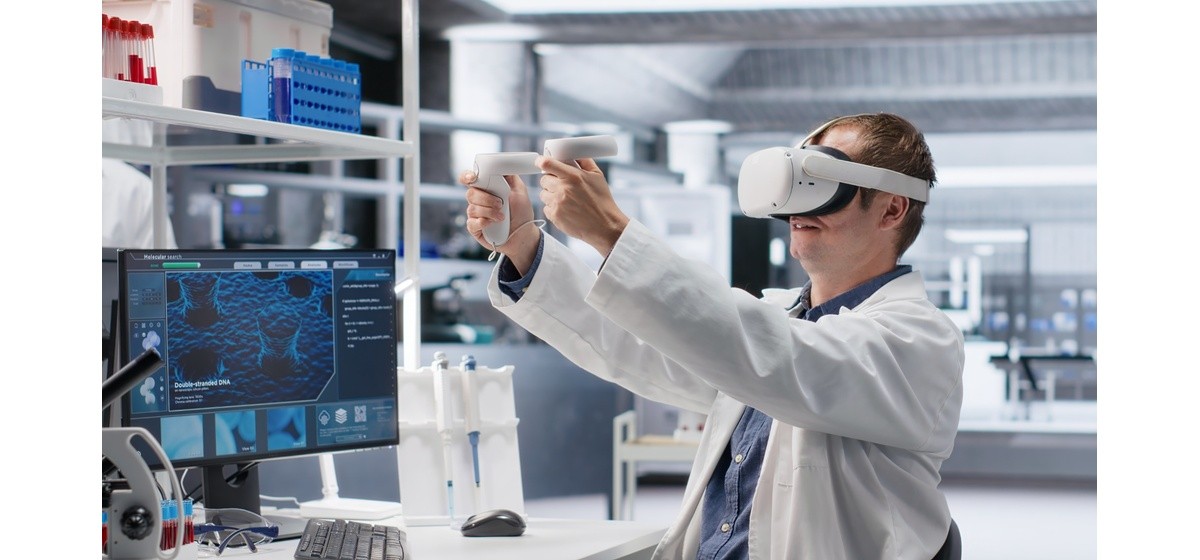
Pharmaceutical manufacturing has some seriously strict rules for quality, safety, and staying compliant. As making drugs gets more complicated and the rules get tighter, drug companies are changing the way they train their people and support their daily work. This blog explores how AR VR applications in Pharma are being used in making drugs, quality control, research, and following the rules.
Why the Pharmaceutical Industry Is Adopting AR VR Applications in Pharma
Pharmaceutical firms face continuous stress to keep product quality consistent as they grow their operations across various locations. Traditional classroom training, paper-based SOPs, and shadowing models struggle to keep pace with cleanroom constraints, limited equipment access, and frequent regulatory updates. As a result, AR VR applications in Pharma are emerging as practical tools rather than experimental technologies.
Immersive tech is being adopted because it reduces mistakes in carefully managed settings. It lets workers train for complicated tasks away from active production, which helps with following rules and getting work done. When combined with insights from virtual reality in Pharma deployments and comparisons such as AR vs VR, Pharma leaders can select the right immersive approach for their work and training.
How AR VR Applications in Pharma Improve Day-to-Day Pharmaceutical Operations
In the pharmaceutical industry, daily tasks demand precision, consistency, and close attention to proven methods. Even minor errors can cause batches to fail, audits to find issues, or production to halt, costing time and money. AR VR applications in Pharma support operational teams by adding instructions and training into their routines as they work, keeping production on track.
AR for Step-by-Step Guidance in Controlled Environments
Augmented reality helps guide workers through standard procedures while they're in cleanrooms or controlled production spaces. By using tablets or smart glasses, AR shows instructions, visual checks, and confirmation prompts without needing workers to look at printed manuals. This hands-free help is really useful for things like gowning, clearing production lines, and setting up gear.
By applying proven AR use cases, Pharma teams can reduce execution errors while ensuring every step follows approved protocols. AR VR in Pharma environments also improves consistency across shifts by delivering the same validated instructions to every operator.
VR for Simulating Complex Lab and Production Processes
Virtual reality lets Pharma teams practice tricky or costly procedures in a simulated setting. VR simulations can replicate steps such as aseptic processing, batch changes, and how equipment works in a space. Operators can repeat workflows until procedural confidence is achieved, without consuming materials or occupying live equipment.
These immersive simulations align closely with established virtual reality examples used in other regulated industries. Virtual Reality in Pharma applications help reduce learning curves while supporting faster onboarding and skill validation.
Mixed Reality for Equipment Familiarization Without Downtime
Mixed reality blends what you see with interactive 3D models, allowing technicians to explore internal components without stopping production. MR experiences help maintenance teams understand machine internals, sensor placements, and assembly sequences before hands-on intervention. This works very well when installing new equipment or moving tech between locations.
Together, AR, VR, and MR improve operational readiness while protecting uptime and product quality across Pharmaceutical facilities.
AR VR Applications That Are Changing Pharmaceutical Training
In the pharmaceutical industry, training must meet strict rules while also being practical. Typical training methods, like classroom lectures and observational learning, don't always get employees ready for the challenges they'll face, especially in contamination-sensitive environments. AR VR applications in Pharma are redefining how training is delivered by making learning immersive, repeatable, and measurable.
VR Cleanroom and Aseptic Technique Training
VR cleanroom simulations allow operators to practice aseptic techniques, material handling, and contamination control before entering classified environments. Users see realistic layouts, airflow, and process steps, which helps build automatic reflexes through practice. This approach aligns closely with modern VR training strategies used for high-risk operational roles. Several Virtual Reality in Pharma initiatives now focus on aseptic assurance and audit readiness.
By combining immersive practice with structured assessments, VR Pharma training programs improve readiness while reducing costly cleanroom rework and retraining.
AR-Based On-the-Job Reinforcement for SOP Compliance
Augmented reality can help support standard operating procedures during operations. AR-based overlays highlight critical steps, acceptable parameter ranges, and safety warnings while tasks are being performed. This approach helps people follow the rules without disturbance or having supervisors watching all the time.
Augmented reality training also supports rapid remediation by guiding operators through corrective actions when deviations occur. The result is stronger procedural adherence and reduced dependency on manual supervision.
These training-focused applications demonstrate how immersive technologies extend beyond learning rooms into real operational contexts.
Where Do AR VR Applications Deliver the Most Value Across Pharma Functions?
Pharmaceutical organizations span multiple functions, each with unique risk profiles and training requirements. AR VR applications in Pharma deliver value across these functions by aligning immersive content with role-specific workflows. The versatility of immersive technologies makes them suitable for both technical and compliance-driven teams. The use of AR VR in Pharma enables consistent execution across manufacturing, quality, and compliance teams without relying on site-specific training methods.
Manufacturing and Fill–Finish Operations
In manufacturing and fill–finish areas, immersive technologies support operator certification, changeover training, and aseptic process validation. VR simulations enable the practice of critical steps without exposing products to contamination risks.
Quality Assurance and Quality Control
Quality teams use VR scenarios to simulate deviation investigations, audit walkthroughs, and inspection readiness exercises. These simulations help teams prepare for regulatory inspections by reinforcing correct documentation and response protocols.
R&D and Analytical Labs
R&D and analytical teams benefit from VR-based instrument familiarization and method walkthroughs. Scientists can explore workflows and safety procedures before handling sensitive samples or expensive equipment.
Compliance and Documentation Training
Compliance-focused AR VR applications reinforce GDP principles, data integrity standards, and ALCOA+ requirements. Immersive training ensures consistent interpretation of regulations across sites and roles.
By spanning operational, scientific, and compliance functions, immersive technologies create a unified learning and execution framework across Pharma organizations.
Real-World Examples of AR VR Applications in Pharma
Across the pharmaceutical industry, immersive technologies are moving from pilot projects to scaled deployments. Global manufacturers are using VR to train operators on aseptic filling lines and AR to guide maintenance technicians during equipment interventions. These applications reflect patterns seen in the broader benefits of VR training, including improved retention and reduced error rates (Source).
Some organizations have reported training time reductions of up to 40 percent after introducing immersive simulations for procedural roles (Source). These examples demonstrate how the use of AR VR applications in Pharma translates directly into operational efficiency and compliance readiness.
As adoption grows, AR VR applications in Pharma are becoming integral to digital transformation initiatives rather than standalone training tools.
What Pharma Teams Should Evaluate Before Implementing AR VR Applications?
Successful deployment of immersive technologies in Pharma requires careful evaluation beyond visual fidelity. Regulatory alignment, hardware suitability, and content governance all play a critical role. AR VR applications in Pharma must be designed with validation and hygiene considerations from the outset.
Accuracy, Validation and GxP Readiness of XR Content
Immersive content must reflect approved SOPs, validated workflows, and current regulatory requirements. Version control, audit trails, and documentation are essential for GxP compliance. Performance data captured during simulations can also support VR training ROI analysis by linking training outcomes to operational metrics.
Hardware Hygiene and Cleanroom Compatibility
Hardware selection must account for cleanroom compatibility, sanitization protocols, and device durability. Factors such as headset materials, ease of cleaning, and user comfort influence long-term adoption. Evaluating the best VR headsets alongside guidance on how to choose VR vendor options helps ensure deployments meet both technical and regulatory expectations.
By addressing these considerations early, Pharma teams can scale immersive programs with confidence and compliance.
Conclusion
AR VR applications in Pharma are transforming how Pharmaceutical companies train their workforce and execute critical operations. By enabling risk-free practice, real-time guidance, and standardized learning, immersive technologies address long-standing challenges in compliance, quality, and scalability. As Pharma organizations continue to modernize, AR and VR are becoming essential components of operational excellence and workforce readiness.