Back to Blog List

AR VR Applications in Mining Safety and Training

AR VR Applications in Mining Safety and Training

Mining work is dangerous and hard to foresee. Places like underground tunnels have heavy machines and are remote, so getting experts there is not easy. Safety and worker preparation are always problems. 

This blog explores how the use of AR VR applications in mining makes things safer on-site, improves worker training, and helps operations run better.

Why the Mining Industry Is Turning to AR VR Applications

Mining companies are under more stress to cut down on accidents, follow the compliance requirements, and train their people more quickly while still keeping production up. Usual classroom teaching, printed guides, and learning through observation can't really replicate dangerous situations or get workers ready for those rare but critical scenarios. 

Because of these limitations, the mining industry is starting to increasingly use immersive technology. The use of AR VR applications in mining helps provide controlled, repeatable environments where workers can experience hazards, practice procedures, and build confidence without exposure to real-world risk. 

Virtual reality in mining industry training is also addressing workforce challenges such as high attrition, contractor onboarding, and skills transfer from experienced operators to new hires.

How AR VR Applications Improve Mining Operations on the Ground

Mining is all about precision, coordination, and situational awareness, since conditions can rapidly change during operations. The use of AR and VR applications in mining has been extremely useful in supporting frontline teams by providing them with contextual information and realistic simulations through which they can understand operational workflows. These technologies enhance decision-making without adding operational risk.

These operational improvements fall broadly into two categories: real-time guidance during live work, and simulation-based preparation for hazardous conditions. Here is how each plays out in practice.

AR for Real-Time Guidance During Field Inspections

AR provides inspectors with step-by-step overlays while conducting safety checks, equipment inspections, and compliance audits. By using augmented reality training on tablets or smart glasses, technicians can view digital checklists, hazard warnings, and equipment data. This also helps technicians rely less on their memory and manuals. This makes inspections more accurate and ensures faster onboarding.

Many companies are expanding these capabilities into broader AR use cases, allowing standardized inspection processes across various locations.

VR for Simulating Underground and Hazardous Conditions

Virtual reality gives mining teams a way to train for dangerous situations that could be dangerous or risky to recreate in real life. VR mining simulations can realistically mimic underground cave-ins, gas leaks, poor visibility, and emergency evacuations. 

This training helps workers learn about space limits and how to make quick decisions before they face these problems at the mine. By using virtual reality in mining industry safety programs, organizations can expose employees to rare but high-impact incidents repeatedly. 

Mixed Reality for Equipment Familiarization Before Deployment

Mixed reality merges physical equipment with digital overlays, allowing workers to interact with virtual elements while working with actual equipment. Before using new equipment, operators can use mixed reality experiences to understand control panels, maintenance points, and safety zones on drills, loaders, or haul trucks. This can lower errors at the start and shorten the time equipment is out of service when first used. 

Together, AR, VR, and, mixed reality create a more resilient operational foundation for mining environments.
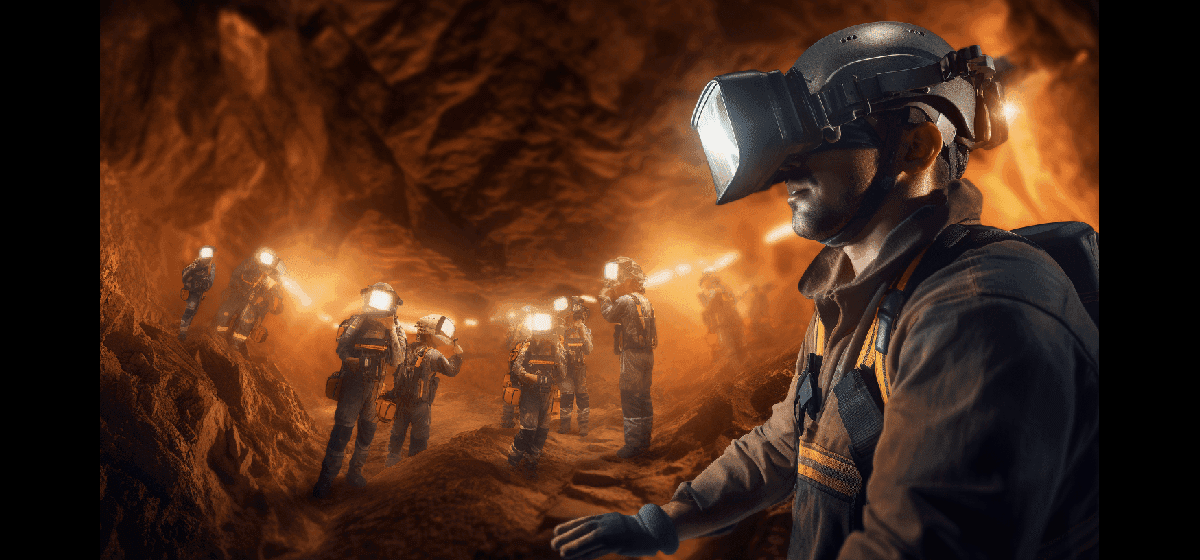

AR VR Applications in Mining That Are Transforming Training

Mining training programs have to find the right balance between safety, speed, and scale, especially when onboarding large contractor workforces or training across remote locations. The use of AR VR applications in mining is transforming training delivery by replacing passive instruction with experiential learning. These methods support consistent skill development without interrupting live operations.

These training-focused applications demonstrate how immersive learning reduces risk while improving workforce capability across mining operations.

VR Emergency Response and Evacuation Drills

Emergency preparedness is critical in mining, where delayed or incorrect responses can lead to severe consequences. Emergency drills that use VR help miners practice how to get out safely, turn off machines, and work together in rescues by making realistic situations. These simulations can be repeated multiple times, enabling workers to practice without fatigue or risk. 

Companies that use VR for emergency training say their workers feel more ready and react faster during drills. (Source) These outcomes align closely with the documented benefits of VR training across industries.

AR-Assisted Training for Heavy Machinery Operations

Operating heavy machines requires precision, awareness of one's surroundings, and following safety rules. AR-assisted training overlays operational guidance directly onto equipment, helping operators understand sequences, safety zones, and error prevention steps. 

AR guidance AR-based operator training also lowers the need for close supervision, and remains available during real tasks, supporting learning in context. When combined with immersive VR simulations, AR creates a mixed learning style, quickly preparing operators while keeping safety standards high.

Where AR VR Applications Deliver the Most Value Across Mining Functions

Beyond safety and training, the use of AR VR applications in mining offers value in areas like exploration and maintenance, improving decisions, speeding up troubleshooting, and boosting teamwork. These gains span the entire mining process.

Exploration and Geological Assessment

Virtual reality lets geologists and planners see terrain, ore deposits, and drilling plans in 3D. Teams can explore data spatially, instead of just using 2D maps. This spatial exploration improves how accurately they understand the data and how confident they are in their plans. These models help exploration teams and planners work together better.

Operations and Site Safety

Immersive experiences can boost the impact of daily safety briefings and hazard identification. VR scenarios will let workers spot unsafe conditions, practice protocols, and reinforce safety rules specific to the location. These tools help strengthen the safety culture while keeping operations running.

Equipment Maintenance and Reliability

Maintenance teams use AR to access guided troubleshooting steps, digital twins, and real-time equipment data while working on assets. This approach reduces diagnostic errors and shortens mean time to repair. When paired with virtual reality examples for complex maintenance procedures, teams gain a deeper understanding of equipment behavior before performing critical tasks.

Remote Collaboration and Expert Support

Mining companies are using VR mining solutions to address safety and staffing challenges. VR safety training programs are now used by many organizations to provide consistent training across different sites and cut down on accidents. Other firms are using AR to support technicians working in remote or hazardous environments.

These workflows highlight practical AR vs VR decision-making, where AR supports real-time assistance while VR supports immersive preparation.

Real-World Examples of AR VR Applications in Mining

Mining companies around the world are leveraging VR mining solutions to deal with safety issues and workforce problems. To maintain uniform training standards across various locations and reduce workplace accidents, some organizations are implementing VR safety training programs. 

Other companies are using augmented reality to help technicians who are working in remote or hazardous places. Studies show that using immersive safety training in dangerous jobs can really cut down on accidents and help people learn skills quicker (Source).

What Mining Teams Should Consider Before Implementing AR VR Applications

To ensure mining teams successfully integrate immersive tech, they should consider factors beyond hardware selection. Teams should assess their infrastructure readiness, their workforce's digital skills, and how the tech will integrate with their present safety and training protocols. Clearly defined goals will guide the selection of VR simulations, AR guidance, or a mix of both.

Hardware selection should consider durability, mobility, and compatibility with site conditions, making guidance such as best VR headsets relevant during planning. Content strategy also matters, with teams choosing between off-the-shelf modules and custom simulations based on operational complexity. 

Evaluating VR training ROI analysis early ensures alignment between investment and measurable outcomes, while understanding how to choose a VR vendor reduces deployment risk. A structured implementation approach ensures AR and VR programs deliver long-term value rather than short-term novelty.

Conclusion

AR VR applications in mining are changing how safety, training, and general operations are handled, especially where risks are high. These tools offer hands-on learning, instant instructions, and ways to team up from a distance. This helps mining groups cut down on accidents and get their workers ready for anything. As these technologies get more common, they're turning into key parts of strong, forward-thinking mining work setups.

Ready to explore AR and VR solutions tailored for mining safety and training? 

Speak with the AutoVRse team to design immersive programs aligned to your operational goals.

FAQ

1. How do AR VR applications improve safety culture in mining operations?

AR and VR programs can make safety training better by allowing workers to go through realistic hazard simulations before they face the actual dangers at work. Going through these situations in virtual reality helps people learn faster through repeated practice. Augmented reality helps them do their jobs more safely in real life. These tools foster a way of thinking that emphasizes foreseeing risks instead of just following the rules after something happens.

1. How do AR VR applications improve safety culture in mining operations?

AR and VR programs can make safety training better by allowing workers to go through realistic hazard simulations before they face the actual dangers at work. Going through these situations in virtual reality helps people learn faster through repeated practice. Augmented reality helps them do their jobs more safely in real life. These tools foster a way of thinking that emphasizes foreseeing risks instead of just following the rules after something happens.

1. How do AR VR applications improve safety culture in mining operations?

AR and VR programs can make safety training better by allowing workers to go through realistic hazard simulations before they face the actual dangers at work. Going through these situations in virtual reality helps people learn faster through repeated practice. Augmented reality helps them do their jobs more safely in real life. These tools foster a way of thinking that emphasizes foreseeing risks instead of just following the rules after something happens.

2. Are AR VR applications suitable for both surface and underground mines?

2. Are AR VR applications suitable for both surface and underground mines?

2. Are AR VR applications suitable for both surface and underground mines?

3. How do AR VR applications support remote mining operations?

3. How do AR VR applications support remote mining operations?

3. How do AR VR applications support remote mining operations?

4. Can AR VR training reduce incident rates for new operators?

4. Can AR VR training reduce incident rates for new operators?

4. Can AR VR training reduce incident rates for new operators?

Let’s talk about

Let’s talk about

Let’s talk about

your training

your training

your training

Talk to our team to learn how to implement VR training at scale

Talk to our team to learn how to implement VR training at scale

Talk to our team to learn how to implement VR training at scale