Back to Blog List

How Pharmaceutical R&D Teams Are Leveraging XR to Accelerate Drug Development and Innovation

How Pharmaceutical R&D Teams Are Leveraging XR to Accelerate Drug Development and Innovation

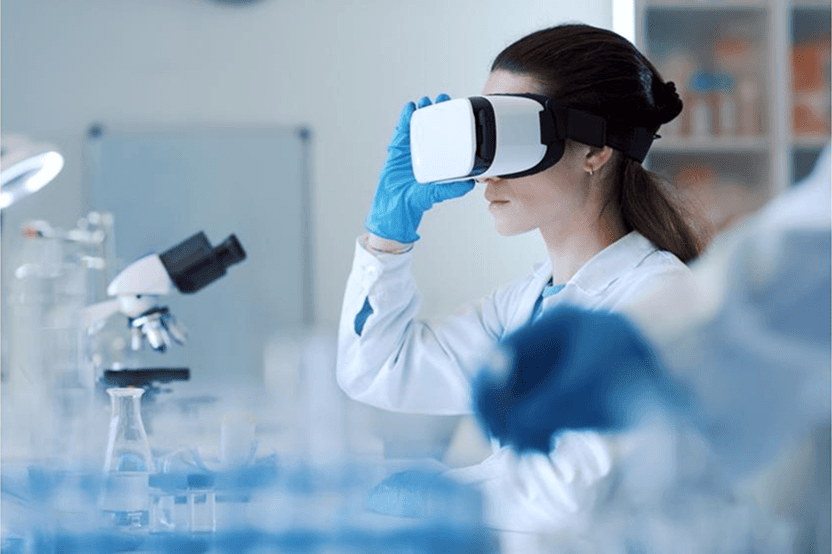
Extended Reality is entering a transformative phase in life sciences, reshaping the way pharmaceutical R&D teams examine molecules, run tests, and collaborate across research centres around the globe (Source).

Using XR in pharmaceutical settings, which are often strictly controlled research environments,  delivers better scientific insight, safer experimentation, and faster decision-making.

This article looks at how XR is advancing drug discovery, what applications are emerging across the R&D lifecycle, and how pharmaceutical innovation leaders can adopt immersive tools effectively.

What Challenges Does Pharmaceutical R&D Face Today?

Pharmaceutical research continues to face mounting complexity, rising development costs, and pressure to bring new drugs to market faster. Typical lab work is resource-intensive. It requires costly materials, controlled environments, and close expert supervision - all of which slow the process down.

The shift toward biologic drugs, personalised therapies, and complex molecular structures also demands tools with far greater precision than traditional approaches can offer. And with research teams spread across the globe, inconsistent training compounds the challenge further.

Using XR in pharmaceutical R&D workflows addresses these constraints directly. It enables immersive visualisation, virtual experimentation, and standardised procedural training (Source). By reducing reliance on physical materials and enabling accurate simulation, immersive tools give R&D teams a faster, more scalable way to innovate. As research demands evolve, XR provides a practical way to prepare pharmaceutical R&D for what’s next.

How Does XR Improve R&D Processes in Pharma?

Pharmaceutical teams are increasingly using immersive tech in pharma innovation to strengthen core research work. Extended Reality, as a category, gives chemists, biologists, and clinical scientists realistic, interactive environments to examine mechanisms, run simulations, and validate processes with greater clarity (Source).

This blends scientific accuracy with spatial visualisation - accelerating idea development and reducing the trial-and-error cycles typical of traditional drug discovery. Here are the three key ways immersive technology improves pharmaceutical R&D processes.

Faster Molecule Visualization and Mechanism of Action Understanding

Static 2D molecular models often limit comprehension when dealing with intricate biological pathways. XR for pharma research introduces spatial representations where researchers manipulate proteins, ligands, and receptor sites in 3D - improving clarity during structure-activity analysis.

Scientists can explore binding affinities, simulate molecular interactions, and visualise mechanism-of-action changes under different conditions. This supports faster hypothesis testing and strengthens decision-making for medicinal chemistry teams.

Virtual Labs for Safe and Repeatable Experimentation

Virtual labs for pharmaceutical R&D unify methodological standards across research sites - ensuring every scientist rehearses identical steps before entering real facilities. Teams can experiment without consuming costly materials or exposing members to risk.

Using VR to simulate lab work allows repeated practice of procedures - from pipetting to handling delicate cell cultures - building accuracy before researchers step into live environments. These settings also help new staff gain practical experience while reducing both lab-related risk and facility demand.

Enhanced Collaboration Between Chemists, Biologists and Clinical Teams

Distributed scientific teams often struggle to collaborate due to location differences, inconsistent lab protocols, and fragmented record-keeping. The use of VR/AR in drug development resolves this by letting researchers share the same digital space, annotate 3D models, and review experiments together in real time.

Teams can evaluate formulation strategies, assess trial scenarios, and flag safety considerations - all within a single XR environment. This shared perspective improves team alignment and leads to more consistent, reliable results.

Which XR Technologies Are Transforming Pharma R&D?

Pharma teams today use a range of immersive tools to address different R&D functions.

Virtual Reality supports spatial modelling and virtual experimentation. Augmented Reality enhances live lab work through contextual overlays. Digital Twins introduce predictive modelling that complements both experimental design and stability analysis.

Together, these technologies represent the next phase of pharma R&D digital transformation. Understanding their role helps leaders identify the most suitable deployment model for their research workflows.

Virtual Reality for Immersive Drug Discovery and Modeling

VR helps researchers study molecules, observe compound interactions, and recreate life-science environments at full scale. This improves spatial understanding and enables more precise molecular modelling.

Immersive walkthroughs of complex molecular environments let research groups evaluate potential drug targets, anticipate reaction pathways, and refine early candidates - all with less reliance on physical lab work. Researchers can also use VR for method-based training exercises, reinforcing procedural accuracy before entering live environments.

Augmented Reality for Real-Time Lab Guidance and Step Validation

AR overlays digital instructions, molecular information, or SOP steps directly onto lab equipment and workspaces. This lets researchers verify procedures in real time, reduce errors, and stay aligned with lab compliance requirements.

AR annotations also help teams avoid mistakes during complex preparation work - improving documentation accuracy ahead of audits. The result is more repeatable, well-controlled experimentation.

Digital Twins for Predictive Drug Behavior and Stability Testing

Digital Twin applications model how biological systems, manufacturing processes, or environmental conditions influence drug performance. For a broader look at how these are used across industries, see our overview of digital twin applications. These simulations allow scientists to predict degradation, assess stability, and replicate process variations before physical testing begins.

In pharmaceutical contexts, Digital Twins can represent reactors, bioprocessing setups, or patient cohorts. As modelling practices evolve, they have become central to pharma R&D digital transformation - supporting predictive, data-driven decision-making at every stage.

How Is XR Used Across the Pharma R&D Lifecycle?

Across the drug development continuum, immersive tools play a distinct role at each stage - enhancing discovery, refining workflows, and standardising training.

Using XR in pharmaceutical R&D integrates naturally within laboratory processes, formulation activities, and compliance-driven functions. These applications benefit both early-stage ideation and downstream preparation for clinical studies. Understanding these touchpoints helps pharma leaders identify opportunities for incremental adoption.

Early Drug Discovery

Using XR for pharma research supports target identification, molecular screening, and structural exploration through 3D interaction with molecular datasets. Researchers can quickly compare candidate compounds, evaluate reaction possibilities, and detect early liabilities.

This accelerates hypothesis validation and reduces the number of low-quality candidates entering preclinical phases. Teams maintain consistent insight across evolving molecular datasets throughout the earliest screening stages.

Preclinical Testing

During preclinical development, immersive visualisation helps teams interpret toxicity data, metabolic pathways, and pharmacokinetic behaviour. XR overlays critical insights into interactive biological models, improving communication between toxicologists and formulation teams.

Predictive exploration enables earlier detection of risk factors before moving to animal studies. Many pharmaceutical organisations now use VR and AR in drug development to align toxicology and formulation specialists on how candidate molecules behave across different biological environments.

Lab Process Simulation

VR for lab simulation allows R&D personnel to rehearse established SOPs before handling live materials. Users can interact with virtual equipment, rehearse delicate steps, and gain proficiency without impacting lab availability.

Simulating batch preparation or quality-control procedures prepares teams for consistent execution in real environments. This is one of the most direct virtual reality in pharma applications delivering measurable gains in procedural readiness (Source).

Regulatory Training

As documentation requirements grow stricter, XR facilitates standardised training on regulatory expectations. Researchers and technicians can walk through compliance scenarios, reinforced with procedural accuracy checks and digital records.

This aligns closely with training needs related to workplace hazards and safety protocols, ensuring teams follow correct processes every time (Source). 

Across each stage, XR strengthens scientific insight, improves readiness, and reduces downstream risk.
What Benefits Can Pharma R&D Teams Expect From XR?

Immersive technologies bring measurable improvements to scientific workflows, organisational efficiency, and researcher capability.

Using XR in pharmaceutical R&D accelerates understanding, reduces risk exposure, and ensures consistent upskilling. These advantages accumulate across the pipeline, helping pharma companies respond faster to innovation demands and competitive pressures.

Faster Drug Development Through Immersive Understanding

By enabling life-sized, manipulable models of molecules and biological responses, using XR in pharmaceutical R&D helps researchers interpret data with greater precision.

This reduces the number of experimental cycles needed to confirm hypotheses and accelerates the transition from discovery to development. When immersive visualisation offers clarity earlier, project timelines shorten significantly.

Reduced Lab Risks and Experimental Errors

Virtual labs and AR-enabled guidance minimise deviations, reduce cross-contamination events, and eliminate unnecessary handling of hazardous materials.

Teams can rehearse unfamiliar steps repeatedly, building accuracy before entering sensitive environments. These capabilities align closely with safety insights covered in discussions around workplace hazards. A clear understanding of measurable outcomes also helps teams justify immersive investments, as reflected in VR training ROI analysis.

Improved Compliance and Documentation Accuracy

XR introduces step-wise validation, real-time annotation, and automated logging into R&D activities. When teams follow workflows supported by immersive tools, documentation consistency improves, and deviations decline. 

These strengths support regulatory submissions and internal quality audits with greater confidence.

Better Upskilling for New Researchers and Lab Technicians

Interactive simulation prepares new researchers for complex tasks without requiring extensive supervision. XR-enabled modules standardise onboarding and ensure that new team members gain hands-on experience quickly.

Compared to traditional methods, immersive training develops stronger procedural memory and technical readiness. The benefits of VR training are especially pronounced in pharma, where precision and protocol adherence are non-negotiable. These strengths are central to VR for Pharmaceutical Training, which focuses on building technical proficiency through repeated, high-accuracy practice.

As these benefits scale, using XR in pharmaceutical environments becomes a central component of a modernised digital R&D strategy.

What Should Pharmaceutical Companies Consider Before Adopting XR?

Adopting immersive technologies requires strategic alignment, infrastructure readiness, and long-term planning.

Pharma organisations must evaluate data risks, hardware constraints, and integration requirements before scaling XR across R&D environments. Addressing these considerations early ensures smooth deployment and sustained value creation.

Data Sensitivity and IP Protection

Pharmaceutical research involves confidential molecular data, proprietary formulations, and sensitive analytical models. XR deployments must ensure that these assets remain protected through encryption, controlled access, and secure data handling. 

Organisations should also validate that immersive platforms comply with internal IP protocols and global data standards.

Hardware and Lab Environment Constraints

R&D teams must assess the physical setup of labs, ventilation pathways, and movement restrictions before implementing head-mounted displays. Some procedures require hands-free operation or compatibility with PPE. 

Selecting devices suited to these constraints ensures researcher comfort and procedural efficiency.

Integration With LIMS and R&D Informatics Systems

To unlock full value, XR experiences should integrate smoothly with existing documentation tools, LIMS platforms, and R&D informatics systems. This ensures that procedural logs, experiment metadata, and performance records remain centralised.

This alignment reinforces broader pharma R&D digital transformation goals by unifying scientific data, procedural records, and immersive training outputs into a single, scalable ecosystem.

By addressing these considerations early, pharmaceutical teams can adopt XR confidently and sustainably.

Conclusion

Immersive technologies are reshaping pharmaceutical R&D by enabling researchers to explore molecular systems, rehearse lab processes, and collaborate across disciplines with greater clarity.

Using XR in pharmaceutical environments accelerates discovery, enhances safety, and improves workforce readiness, making it one of the most impactful digital tools available to modern R&D teams (Source).

As pharma organisations move toward more scalable, data-driven research models, XR provides the foundation for faster innovation and higher scientific accuracy.

Looking to explore XR-enabled R&D?

Connect with our team to evaluate the best use cases for your scientific workflows.

FAQs

1. Can XR be used in wet-lab environments?

Yes, XR can be deployed in wet-lab environments as long as the hardware and workflow are adapted for safety and compliance. Many head-mounted devices support hands-free interaction, making them suitable for high-precision experiments. 

Virtual simulations also allow researchers to practise steps beforehand, lowering risk inside actual labs.

1. Can XR be used in wet-lab environments?

Yes, XR can be deployed in wet-lab environments as long as the hardware and workflow are adapted for safety and compliance. Many head-mounted devices support hands-free interaction, making them suitable for high-precision experiments. 

Virtual simulations also allow researchers to practise steps beforehand, lowering risk inside actual labs.

1. Can XR be used in wet-lab environments?

Yes, XR can be deployed in wet-lab environments as long as the hardware and workflow are adapted for safety and compliance. Many head-mounted devices support hands-free interaction, making them suitable for high-precision experiments. 

Virtual simulations also allow researchers to practise steps beforehand, lowering risk inside actual labs.

2. How accurate are XR-based simulations for drug discovery?

2. How accurate are XR-based simulations for drug discovery?

2. How accurate are XR-based simulations for drug discovery?

3. Can XR help reduce early-stage drug development costs?

3. Can XR help reduce early-stage drug development costs?

3. Can XR help reduce early-stage drug development costs?

4. What type of pharma research teams benefit most from XR?

4. What type of pharma research teams benefit most from XR?

4. What type of pharma research teams benefit most from XR?

Let’s talk about

Let’s talk about

Let’s talk about

your training

your training

your training

Talk to our team to learn how to implement VR training at scale

Talk to our team to learn how to implement VR training at scale

Talk to our team to learn how to implement VR training at scale