Back to Blog List

How Manufacturing R&D Teams Are Leveraging XR to Accelerate Innovation

How Manufacturing R&D Teams Are Leveraging XR to Accelerate Innovation

Extended Reality (XR) is changing how R&D teams work in manufacturing - an industry where speed, accuracy, and technical precision directly determine competitive position (Source).

As the use of Extended Reality (XR) in manufacturing grows, R&D leaders are deploying VR, AR, Mixed Reality, and Digital Twin tools to build better prototypes, tighten team collaboration, and validate designs without physical risk. 

This article takes a look at how the introduction of XR in manufacturing R&D is compressing product timelines, cutting costs, and reducing the kind of late-stage engineering errors that are expensive to fix. While also enabling R&D teams to explore product concepts with precision and speed not possible using traditional tools.

Why Do Manufacturing R&D Teams Need XR Today?

Manufacturing R&D teams are coming under the storm these days to cut short on delivery times. Product cycles are shorter, engineering is more complex, and competitors move fast if delays occur. 

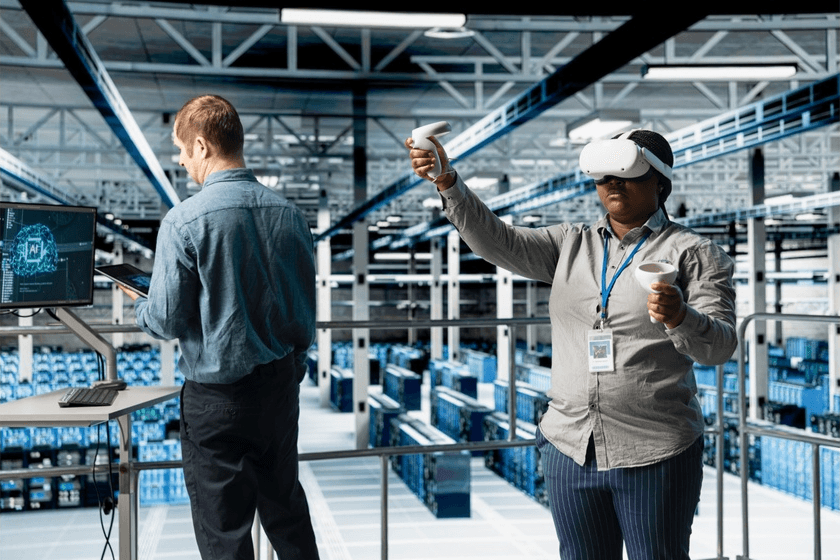
The use of XR helps manufacturing teams visualise, simulate, and test concepts earlier and quicker. Instead of waiting for physical prototypes to identify design flaws, engineers now run virtual stress tests from day one. Instead of flying team members across the world for design review, organisations now share the same 3D models in a virtual space for teams across continents to work on simultaneously. 

The shift from physical to immersive is where the real time and cost savings start. 

Companies that have adopted XR for manufacturing R&D report clearer communication, better collaboration with design teams, faster iterations, and better alignment across departments. 

The same advantages show up in immersive training environments where repeated exposure to simulated workflows measurably improves precision and reduces rework and operational outcomes.

How Does XR Improve Manufacturing R&D Processes?

XR tools do more than just add a layer of visualisation to existing workflows. They help drastically reduce development timelines and help bring data from across teams into a unified development environment. 

Engineers can interact with full-scale digital models of components before they are fabricated into physical components. They can simulate how components behave under load, identify tolerance issues, and iterate on models - all without working with physical materials. The ability to run iterations digitally is where XR delivers its most direct impact on R&D efficiency (Source).

Here are the key ways in which immersive technology improves manufacturing R&D:

Faster Prototyping and Validation

Virtual prototyping moves teams away from the traditional build-and-break cycle. Instead of fabricating a physical model to test dimensions, assembly fitment, and ergonomics, engineers prototype inside detailed VR simulations that accurately replicate real world scenarios and physics. 

For example, a team designing a new industrial pump house - using VR, engineers can assemble individual components virtually, check clearance tolerances to the millimetre, and run simulated fluid dynamics tests - all before a single part is manufactured. If a nut or a bolt interferes with an access point, teams catch it in the virtual environment, not on the factory floor. 

The result: Fewer revisions, lower fabrication costs, and faster sign-offs. 

Better Design and Engineering Collaboration

XR gives distributed teams a shared spatial environment that flat screens and slide decks cannot provide. 

In a Mixed Reality based design review, engineers in different locations see the same holographic model overlaid onto their defined physical environment. They can walk around it, annotate specific components, and flag issues in real time. Compare that to a traditional review where they wrangle with PDFs, screenshots, a prolonged call, and follow-up email chains to resolve queries. 

The speed and efficiency difference from using XR solutions comes along with massive gains in team productivity and alignment. 

Safer Testing for Complex Scenarios

Some manufacturing processes are too hazardous, expensive, or involve rare materials to be effectively tested in a live environment. XR helps teams simulate scenarios that would constitute as workplace hazards in a safe environment. For example, extreme heat exposure, mechanical failures under stress, incorrect assembly sequences, and so on. 

The manufacturing process gets thoroughly validated in a risk-free space before it reaches the production floor without endangering the staff, the equipment, or affecting production hours.
Key XR Technologies and Use Cases Transforming Manufacturing R&D

Extended Reality in manufacturing innovation isn’t a single tool, it’s a family of technologies. Extended Reality, as a category, contains VR, AR, Mixed Reality, and Digital Twins, each playing a distinct role in the R&D process. 

Used together, they give teams the ability to iterate faster, evaluate design concepts in context, and simulate real-world performance at a level physical testing alone would take a lot of time and resources. 

products.

Virtual Reality for Product Simulation

VR in manufacturing creates fully immersive environments where engineers interact with complete digital models of their concepts before fabrication. 

Teams use it to validate assembly sequences, check dimensions, and assess the ergonomics of the product in real world conditions. Early-stage design reviews happen inside the simulation cutting down on misinterpretation and speeding up decision-making. The accuracy of modern VR simulations, which are physics-based and spatially precise, makes them the perfect solution for engineering-grade precision, not just virtual walkthroughs. 

Augmented Reality for Design Iteration

AR overlays digital models onto the physical world, giving engineers a direct comparison between design and real-world context. 

AR VR in manufacturing product development gives engineers a practical way to verify part alignment, check spatial constraints, and improve assembly workflows against actual physical conditions. Issues that usually only surface during physical installation get identified during the design phase instead - this makes the implementation of AR in manufacturing particularly valuable when working with intricate machinery or multi-component assemblies. 

Digital Twins for Realistic Testing

A Digital Twin is a live digital replica of a physical asset, continuously updated with real-world sensor data. For a deeper look at how these are used across industries, see our overview of digital twin applications.

When integrated with XR in manufacturing, engineers can observe how a component behaves under operating conditions such as temperature variation, load cycles, wear patterns, without running physical tests. That data feeds back into the design process, improving maintenance planning, refining geometry, and building confidence in performance before production.

What Benefits Can Manufacturing R&D Teams Expect?

Immersive technologies for manufacturing R&D are delivering measurable gains across three areas: speed, cost, and engineering accuracy. Companies that integrate XR into their R&D workflows report shorter development cycles, fewer physical prototypes, and higher confidence in designs before they reach the application of their ideas into product development. 

Together, these benefits help R&D divisions operate more efficiently - reducing both development timelines and overall expenditure. 

Reduced Time-to-Market

XR-enabled design workflows minimize delays by allowing faster iteration and instant feedback cycles. When VR for manufacturing R&D is used throughout development, teams can validate assumptions far earlier and compress multi-week activities into days. 

This faster cycle gives manufacturers the ability to respond to market shifts and changing customer requirements without sacrificing on engineering rigour. The measurable impact on delivery timelines is one of the most consistently reported benefits of VR training

Lower Prototype Costs

Physical prototyping often accounts for a significant share of manufacturing R&D spend. Virtual prototyping in manufacturing reduces the need for repeated fabrication, lowering material consumption and eliminating costly rework cycles in the process. 

The ability to evaluate multiple design variations digitally also improves investment decisions before production starts. When doing a VR Training ROI analysis, these prototype cost savings tend to be among the largest contributors to overall returns. 

Higher Accuracy and Fewer Failures

Mixed Reality in manufacturing R&D lets teams catch spatial mismatches, component clashes, and assembly errors before they reach the production floor. Engineers work with immersive models that reveal fit and clearance issues at full scale, highlighting problems that help avoid expensive errors later down in the process. 

Higher accuracy in the planning stages means fewer downstream failures, less rework, and more reliable handoffs.

What Should Companies Consider Before Adopting XR?

While XR in Manufacturing offers substantial benefits, manufacturers must evaluate certain operational, technological, and security factors before integrating immersive workflows. Hardware, software, and current engineering systems all must be in sync for any execution to go well. XR for manufacturing research does better when it fits smoothly into current digital setups.

The considerations below help teams prepare for a scalable deployment. Addressing these factors early ensures consistent performance and long-term ROI.

Hardware Requirements

The right hardware depends on the specific use case. High-fidelity VR for large 3D models demands capable workstations and tethered headsets. AR-driven field tasks might be easier to run on lighter mobile devices. 

Teams should factor in device comfort, portability, and compatibility with safety protocols in production environments before making procurement decisions.

Simulation Accuracy and Data Security

Engineering-grade simulations need accurate geometry, realistic physics models, and reliable material behaviour data. XR platforms should meet those standards before being used for consequential design decisions.

Data security is equally important. XR environments often involve proprietary schematics, IP, and live Digital Twin data streams. Strong encryption and secure cloud workflows are non-negotiable.

Integration with CAD Tools

Engineering teams must confirm that XR systems integrate seamlessly with CAD files from tools like SolidWorks, CATIA, or Siemens NX. Efficient file handling reduces friction between design and immersive review sessions. 

When XR integrates smoothly with CAD systems, engineering alignment becomes faster and more consistent.

Conclusion

The use of XR in Manufacturing is transforming how R&D teams ideate, test, and validate new products. By integrating VR for manufacturing R&D, AR VR in manufacturing product development, and Digital Twins, companies can reduce uncertainty and improve engineering precision at every stage. 

As the manufacturing sector continues its shift toward immersive innovation, XR will become a defining element of future-ready R&D workflows (Source).

Ready to bring XR innovation into your R&D pipeline?

Speak with the AutoVRse team to explore how XR manufacturing product development can accelerate your R&D roadmap.

FAQs

1. What types of manufacturing products can be prototyped in XR?

Immersive simulation allows manufacturers to prototype machinery, car parts, consumer goods, heavy equipment, and precise systems. Teams can use XR environments to check assembly behavior, space limits, and how well things work before making them. Because immersive modeling is flexible, it works for both simple and complex products in different manufacturing areas.

1. What types of manufacturing products can be prototyped in XR?

Immersive simulation allows manufacturers to prototype machinery, car parts, consumer goods, heavy equipment, and precise systems. Teams can use XR environments to check assembly behavior, space limits, and how well things work before making them. Because immersive modeling is flexible, it works for both simple and complex products in different manufacturing areas.

1. What types of manufacturing products can be prototyped in XR?

Immersive simulation allows manufacturers to prototype machinery, car parts, consumer goods, heavy equipment, and precise systems. Teams can use XR environments to check assembly behavior, space limits, and how well things work before making them. Because immersive modeling is flexible, it works for both simple and complex products in different manufacturing areas.

2. How accurate are VR and AR simulations for engineering-level decisions?

2. How accurate are VR and AR simulations for engineering-level decisions?

2. How accurate are VR and AR simulations for engineering-level decisions?

3. Is XR expensive to implement for smaller manufacturing R&D teams?

3. Is XR expensive to implement for smaller manufacturing R&D teams?

3. Is XR expensive to implement for smaller manufacturing R&D teams?

4. What hardware is required for XR-based manufacturing R&D?

4. What hardware is required for XR-based manufacturing R&D?

4. What hardware is required for XR-based manufacturing R&D?

Let’s talk about

Let’s talk about

Let’s talk about

your training

your training

your training

Talk to our team to learn how to implement VR training at scale

Talk to our team to learn how to implement VR training at scale

Talk to our team to learn how to implement VR training at scale