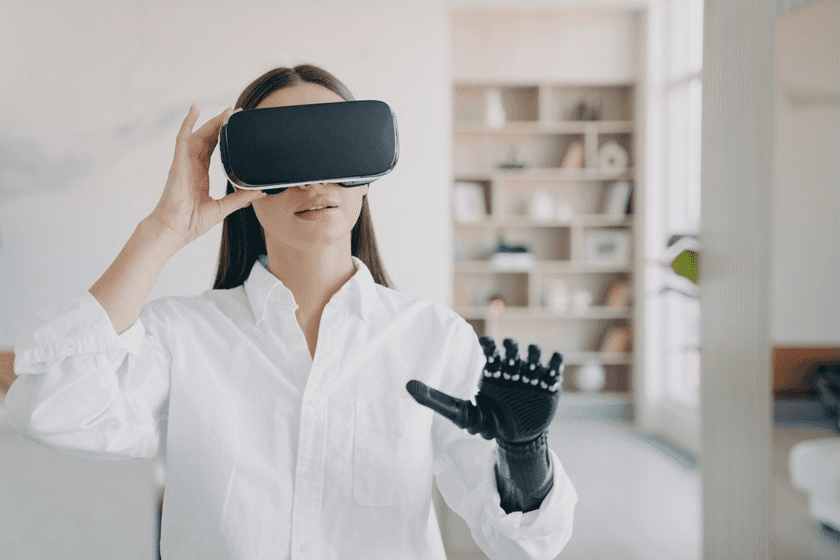
What Are VR Gloves?
VR gloves are wearable tech that lets people use their hands to touch and affect what's in virtual reality. They use motion tracking and touch feedback to see how your hands move, so you can grab, push, and move things in VR just like you would in real life with much more accuracy than regular controllers. Companies use VR gloves for training, simulations, design checks, and to control machines, since they allow for very precise actions that feel natural.
How VR Gloves Work
VR gloves use hardware sensors, tracking tech, and touch systems to mimic real hand movements in virtual reality. Virtual reality gloves translate each finger movement into the digital world, making detailed interactions feel natural. These systems make things more precise for fields like manufacturing, cars, and healthcare, where exact hand motions are important.
Sensors and Tracking in VR Hand Tracking Gloves
Most VR tracking gloves use IMUs, optical markers, or magnetic tracking to map finger joints and wrist orientation. This blend of motion-capture technologies allows VR gloves to follow fast or subtle movements without drift. Optical systems such as those used in professional mocap pipelines typically provide millimetre-level precision, giving designers and engineers accurate digital replicas of their hand positions (Source). Many enterprise VR gloves incorporate multi-sensor arrays so that even partial occlusion does not interrupt tracking.
Haptic Feedback Systems in Virtual Reality Gloves
VR gloves use haptic systems to make you feel like you're really touching things in a virtual world by mimicking sensations such as pressure, clicks, or resistance. Some use tiny motors, while others use force feedback to simulate weight or tension. Research from the University of Waterloo shows that when these sensations feel real, people are much more accurate when handling objects in VR (Source). This accuracy is useful for employees who need to practice specific skills without any danger.
Motion Capture and Gesture Recognition Capabilities
VR gloves use motion-capture tech to read hand movements. This includes pinches, grips, pushes, and rotations. Recognizing gestures makes work easier, since people don't have to just hit buttons or use strange controls. These gloves use models to figure out what the user is trying to do, even with small movements. This cuts down on lag and makes for smoother actions.
With all these parts working together, VR gloves give you more exact hand control than regular controllers. This is quite useful when you need to be precise.
Types of VR Gloves and Their Use Cases
VR gloves are available in multiple categories based on their capabilities, and each type brings a different value depending on the industry’s needs. Different organizations have different priorities. Some care most about simulations that really put operators in the thick of things for training. Others are more concerned with getting precise data on hand movements, which helps when making prototypes. Knowing what these differences are can assist groups in picking the best system for what they need.
Teams choose either VR gloves that use touch or lighter gloves that just track movement. Usually, their aim is to make the experience feel real, cut down on training, and lower the rate of mistakes on the job.
Haptic VR Gloves for Training and Simulation
VR gloves that provide touch can aid staff in the learning of physical skills. Firms in areas such as shipping, production, and power are using these gloves to mimic the feel of using tools or putting things together, but in a safe, virtual space. This touch feedback can be used for things like gripping tools or using controls. This lessens the amount of time needed for real-world training. Firms also get the advantage of safer training, since people can try out tasks first in a virtual world before going into risky areas.
VR Tracking Gloves for Motion Capture and Design
VR tracking gloves focus on precision rather than haptics. Automotive and aerospace teams often use these gloves for design evaluations because the technology records accurate finger articulation. This level of tracking allows engineers to interact with virtual models at scale and understand ergonomic constraints before physical prototypes are created. Motion-capture-oriented VR gloves are also widely used in animation and research because they support reproducible hand movement sequences.
Lightweight VR Hand Gloves for General Interaction
Lightweight VR hand gloves address simple interaction use cases where full haptic or mocap fidelity is not required. These gloves typically integrate with standard VR systems for navigation, pointing, menu control, and basic manipulation. Training teams prefer lightweight options for soft-skills modules, virtual walkthroughs, or collaborative sessions where comfort and long-term wearability matter more than advanced tactile feedback.
Choosing between these categories depends on the precision requirements, session duration, and training objectives for the organisation.
Key Benefits of Using VR Gloves
VR gloves bring tangible advantages to enterprise training, usability research, and design validation. When teams adopt virtual reality gloves, they gain access to interaction modes that closely resemble real-world hand use. The technology helps organisations reduce dependency on physical prototypes, enhance learning retention, and elevate user engagement.
Across sectors, VR hand tracking gloves consistently reduce error rates, increase situational awareness, and support more consistent training outcomes.
Enhanced Realism and Engagement
VR gloves provide intuitive, natural interactions that improve immersion. Instead of interacting with virtual elements using abstract controller inputs, users rely on familiar hand movements. According to research published by ACM Digital Library, natural interaction increases task completion rates by up to 28 percent in training simulations (Source).
Improved Precision for Industrial VR Applications
Industrial workflows benefit from the high accuracy offered by VR gloves because employees can practise intricate actions without handling real tools. Realistic hand tracking allows teams to test accessibility, reach, and ergonomics early in the design cycle. For frontline workers, precision drives better performance during operations where mistakes have a high cost.
Better Skill Transfer Through Hands-On Virtual Practice
Hands-on training using VR gloves equips employees with practical experience before they interact with live equipment. Repeated exposure to simulated tasks enables faster skill acquisition and reduces anxiety during real-world operations. Over time, organisations see measurable improvements in consistency and readiness among their trainees.
The combined impact of immersion, accuracy, and repeatability makes VR gloves a powerful tool for enterprise learning and development.
The Future of VR Gloves
The future of VR gloves is moving toward lighter components, improved haptic textures, and AI-powered adaptation. Many manufacturers are already integrating neural signals, predictive gesture recognition, and wireless modules to reduce latency. Upcoming developments will introduce more responsive materials and dynamic force feedback, allowing users to feel texture, temperature, and granular resistance. As enterprise VR adoption grows, VR gloves will become central to training and simulation strategies across sectors like energy, automotive, pharmaceuticals, and manufacturing.
Want to explore VR gloves in your enterprise training?
Get in touch with AutoVRse to see how you can transform enterprise training using VR gloves.