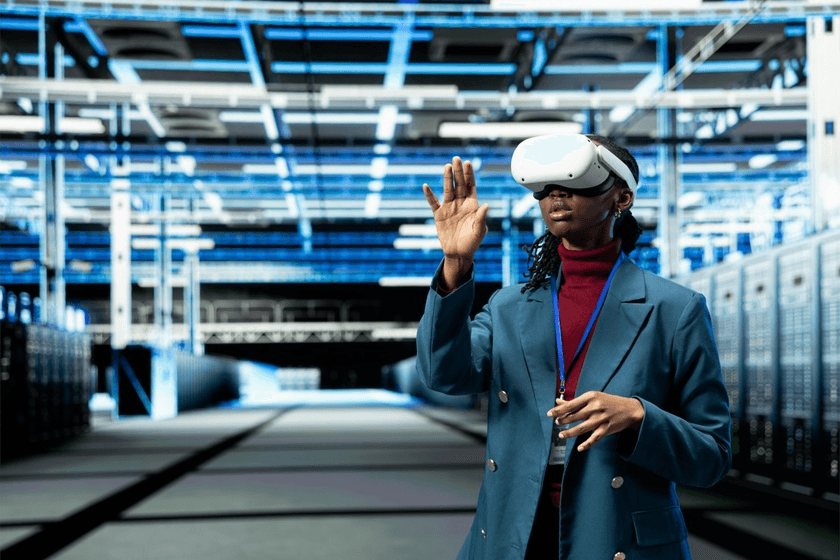
What is the Industrial Metaverse?
The industrial metaverse is a network of persistent, interconnected virtual environments built for industrial use. It combines digital twin technology, VR and AR, real-time IoT data, and AI to create simulated replicas of factories, plants, supply chains, and infrastructure that organisations can use for design, training, simulation, and operations management.
Unlike the consumer metaverse, which is primarily about social interaction and entertainment, the industrial metaverse is about reducing the cost and risk of decisions involving complex physical systems. The fundamental value proposition is simple: test things in the digital environment before committing resources in the physical one.
The more accurate and responsive the virtual environment, the more confidently organisations can act on what they learn from it.
Core Technologies Powering It
Industrial metaverse calls upon some cutting-edge tech bundled together to provide a seamless experience to businesses. These technologies extend to and are not limited to:
Digital Twins
Digital twins are virtual replicas of physical assets or systems that update in real time using sensor data from the actual equipment. In the industrial metaverse, digital twins are the foundational layer; they make the virtual environment accurate enough to be useful for engineering decisions, not just visualisation.
A digital twin of a production line doesn't just look like the line; it behaves like it, reflecting current throughput, equipment health, and process parameters based on live sensor feeds.
XR as the Human Interface
Virtual and augmented reality are the interfaces through which people interact with the industrial metaverse. An engineer can walk through a virtual factory in VR to review a proposed layout change before any physical reorganisation begins.
A maintenance technician can see AR overlays from the industrial metaverse system while working on real equipment, showing live performance data, maintenance history, and step-by-step guidance in spatial context. XR makes the data in the industrial metaverse human-accessible in a way that dashboards and reports cannot.
AI and Real-Time Data Integration
AI layers on top of digital twin data to generate predictions, identify anomalies, and surface actionable insights. Predictive maintenance models, for example, analyse sensor patterns to flag equipment likely to fail before it does.
Real-time data from IoT sensors keeps the digital environment synchronised with the physical world, so simulations and analyses are based on current conditions rather than static models that may be weeks or months out of date.
Industrial Applications
The industrial metaverse supports a number of critical tasks and services delivered within the scope of large organisations. Here are the most effective use cases for the industrial metaverse:
Product Design and Prototyping
Automotive and aerospace manufacturers use industrial metaverse environments to design, prototype, and validate products entirely in virtual space before building physical prototypes. BMW and Ford have both reported significant reductions in design cycle time from this approach.
Teams across different locations can review the same 3D model simultaneously, mark up changes, and run virtual tests without the burden of cost or lead time of physical prototyping.
Workforce Training
Employees can train on virtual replicas of the exact equipment and environments they'll work with - including rare or hazardous scenarios that can't be safely replicated in real training. Training in the industrial metaverse is also fully instrumented; every action is recorded, making competency assessment far more detailed than traditional observation. When a new piece of equipment is commissioned, the digital twin already exists and can be used for training before the physical equipment is even installed.
Operations and Maintenance Optimisation
By running simulated scenarios against a digital twin of a live plant, engineers can test process changes, model different maintenance schedules, and predict failure modes before touching the physical system. This is particularly valuable for continuous-process industries where taking equipment offline for testing carries a significant production cost.
Challenges
Building a high-fidelity industrial metaverse environment requires substantial data infrastructure, ongoing sensor integration, and 3D content development. Interoperability between different vendors' platforms and data formats is still inconsistent. Therefore, a digital twin built in one platform doesn't necessarily exchange data cleanly with an XR training platform built in another.
For most organisations, the practical path is starting with a focused use case (a single production line or equipment type) and proving value before expanding the scope.
Where It's Heading
Platforms like NVIDIA Omniverse are making it easier to build multi-party industrial metaverse environments that different teams and vendors can contribute to simultaneously.
As standards like USD (Universal Scene Description) and OpenXR mature and hardware costs fall, the industrial metaverse will become a normal part of how engineering and operations teams work, just as CAD tools became standard once they stopped requiring specialist operators to run them.
