What are Degrees of Freedom?
Degrees of Freedom (DoF) in virtual reality helps you understand how much you can move around and work with objects in a virtual world. It tells you how many ways the VR system can track your motion, and that makes a big difference in how real and immersive everything feels. Whether you’re making content for training or creating a detailed industrial setup, knowing your DoF is important so that you can create valuable virtual things.
Basically, DoF tells you if you can just look around (rotation), move around (position), or both. The more movement you get, the closer you get to feeling like you're really there, which is highly useful for training that copies real-world actions.
Breaking Down 3DoF and 6DoF
There are two forms of VR: 3 Degrees of Freedom (3DoF) and 6 Degrees of Freedom (6DoF). Each one lets you do different things.
3DoF VR
Tracks how you turn, tilt, and lean your head.
Limited physical mobility, especially dynamic movements.
Works well when you need to stay in one spot, like - watching training videos, practicing soft skills or viewing product demos.
6DoF VR
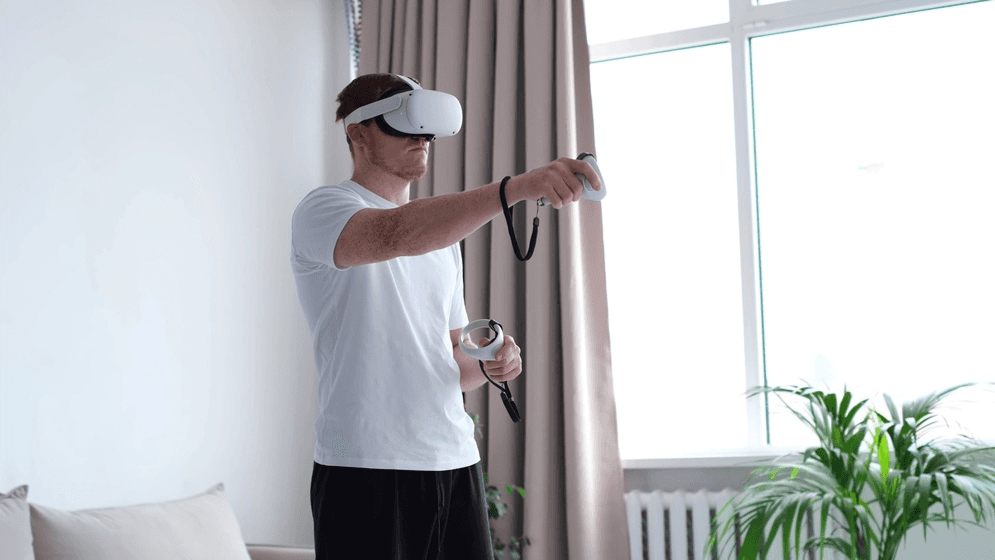
Tracks both - how you turn your head and where you move your body in the 3D world.
You can walk, crouch, reach, and lean like you would in real life.
Best for - Spotting hazards in a virtual space, learning how to work machines and reviewing designs in collaboration with others.
Why Degrees of Freedom Matter
Choosing between 3DoF and 6DoF depends on the extent to which people need to interact with the VR world. If it's just for looking around, 3DoF is fine. But if physical movement for behavioral accuracy is required, 6DoF is the way to go.
The VR DoF has a direct impact on how people pay attention and how much they remember. A 6DoF setup lets people actually play around with objects in the virtual world, which helps them think better and replicate real-world skills. For example, someone training on a 6DoF machine can walk all around it, bend down to get a close look, and practice using tools.
Why 6DoF VR Is a Game-Changer for Training
Active Engagement, Not Passive Watching: Traditional training often means watching videos or clicking through slides. With 6DoF VR, learners do. They move, interact, and respond, keeping focus levels high and distractions low.
Spatial Memory Boosts Retention: When trainees physically perform tasks in VR, they remember them better. Movements tied to locations and actions help embed learning deep into long-term memory.
Instant Feedback in a Safe Environment: Every action in the virtual world has a consequence just like in real life. This real-time feedback loop reinforces the right behavior while eliminating real-world risk.
Higher Recall vs. Traditional E-Learning: Studies show that VR-trained individuals outperform their e-learning counterparts in both retention and real-world recall, especially in high-stakes or safety-critical environments.
On the other hand, 3DoF VR is good enough for introductions, safety guidelines, and for learning through reading and hearing. It's also easier to set up fast, especially if you don't have a ton of room to work with.
CTA: Want to create VR solutions that take full benefit of 6DoF immersion?
Our team can help. From designing the simulations to figuring out the best way to use them, we partner with companies to help them train efficiently.
How to Choose the Right VR DoF
To figure out if 3DoF VR or 6DoF VR is the best option for you, keep these in perspective:
What you're training for: Go with 6DoF for physical jobs like working on an assembly line, finding hazards, or medical content (Source). Go with 3DoF for learning rules, practicing for different situations based on role, or telling stories.
What people need to do: Walk, lift material, or use hands?
What you've got: Do you have enough space and the right equipment for 6DoF?
How much you can spend: 3DoF is cheaper to use if it’s a larger group, especially if you're using phone-based VR.
Here’s a quick comparison to help you decide if you should go with 3DoF or 6DoF:
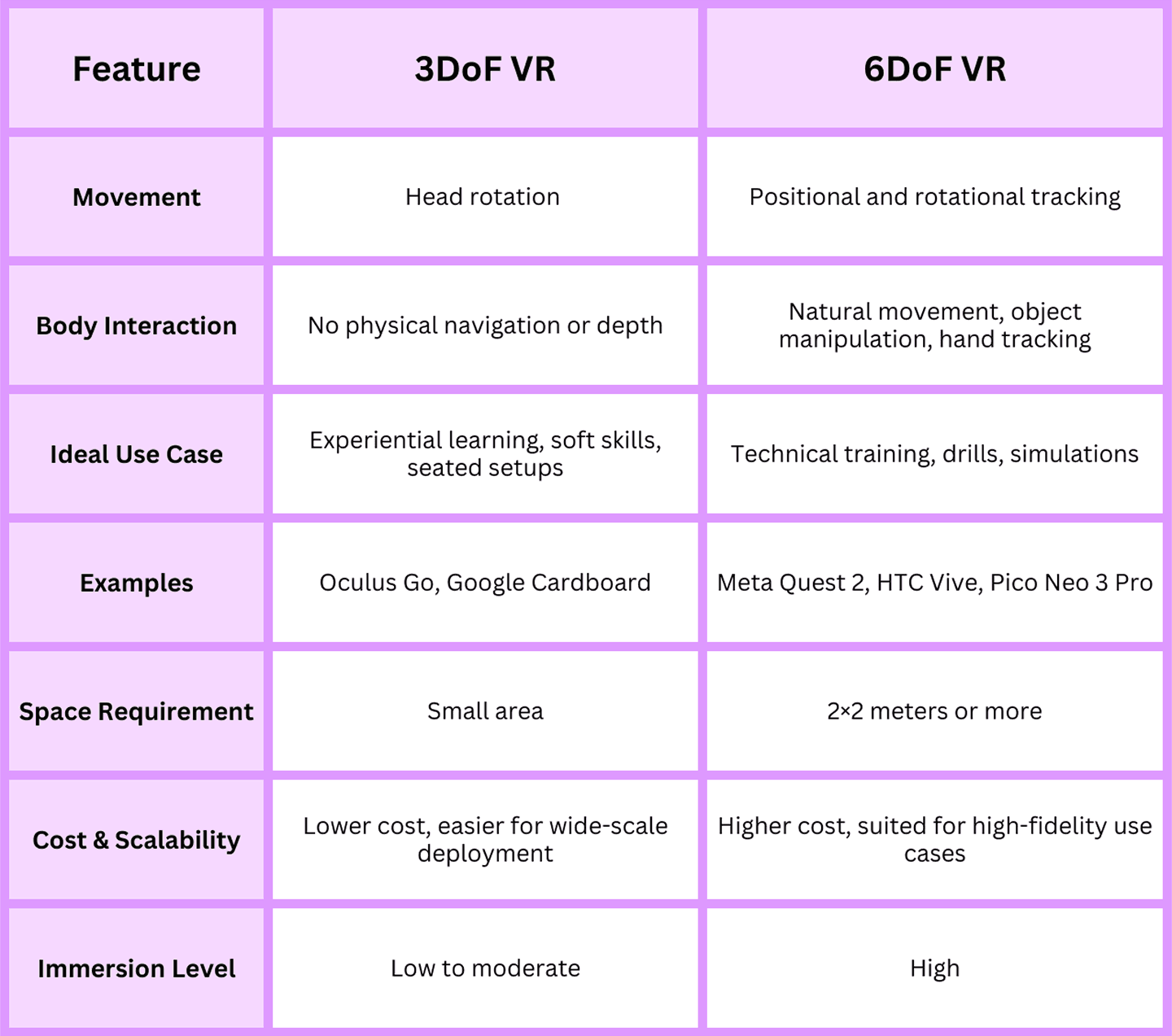
Companies often start with 3DoF and then switch to 6DoF when they need to do more complicated stuff and have more money.
What Makes 6DoF VR Work
To get reliable 6DoF VR, you need efficient motion tracking and well-made content. Here are some of the technologies enabling it:
Inside-out tracking: Headsets use cameras to see the room around you and track where you're moving (like Meta Quest, Pico 4).
Outside-in tracking: Uses sensors placed around the room to track your movement (like HTC Vive with SteamVR base stations).
Hand tracking and controllers: Lets you use hand tracking and controllers to grab and move objects naturally.
Software: Unity and Unreal Engine are the platforms that help make 6DoF VR more realistic and immersive.
Smart sensors: Gyroscopes, accelerometers, and cameras work together to track movements.
These technologies are getting cheaper and easier to move around, which means more and more industries are starting to use full-motion VR.
What's Next for VR DoF
In the future, VR DoF won't just be about tracking your head and hands. The industry is moving toward tracking your whole body, knowing what's around you, and using smart systems that change based on how you act.
Some trends to watch for:
AI that predicts movement for smoother, faster experiences.
Suits and haptic gloves that let you feel things all over your body, not just with controllers.
VR versions of the same thing that work on both 3DoF and 6DoF, depending on what equipment you have.
Spatial setups that mix AR/VR with real-world stuff.
As companies want to train and work together in virtual spaces, 6DoF VR is going to become standard.
In Conclusion
Degrees of Freedom is not as complicated as it sounds, it's simply about how people learn, play around, and get things done in VR. Whether you pick 3DoF VR for quick training or 6DoF VR to simulate real-world experiences, make sure you take into account the real life applications of the training program.
3 DoF VR is great for customer service problem solving, but an HVAC personnel might need the immersion of 6DoF VR to VR DoF matches what you're trying to achieve.
Need virtual reality HVAC training?
Explore how VR can transform HVAC training here.