What is Cognitive Load?
Cognitive load describes the amount of mental effort someone uses in their working memory at one time. It looks at how our brains handle information when we’re doing something new. In essence, it is about how the brain processes, stores, and applies information when faced with new tasks. Every task requires mental resources, be it reading directions, being taught a machine process, or interacting with a VR training space. When material is organized in a clear and logical way, learning becomes easy and efficient. But if the amount of information is too great, it exceeds mental abilities which can cause comprehension to suffer.
Understanding Cognitive Load Meaning
Cognitive load refers to how the mind allocates its restricted processing ability during cognitive tasks. To understand cognitive load and its meaning, one needs to appreciate the architecture of human memory. The model often contains three key components: sensory memory, working memory, and long-term memory. Sensory memory briefly holds incoming sensory information, while long-term memory stores previously retained data. Working memory is where active thought occurs, blending new knowledge with old material from long-term memory. Working memory is limited, and cognitive load theory is directly related to this constraint.
Types of Cognitive Load
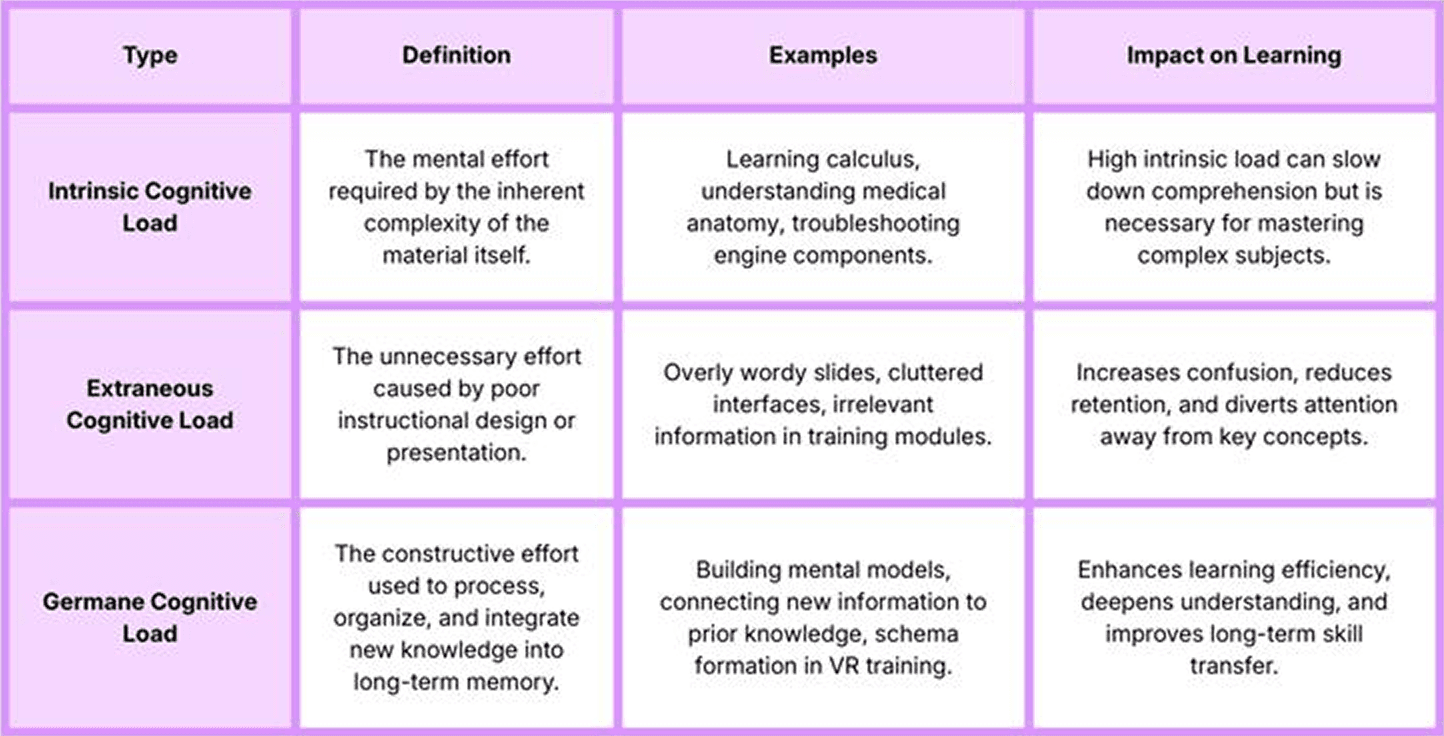
Cognitive load, a keystone concept in understanding learning processes, can be generally sorted into three main groups (Source).
Intrinsic Cognitive Load
Comes from the difficulty of the subject material itself. It’s the unavoidable mental effort needed to understand the core concepts. Complex subjects naturally demand more mental energy. For instance, grasping advanced physics needs more effort compared to memorizing basic vocabulary words.
Extraneous Cognitive Load
Comes from how the information is presented. Poorly designed learning materials, confusing interfaces, or disorganized presentations can create unnecessary mental clutter. This extra load takes away from the mental resources that could be used to understanding the actual material. Well-structured and clear presentation is essential to lower this type of load.
Germane Cognitive Load
Involves the effort learners put into creating mental frameworks and achieving long-term understanding. It's about actively processing information, relating it to prior knowledge, and building lasting knowledge structures. Educators and instructional designers aim to promote this type of load. This helps with deeper learning and retention.
Here’s a summary with examples:
Cognitive Load vs Cognitive Overload
When handled correctly, cognitive load can be helpful. But cognitive overload happens when too much info is given at the same time. Overload causes confusion, stress, and poor work. In VR training, this can happen if a simulation shows too many controls or instructions at once, which takes the learner away from what they should be learning. By knowing the difference between load and overload, companies can create learning situations that help people learn more and get annoyed less.
Why Cognitive Load Matters in VR and Training
In VR and AR environments, managing cognitive load is critical to effective learning. These systems create simulations that mirror real-world conditions. If not well planned, they can overwhelm users with too much sensory data. Creating a learning environment that fits into the human mind improves learning. In structured training environments and VR simulations, cognitive effort needs to be balanced so that learners are focused on key objectives rather than expending energy on irrelevant details.
Role in Learning and Retention
Research indicates that students understand ideas more quickly and remember them better when learning materials are simple and well-organized. When designing lessons, teachers should try to lower extraneous cognitive load to help students learn. By making the learning experience more focused and less mentally taxing, students are able to engage deeper with the material, build connections, and retain data for a longer time.
Implications for VR Simulations
VR training offers spaces that are both immersive and interactive, breaking down jobs into understandable steps. By cutting out extra distractions, the chance of mental overload is decreased, letting students focus better (Source). A good example is how pilots can use VR to safely practice flying protocols in a setting that doesn't have real-world dangers, which helps them learn faster.
Workplace Applications
VR training is now used in fields like healthcare, construction, and manufacturing to help people learn skills without feeling overwhelmed. For example, someone training in healthcare can learn the steps of a surgery one at a time, which helps them feel more sure of themselves. When learning isn't too hard or too easy, companies see fewer mistakes, people remember what they learned better, and workers are more prepared.
In these situations, handling workload helps people learn and boosts safety, productivity, and skill development over time in different job fields.
Designing with Cognitive Load in Mind
Instructional design, when thoughtfully planned with cognitive load in mind, helps make sure training is both useful and interesting for people. When creating teaching materials, it's important to think about how much information people can process at once. If there's too much, they might feel overwhelmed and not learn well. If there's too little, they might get bored and lose interest. The aim of good instructional design isn't to get rid of thinking, but to guide it in a good way. Instead of avoiding mental effort completely, the idea is to direct it toward activities and information that will really help in learning and retention (Source).
Principles for Managing Cognitive Load
To help designers and educators in ensuring that their content is not overwhelming, the following are a few steps that can be taken (Source):
Split big tasks into smaller, simpler steps.
Use pictures, charts, and visuals to make concepts easier to grasp.
Give immediate and constructive feedback, so people can fix mistakes quickly.
Cut out anything that is said more than once while providing instructions.
How VR Reduces Cognitive Overload
VR is naturally advantageous because it simulates real-world settings. Students can use common objects and environments, which decreases unnecessary burden. For instance, logistics workers who practice operating forklifts in VR can learn hands-on without having to read long instruction books. The immersive experience makes sure their mental focus is on doing the task instead of trying to understand complicated instructions.
When organizations put these design ideas into practice, they can create training that is interesting, works well, and is relevant to what happens in the real world.
The Future of Cognitive Load Research in VR Training
Cognitive load management is moving toward systems that adapt and learn. Platforms powered by AI are starting to watch things like eye movement, stress, and how quickly people respond to figure out how hard they are thinking. These systems might then change how hard VR training tasks are to keep people interested but not overwhelmed.
As VR training improves, cognitive load will be key to creating future learning tools. Groups that use adaptable systems will see workers learn quicker, remember more, and handle problems better.