What is 6DoF?
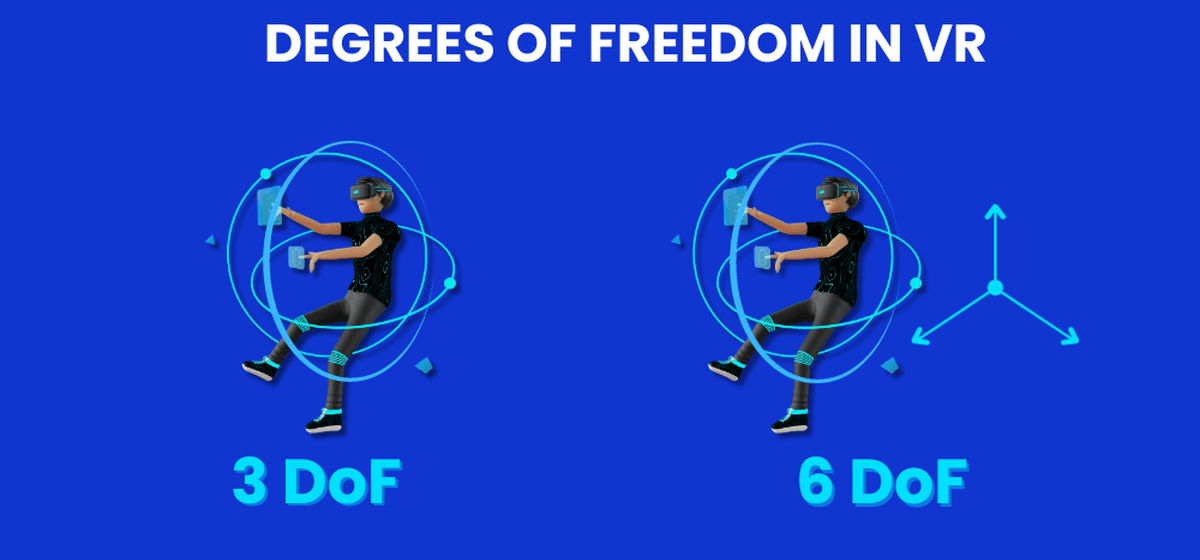
6DoF, or 6 Degrees of Freedom, is a system that can track movement and rotation in space. A VR setup with 6DoF lets you move in any direction and rotate smoothly. This makes VR feel real and natural, especially for training and simulations in business. 6DoF tracking offers a complete representation of user movement by combining orientation tracking with precise positional mapping. The result is a VR experience where your movements in the real world translate smoothly and naturally into the virtual one.
Understanding 6DoF and How It Works
A 6DoF sensor suite typically blends inertial measurement units, depth perception systems, and camera-based tracking. IMUs measure acceleration and rotation. Depth sensors or SLAM systems map what's around to figure out where the user is. Current 6DoF tracking uses inside-out vision, making it easier to set up and keeping it accurate. A number of enterprise headsets now use multiple cameras to keep tracking steady, even when the light or movement changes a lot. This shift from external beacons to onboard sensing has reduced complexity and improved overall stability.
6DoF vs Traditional Tracking Systems
VR systems have historically used simpler 3DoF tracking, which only measures rotational movement. While 3DoF works for seated or passive interactions, many enterprise applications require movement across a defined space. As training modules expand to cover procedures like assembly, navigation, and operational handling, the need for position-aware interaction becomes unavoidable.
Differences Between 3DoF and 6DoF Interactions
3DoF captures where the user is looking but not where they are located in the environment. In contrast, a 6DoF headset tracks both head direction and body movement within a mapped zone. That upgrade enables natural exploration and object manipulation. Think about a technician checking a control panel. They might lean in, move to the side, or kneel to get a better view. You just can't do that with 3DoF systems. This 6 Degrees of Freedom setup replicates how people actually move. It also helps workers build up muscle memory, which they can then put to use when performing the real task.
Hardware Components That Enable 6DoF
The jump from 3DoF to 6DoF depends heavily on hardware. Vision cameras, 6DoF sensors, and IMUs are embedded across the headset and controllers to estimate position with high precision. Some platforms use advanced SLAM algorithms; others have IR-based systems for dependable tracking in large industrial spaces. The precision of a 6DoF sensor impacts how effective the interactions are, mainly when people use virtual tools or collaborative workflows. As hardware gets better, companies want to make lighter designs, better thermal performance, and faster data fusion.
Real-World Use Cases Where 6DoF Provides an Advantage
Industries adopting VR for assembly training, safety protocols, and remote collaboration consistently choose 6DoF systems. Automotive OEMs use 6DoF headsets to evaluate ergonomic feasibility during design reviews. Construction teams employ 6DoF VR to walk through site models and identify hazards or design clashes. In manufacturing, operators rehearse equipment startup sequences using virtual panels that match the physical workflow. Each use case benefits from accurate spatial feedback, which strengthens decision-making and reduces risk.
With organizations moving toward simulation-first learning cultures, 6 Degrees of Freedom plays a key role in ensuring behavioral accuracy and operational readiness.
Enterprise Applications of 6DoF in VR
As VR gets integrated into how companies train employees, 6DoF systems allow for training programs that would be hard or unsafe to do in the real world. Companies that have remote workers or use complicated machines count on VR to provide reliable and consistent training to many people.
6DoF for Precision Safety Training
Safety teams prefer 6DoF VR because it allows trainees to navigate hazardous environments without real risk. A worker learning lockout-tagout procedures can perform each step in sequence and move around the virtual machine exactly as they would on the shop floor. Studies show that realistic spatial interaction improves hazard recall and speeds up onboarding cycles, supporting organizations in reducing incident rates (Source). A 6DoF VR scenario replicates both the posture and proximity required for safe execution.
6DoF in Design Review and Virtual Prototyping
Engineering teams use 6DoF VR to inspect models at full scale. Designers can walk around a prototype, evaluate reach envelopes, and validate usability. Because 6 Degrees of Freedom supports precise alignment of user position with the virtual model, teams catch issues early. Integrating 6DoF sensors with CAD and simulation tools helps reduce rework and shortens iteration cycles.
Tracking Accuracy and User Performance Insights
Training administrators value the data produced by 6DoF systems. Motion paths, dwell time, angles of approach, and spatial behaviors can be exported for assessment. These signals give instructors a clearer sense of whether the learner followed the correct procedure, maintained adequate distance, or worked with appropriate posture. Companies using data-driven learning see stronger performance predictability and more targeted interventions.
Enterprises adopting 6DoF VR gain more reliable measurement, more realistic task replication, and better behavioral insights that directly influence productivity.
The Future of 6DoF
6DoF tracking is improving through better SLAM, sensors, and AI, enabling faster and more stable performance. Advances in computer vision allow for detailed capture, useful for high- precision tasks like medical simulations. Multi-camera systems and depth-based mapping are getting more attention for handling challenging environments. AI helps 6DoF tracking by predicting movement and compensating for sensor limitations. Merging 6DoF with AI analytics can boost adaptive learning in various sectors. Manufacturers focus on headset weight reduction and easy setup, and they're testing wireless, high-resolution tech for comfy, longer use. 6DoF is going toward more intuitive systems and smoother integrations. This helps enterprises use VR training with greater confidence.
Ready to build high precision 6DoF VR training for your workforce?
Get in touch with AutoVRse to deploy spatially accurate VR at scale.