Back to Blog List

Why XR training fits how your workers actually learn

Why XR training fits how your workers actually learn

Think back to the last lecture you heard about a topic you care about. You may have left the lecture having understood all the important points. 

But can you recall every one of those points now?

Chances are, you can’t. Don’t worry, I bet neither can anyone else who attended the lecture.

Now think back to the last time you solved a critical problem at work. You may have used a new approach or technique that helped you.

But can you recall what you used now?

Chances are, you can.

Because we humans learn best through problem-solving.  Not through passive experience.

But our education system still relies on passive learning methods.  And it’s not restricted to schools and universities. Corporate training programmes have also followed the same approach. 

Fortunately, that’s changing.

Corporate training is evolving to fit how humans actually learn

Corporate training programmes are increasingly adopting XR (Extended Reality). XR—which is a collective term for VR (Virtual Reality), AR (Augmented Reality), and MR (Mixed Reality)—fits the actual cycle of human knowledge acquisition. 

Let’s rewind a few decades. 

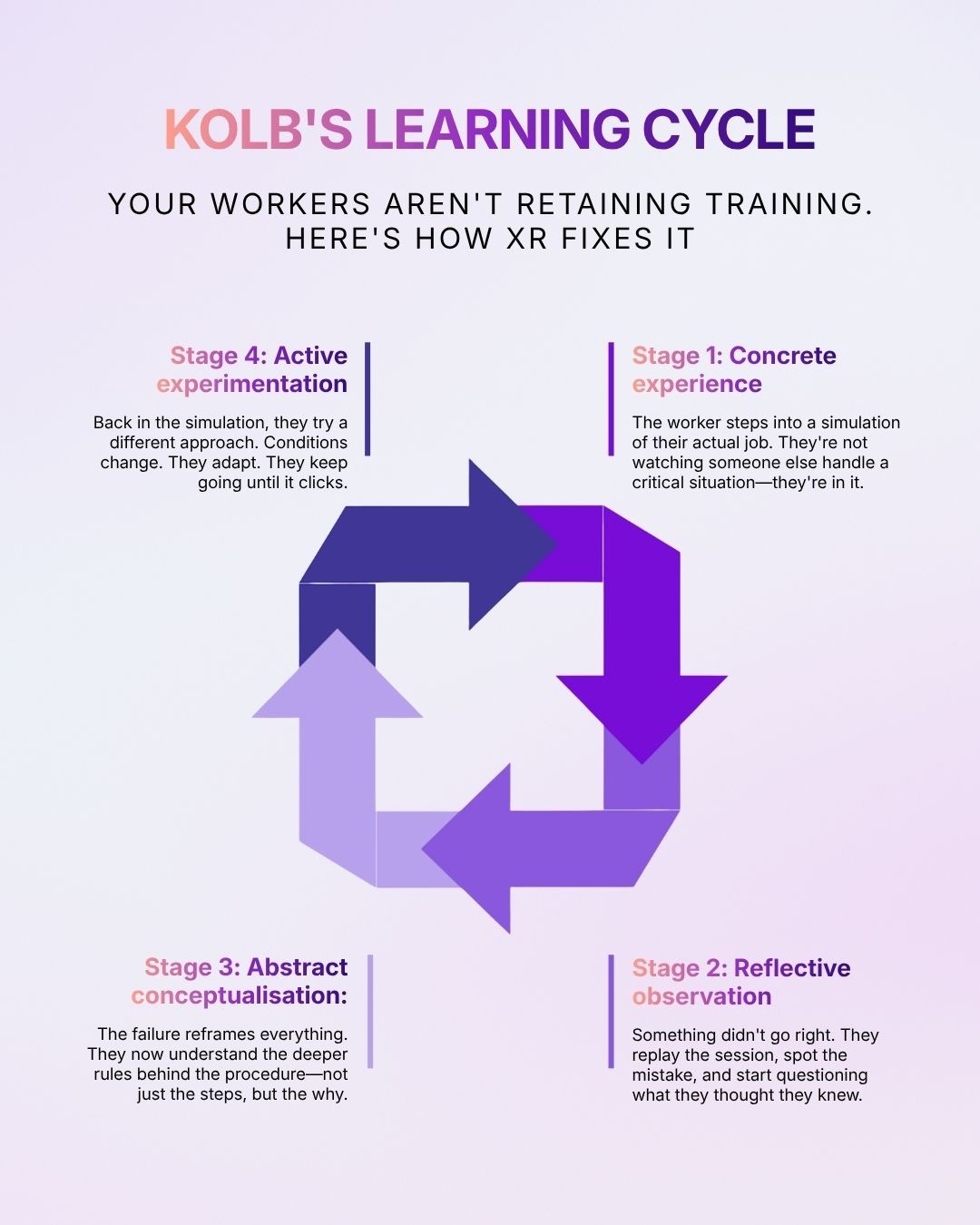
In 1984, American educational theorist David Kolb publicized his unified theory on how humans learn from their experiences. He outlined his observations into a 4-stage framework he named Kolb’s Learning Cycle:

XR fits seamlessly into all 4 stages:

Stage 1: Concrete Experience

Concrete experience is the learning experience a person undergoes. In a workplace context, it means your real-world exposure to a new problem—one that demands you to learn new information or build a new skill.

XR helps you give your workers the hands-on training, which is the best method to have the concrete experience Kolb’s talking about. You can let your workers practice the specific procedures they have to follow on their job. 

Let’s assume you want to teach one of your workers to deal with fire emergencies. You can use VR to recreate the events that unfold during a fire emergency. 

You now put Jordan, one of your new workers, inside the VR experience.  Once Jordan puts on the headset, he hears the fire alarm, sees the red strobe lights, and witnesses the increase in smoke once they wear the VR headset. 

Immediately, he grasps the gravity of the situation.

After listening to the instructions, Jordan understands he has to pick up the virtual fire extinguisher and follow the PASS technique to kill the fire. If Jordan successfully kills the fire in time, he passes. If not, he fails.

If Jordan were in a classroom lecture for fire safety, he would have seen the PASS technique as a sequence of images. 

Stage 2: Reflective Observation

Imagine Jordan fails. The fire remains, even after he accurately uses the PASS technique.

Jordan later watches a replay of his VR session and identifies the mistake he made: he didn’t pick the right fire extinguisher. The fire he saw was a Class D fire and required a dry powder fire extinguisher. He had instead grabbed the standard ABC extinguisher. 

This brings us to the second stage in the cycle, where the learner reflects on the learning experience they had. 

Reflection is the opposite of passive learning. Because when you reflect, you think about the subject and expand your current perspective on it. 

In Jordan’s case, his failure challenges his existing knowledge. His thinking models about fire and extinguishers don’t fit the learning experience he just had.

Stage 3: Abstract Conceptualization

The learner builds abstract models. They learn the higher-level rules; why and how things happen the way they do. They deepen their understanding of the subject.

To return to Jordan, he now understands: 

  • There are different classes of fire. 

  • How to identify each class of fire.

  • There are different types of extinguishers.

  • How to distinguish between these types.

Jordan now has a hypothesis of his own on what will work and what won’t. 

Stage 4: Active Experimentation

By now, the learner has come up with various strategies to try out, based on the knowledge they’ve acquired. It’s in this stage that they test them.

So, the next time Jordan is in the same VR experience, he experiments. He picks the dry powder fire extinguisher, kills the fire, and passes the training.

XR training also allows your trainees to fail without consequences

Suppose Jordan selects the dry powder extinguisher as planned, but the fire is of a different class from the one he saw first.  The failure would restart the learning cycle. Jordan reflects further, deepens his knowledge, and eventually becomes good at dealing with fire emergencies.
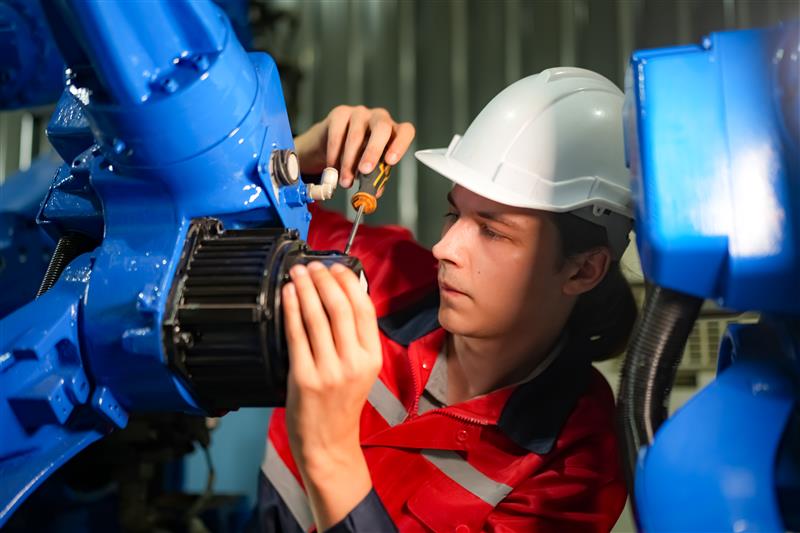
Expert assistance that is actually productive

Oftentimes, learning from an expert who knows more about the subject than you do helps you save time. 

Russian psychologist Lev Vygotsky called these experts we lean on, MKOs (More Knowledgeable Others). He also coined the term The Zone of Proximal Development, which is the gap between what you can learn alone and what you can learn with the help of an MKO. 

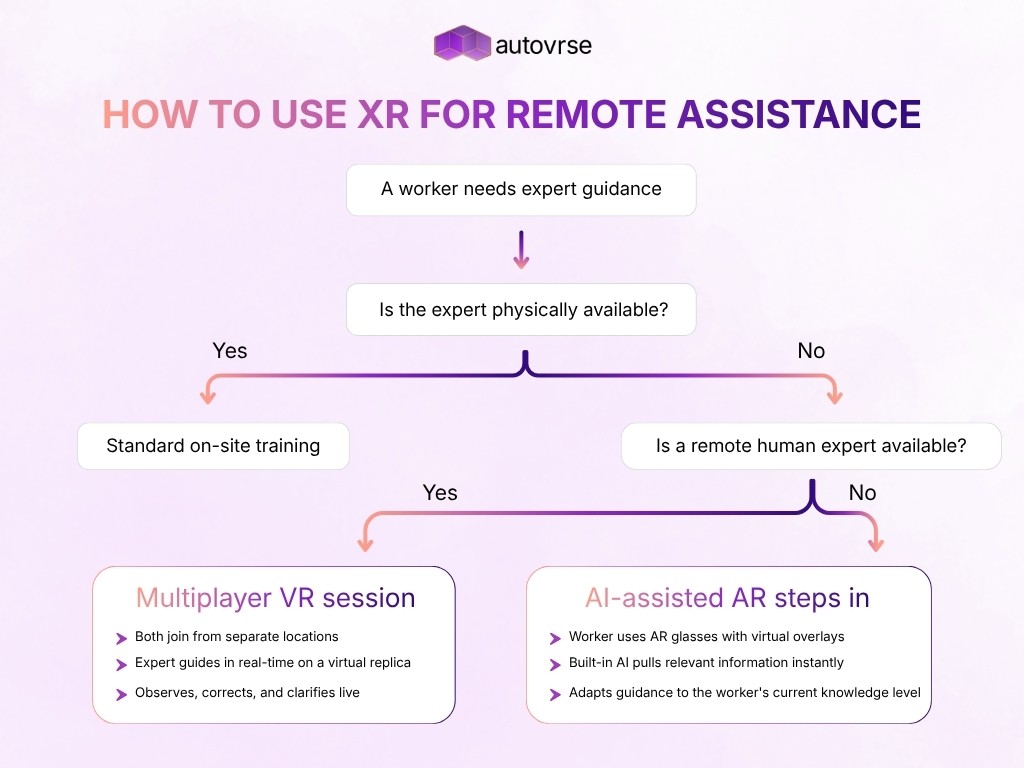
Imagine Marcus, a technician struggling to learn how to operate a rare machine. Leila is one of the few experts Marcus can learn from, but she is thousands of kilometres away on another assignment. Marcus has no option but to wait.

Now, imagine Marcus and Leila have access to a multi-player VR simulation of the same machine:

  1. Leila and Marcus join the VR experience from their respective locations.

  2. Leila guides Marcus in real-time on a virtual replica of the machine.

  3. Leila observes Marcus operating the machine, corrects his mistakes, and clarifies his doubts. 

For such remote assistance, the expert doesn’t have to be a human. It can be an AI. 

Consider a different scenario, where Leila must perform routine maintenance on the same rare machine. She wears AR glasses and uses virtual overlays to complete all the right steps.

However, Leila notices that this machine is an updated model and has a difference she hasn’t encountered before. Instead of hesitating, she chats with the built-in AI within the AR experience and asks it to pull up relevant information. Since the AI is trained on every manual, it returns the information Leila needs within seconds. 

Introduction of AI assistance into XR experiences ties into Vygotsky’s model of Scaffolding, which states: 

  1. To maximize learning effectiveness, you must tailor new information to the learner’s existing level of knowledge. 

  2. If the information you give the learner is too complex for them personally, they’ll retain nothing. 

AI is one of your best allies if you want to customize your learning experiences.  AI can tailor the assistance and knowledge it gives to your workers, based on their current level. 

  • To an expert like Leila, AI gives straightforward information. 

  • To a beginner like Marcus, AI simplifies the information into a less complex format sufficient to achieve his current goal.

Building competency long-term

How do you test a person’s competency in a subject or a skill?

Most people’s answer would be: standardized testing. You prepare a standard set of criteria, and the learner has to meet those criteria. They come across a question or problem and recall the relevant information or procedure that matches the requirement. 

However, retrieval isn’t only useful for measuring competency; It’s also useful for building competency.

Studies in recent years show that retrieval practice outshines other common modes of learning, such as rote memorization. The reason is that human memory is re-constructive, i.e., every time you retrieve a memory, you are creating it anew. Also, the more you practice retrieving a piece of information, the better you become at retrieving it later on—even if you are wrong the first time. 

Think of it like clearing a path through the wilderness; The more you travel the same path, the more worn out and easier it becomes to travel. 

Using an example, I’ll explain how XR can leverage retrieval practice. 

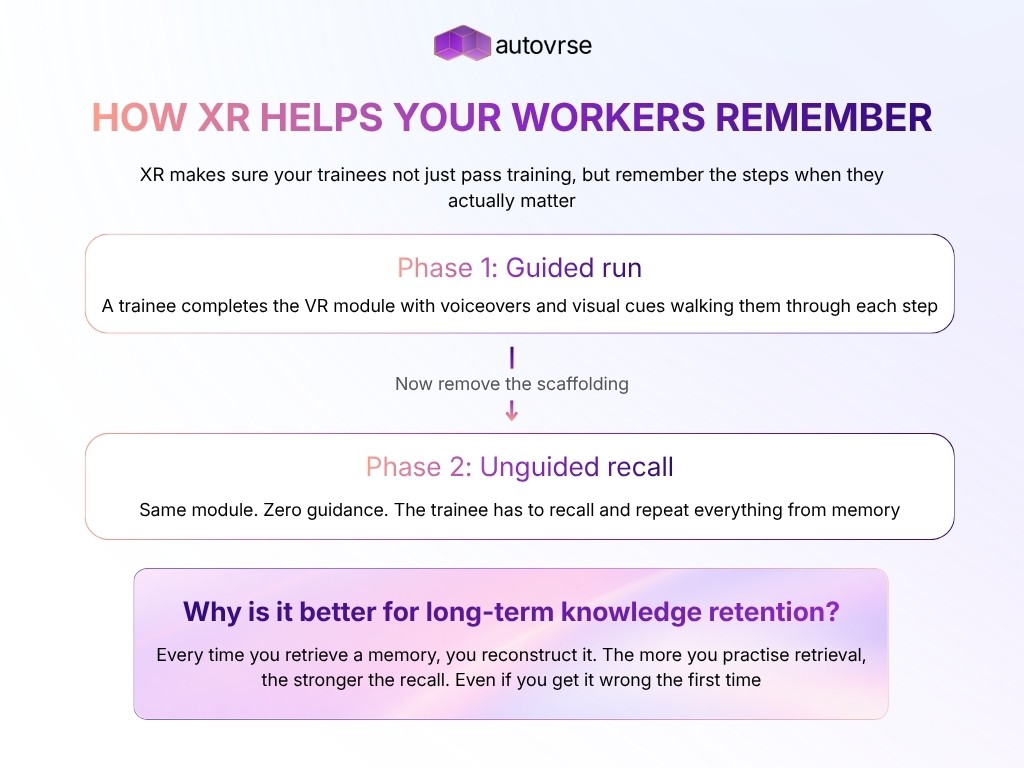
Suppose you want to train Avery to follow Sterile Techniques. You train Avery in your VR Sterile Techniques module, which guides her through the entire process with voiceovers and visual cues. She completes it successfully. 

Next, you ask her to repeat the same module—but this time, she gets zero guidance. Avery has to recall what she just learned and try to repeat everything she just did. 

Even if Avery fails in her first try in the unguided mode, she’ll gain a better understanding of Sterile Techniques. She’ll fail a few times and eventually master the procedures.

Since XR enables unlimited practice, Avery can repeat the process until she meets your proficiency standards.

Learning that drives outcomes

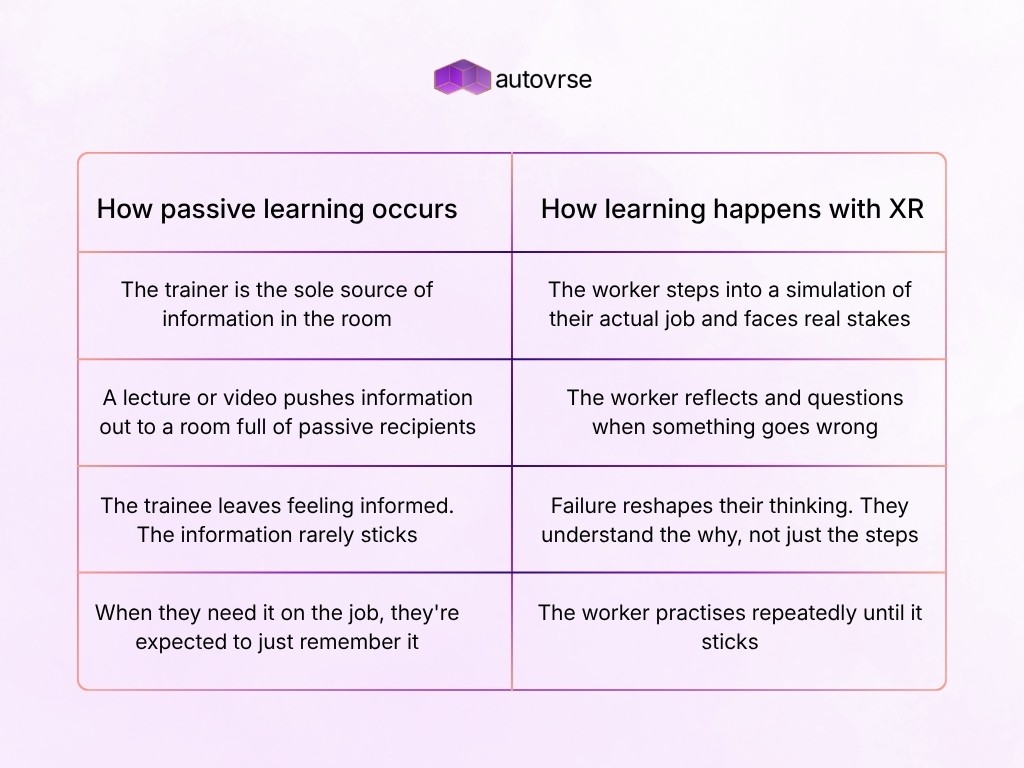
Our present training methods approach learning as if it were the same as file transfer between computers.

  1. The trainer has certain valuable information in their memory.

  2. Through lectures or video sessions, they transfer the information to multiple trainees. 

  3. This information is then stored in the trainees’ hard drive, i.e, long-term memory, forever. 

  4. If the trainee requires the information in the future, they can just access their memory to retrieve it. 

Easy. 

But this facade of learning falls like a castle of cards the moment your trainees face an actual problem. The information they’ve passively listened to was never recorded in their long-term memory. It left their minds hours after they left the lecture hall.

If you want to ensure someone retains the information they’ve learned, you have to make them actively learn the material.

XR-based methods are ideal for this. You can teach your trainees by making them do the actual procedures they have to use in their job.

Because who would you rather have? Workers who know the right steps? Or workers who follow the right steps?

Let’s talk about

Let’s talk about

Let’s talk about

your training

your training

your training

Talk to our team to learn how to implement VR training at scale

Talk to our team to learn how to implement VR training at scale

Talk to our team to learn how to implement VR training at scale