Back to Blog List

How XR Is Accelerating Breakthroughs in Automotive Research and Development

How XR Is Accelerating Breakthroughs in Automotive Research and Development

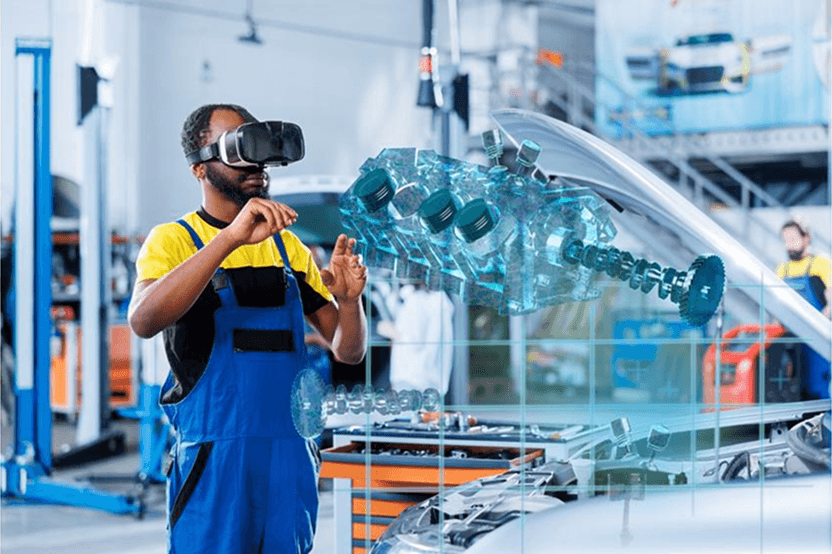
Extended Reality is changing how automotive Research and Development teams design cars, test prototypes, and study how engineering works way ahead of building physical models (Source). As car makers face rising pressure on cost, safety, and development speed, using XR in the automotive industry is helping teams make faster, more accurate engineering decisions.

This article explores how XR is transforming automotive R&D processes, the technologies driving that shift, and the tangible impact on vehicle development.

What R&D Challenges Are Auto Manufacturers Facing Today?

Automotive R&D teams juggle evolving powertrains, connected systems, regulatory requirements, and safety validation, all under the pressure to adhere to strict deadlines. Traditional prototyping struggles to keep pace. Each physical build is expensive and time-consuming, and design, engineering, and QA teams frequently operate from different tools - leading to rework and slow decision cycles.

Teams leveraging XR in the automotive industry gain the speed and spatial clarity needed to rethink early-stage workflows. As immersive tools complement CAD and CAE, teams can evaluate design feasibility much earlier - reducing costly downstream rework.

How Does XR Enhance Automotive R&D Processes?

Automotive R&D demands thorough evaluation of geometry, ergonomics, manufacturability, and performance. XR changes how that evaluation happens - making it earlier, more spatial, and more collaborative.

Here are the three core process improvements teams see when using XR for automotive engineering.

More Immersive Concept and Design Exploration

With VR in vehicle design workflows, teams immerse themselves in full-scale digital models and evaluate proportions, sightlines, and ergonomics well before any physical clay is cut.

Picture a styling team reviewing three SUV roofline variants in a single session, walking around each variant at 1:1 scale, comparing surface tension, headroom, and rear visibility in real time. 

What would require three separate foam models and weeks of build time now takes an afternoon. Feedback is captured immediately, and geometry decisions are locked in earlier. 

Reducing ambiguity, accelerating design maturity, and keeping the work aligned with manufacturing constraints from the start.

Better Synchronization Between Design, Engineering and QA

Traditional visualisation tools often fail to convey the spatial and functional nuances that engineering teams need. XR for automotive engineering lets stakeholders observe component relationships, check assembly feasibility, and validate subsystem integration in a shared environment.

Consider a powertrain integration review where a mechanical engineer, a body designer, and a QA lead all step into the same virtual vehicle model. The engineer flags a clearance issue around the battery housing. The designer proposes a revised floor tunnel geometry on the spot. The QA lead annotates the revised section directly. All three walk away aligned - no email thread, no follow-up meeting required.

Quality teams also use AR for automotive prototyping to overlay digital instructions on early components, ensuring alignment between model intent and the physical build and catching inconsistencies before they become expensive corrections.

Faster Iteration Cycles Without Full Physical Builds

Physical prototypes remain essential but they should not be required at every iteration. Virtual car testing gives teams an accelerated pathway to check feasibility and explore configurations before committing to materials (Source).

An aerodynamics team, for instance, can simulate twelve diffuser configurations in a single session. The team can be testing drag coefficients, underbody airflow, and cooling inlet performance all in an immersive environment. 

Traditionally, each configuration would require a physical wind tunnel model. With XR, that exploration happens digitally, so physical builds are reserved for final validation rather than early-stage comparison. The result: faster iteration cycles, fewer production delays, and more design options explored within the same budget.
How Automotive Teams Use XR Throughout the R&D Cycle

Automotive development moves through defined stages - styling, prototyping, testing, and manufacturing readiness. Automotive innovation XR strategies bring a different tool to each stage: VR for immersive evaluation, AR for real-time field guidance, and Digital Twins for physics-informed simulation.

Together, these tools give teams an end-to-end view of vehicle development while reducing uncertainty at every milestone and improving confidence before production commitments are made.

Styling and Design

VR for automotive R&D gives designers full-scale digital environments to examine vehicle proportions, lighting behaviour, and surface continuity. Multiple configurations can be loaded and compared instantly without rebuilding a single physical model.

Colour and trim teams experiment with material selections digitally, eliminating physical sample boards. Early design validation becomes interactive as stakeholders experience concepts in context rather than reviewing static renders.

Prototyping

AR for automotive prototyping overlays engineering instructions, annotations, and component relationships directly onto physical parts. Assembly teams use these overlays to verify wiring layouts, check body fitment, and catch spatial interferences - without relying on static blueprints.

Engineering changes are reviewed faster, documentation cycles are shorter, and the number of physical prototype iterations required drops significantly.

Testing

Virtual car testing supports aerodynamics studies, driver-in-the-loop simulations, and crash analysis. XR for crash simulation allows teams to examine deformation patterns, energy absorption, and passenger compartment integrity - without multiple destructive physical tests (Source).

Digital twins in automotive R&D go even further, replicating real vehicle behaviour using sensor data, physics engines, and AI-driven prediction. Teams validate structural performance, thermal responses, and powertrain behaviour before any hardware is built. 

This drastically reduces physical test dependency while expanding test coverage.

Manufacturing R&D

Before assembly lines are commissioned, manufacturing teams use XR to validate line layouts, worker ergonomics, and equipment positioning in a fully simulated environment.

This ensures process safety and efficiency are validated before any physical infrastructure is built, reducing costly reconfiguration after installation.

What Gains Can Automotive R&D Teams Expect From XR?

Beyond improving how processes work, XR delivers measurable business outcomes. Manufacturers adopting XR report improvements in speed, cost efficiency, and engineering accuracy, all with a direct impact on development timelines.

Using XR in the automotive industry also unlocks new predictive capabilities such as helping engineering teams anticipate risk and reduce bottlenecks before vehicle programs enter pre-production.

Significant Reduction in Prototype and Material Spend

Physical prototypes are among the highest-cost elements of automotive R&D. XR allows teams to evaluate geometry, assembly behaviour, and component fitment without committing to materials.

This reduces the number of prototype cycles required and optimises resource allocation across programs that helps allocate more resources for higher-value late-stage validation.

Faster Movement From Concept to Test-Ready Model

Immersive visualisation shortens the distance between conceptualisation and functional evaluation. Teams can perform rapid checks on ergonomics, safety, and manufacturability well before physical engineering begins.

This reduces the time spent on back-and-forth model validation. Compressing the production cycle from initial concept to engineering approval.

Improved Pre-Production Safety and Performance Accuracy

Digital twins and VR-based crash simulations surface insights on crash behaviour, thermal responses, and structural performance earlier than traditional methods allow.

These insights strengthen safety decisions and improve engineering confidence well before regulatory validation phases begin.

Greater Innovation Velocity Across Distributed Teams

Distributed teams can collaborate inside shared virtual simulations regardless of location, thereby eliminating the delays and misalignments common in asynchronous review cycles.

By sharing immersive evaluations, teams reach consensus faster and advance programs with fewer scheduling constraints and accelerating the overall pace of innovation.

Key Considerations Before Adopting XR in Automotive R&D

Deploying XR in automotive R&D requires more than selecting the right headset. Manufacturers should evaluate model fidelity, data compatibility, and security requirements before scaling deployment.

Addressing these factors early and ensuring alignment between software ecosystems, engineering teams, and IT policy, allows manufacturers to scale XR confidently across engineering domains.

Engineering-Grade Precision of Simulations

Automotive engineering depends on millimetre-level accuracy. XR tools must match the geometric and physics precision of CAD and CAE systems to support reliable decision-making.

Virtual models that do not reflect actual engineering considerations and tolerances introduce risk during design reviews, making simulation fidelity a non-negotiable prerequisite.

Compatibility With CAD/CAE Tools

XR platforms should integrate seamlessly with existing CAD and CAE tools to avoid redundant data preparation (Source). 

Data pipelines must support real-time conversion, version control, and large-model visualisation to maintain engineering continuity across tools.

IP and Data Protection for Confidential Vehicle Models

Vehicle programs contain some of the most commercially sensitive data in manufacturing. Unreleased model geometry, proprietary powertrain data, and safety test results must be protected across every device and network the XR system touches.

XR platforms must incorporate encryption, secure access controls, and robust device management protocols before any confidential engineering assets are loaded into a shared environment.

Conclusion

XR has become a strategic advantage for automotive R&D teams aiming to accelerate design maturity, reduce prototype cycles, and improve engineering confidence before production.

As vehicle complexity increases, the role of using XR in the automotive industry will continue to expand - supporting faster breakthroughs and more innovative mobility concepts (Source).

Interested in building XR capabilities for your automotive engineering teams?

Speak with the AutoVRse specialists for customised recommendations.

FAQs

1. How reliable are virtual crash tests?

Virtual crash tests have become increasingly reliable, driven by digital twin technology and physics-based simulation models. When calibrated with sensor data, they accurately replicate deformation patterns, force distribution, and occupant safety responses.

While physical crash tests remain essential for regulatory sign-off, virtual testing significantly reduces the number of destructive builds required and helps teams validate more scenarios earlier in development.

1. How reliable are virtual crash tests?

Virtual crash tests have become increasingly reliable, driven by digital twin technology and physics-based simulation models. When calibrated with sensor data, they accurately replicate deformation patterns, force distribution, and occupant safety responses.

While physical crash tests remain essential for regulatory sign-off, virtual testing significantly reduces the number of destructive builds required and helps teams validate more scenarios earlier in development.

1. How reliable are virtual crash tests?

Virtual crash tests have become increasingly reliable, driven by digital twin technology and physics-based simulation models. When calibrated with sensor data, they accurately replicate deformation patterns, force distribution, and occupant safety responses.

While physical crash tests remain essential for regulatory sign-off, virtual testing significantly reduces the number of destructive builds required and helps teams validate more scenarios earlier in development.

2. Can XR support EV battery and thermal R&D?

2. Can XR support EV battery and thermal R&D?

2. Can XR support EV battery and thermal R&D?

3. Is XR useful for autonomous vehicle research?

3. Is XR useful for autonomous vehicle research?

3. Is XR useful for autonomous vehicle research?

4. What hardware do auto companies need to get started?

4. What hardware do auto companies need to get started?

4. What hardware do auto companies need to get started?

Let’s talk about

Let’s talk about

Let’s talk about

your training

your training

your training

Talk to our team to learn how to implement VR training at scale

Talk to our team to learn how to implement VR training at scale

Talk to our team to learn how to implement VR training at scale