Back to Blog List
Back to Blog List

The need for VR work at height training in oil and gas

The need for VR work at height training in oil and gas

Work-at-height incidents in oil and gas operations carry consequences that extend far beyond the immediate injury or fatality.

Imagine a height-related hazard happens. The incident leads to a chain of events across the entire operation.

  • Immediate impact: Medical response and evacuation (tens of thousands offshore). Production shutdown across connected operations.

  • Extended impact: Regulatory involvement with potential high penalties. Legal proceedings stretching months or years.

  • Hidden costs: Crew morale drops, insurance premiums may rise. Total costs often far exceed the direct expenses.

Oftentimes, the core issue behind such costly incidents is the lack of procedural understanding that workers have. Sure, they’ll have a theoretical foundation. But would lack mastery of the actual steps.

Translating that theoretical knowledge into confident action is a challenge to existing systems. 

But not to VR.

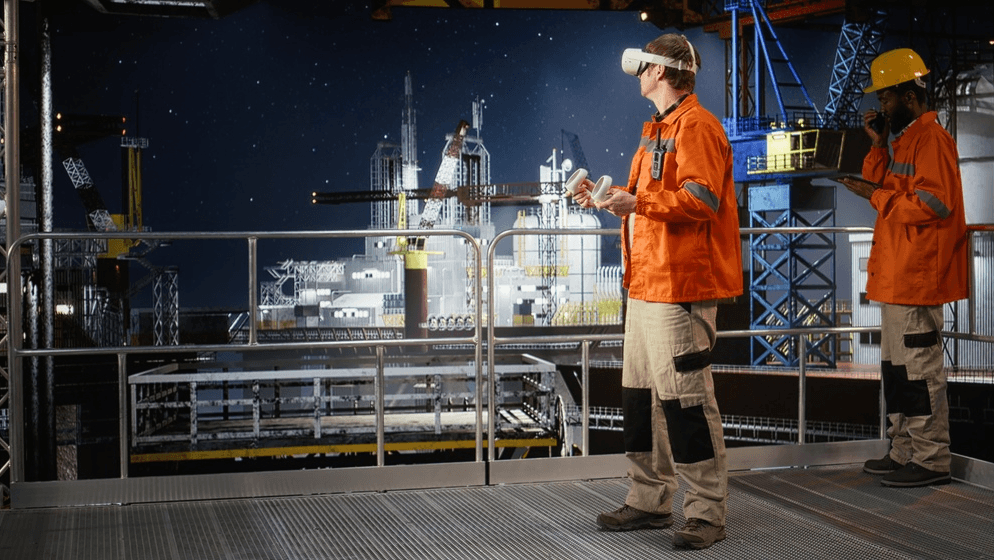
VR helps workers immerse themselves in the actual working conditions and execute the exact steps required to work safely at heights. It helps build the critical muscle memory that needs to kick in when faced with an actual hazard.

In this blog, we’ll explain how virtual reality work at height training for oil and gas sector can help improve existing outcomes. First, let’s turn towards the issues that plague working at height in oil and gas facilities:
Ready to build genuine height safety competence? Explore our AI-powered work at height module. 

See the module

Height safety challenges in oil and gas operations

Oil and gas work environments create height challenges that typically don’t exist in a lot of other industrial settings. This adds additional complexity to an activity that is already high-risk:

Offshore platforms

The platform itself moves with wave action. Workers have to manage fall protection while the surface beneath them shifts. Exposure to weather, which is often extreme, is constant. Evacuation options are also limited.

Refinery towers and columns

Workers have to navigate tight vertical spaces. Complex piping creates obstacles during climbs and horizontal movement. Also, hot processes run nearby. 

Drilling derricks

Heights regularly exceed 100 feet. Equipment moves constantly during operations. Also, there's no pause button on drilling operations.

Storage tanks

Workers face full weather exposure on these open structures. A routine inspection can mean hours at elevation with limited rest opportunities.

Why existing systems fall short when it matters most

Current height safety preparation methods lead to significant gaps between what workers know and what they can actually do. Unfortunately, these gaps show up when it matters most; under pressure, in real conditions.

The knowledge-to-execution gap

Current systems don’t allow workers to practice emergency scenarios safely in their actual work environments.

Workers can explain the steps, pass the tests, and demonstrate at ground level. But when it comes to the actual task, such as attaching carabiners with cold hands and repositioning lanyards around obstacles, they lack the skills.

The consistency challenge

Multi-site operations lack unified standards. One site emphasizes certain procedures, another focuses on different aspects.

Geographic distribution complicates the situation. There are often different trainers, different equipment, and different norms.

The result? The workforce receives inconsistent preparation across different sites.

The assessment limitation

There's no comprehensive way to verify readiness before workers face actual height situations. The observation-based assessments currently used provide limited data points. A trainer watches one or two climbs in controlled conditions and has to certify the worker.

Hence, the gap between "completed training" and "ready to perform safely" remains unmeasured.

The retention reality

A worker completes height training, then doesn't work at elevation for two months. When the assignment comes, procedures feel distant in memory.

Infrequent height work means procedures aren't reinforced through practice. There's no accessible way for workers to refresh capabilities between assignments.

As time passes between learning and application, skills decay.


How implementing VR work at height training in oil and gas operations solves this

How implementing VR work at height training in oil and gas operations solves this

VR training closes the gaps that existing systems leave open. It focuses on making your workers arrive at height with muscle memory, and not just mental recall.

Experiential learning that builds real competence

Workers practice the actual sequence: PPE selection, barricade placement, harness donning, lifeline attachment, climbing, horizontal traversal. They repeat it until their hands move automatically.

The physical repetition builds procedural memory that activates under pressure. The hesitation gap disappears because the body actually knows what to do when faced with the situation.

Moreover, the repetition happens without risk or operational disruption. No trainers are tied up. No equipment monopolized. No access restrictions to actual structures.

Realistic oil and gas environments

Implementing VR work at height training in oil and gas operations means you can recreate your exact offshore platforms and other environments. This means workers build spatial familiarity with their actual work environment before they ever climb the real thing.

As a result, when they face the actual structure, the cognitive load drops. Uncertainty decreases because they've already been there.

Also, site-specific procedures replace generic scenarios. No translation step between general training and specific site requirements. Fewer errors from misapplication.

High-stakes scenario training

Workers rehearse life-saving responses they'll never get to practice in real environments. Without any actual dangerous situations being created.

Team-based rescue operations are also possible in VR. Coordination and communication protocols can be practiced until they’re second nature. Meaning, everyone knows their role and everyone understands the right sequences.

Objective competency measurement

In VR, every action can be tracked. The system can identify specific capability gaps for individual workers before they face real heights.

Operations and safety leadership can assess readiness across the entire workforce. Crucial assignments can be made based on demonstrated competency, not impulsive assumptions about preparedness.

The data also makes compliance documentation a less burdensome endeavour. Administrators can prepare detailed reports with concrete evidence for audits and investigations.

Scalability across operations

Implementing VR height safety training in oil and gas means standardization happens across all rigs, refineries, and pipeline sites. Regardless of location, every worker gets the same preparation.

In addition, procedure updates reach every worker simultaneously across all locations. Meaning everyone operates from the same current procedures. The version inconsistencies that are often dangerous become non-existent. 

Building true height safety mastery

The implementation of VR work at height training in oil and gas companies changes the question from "Do they know the procedure?" to "Can they execute it safely under real conditions?"

Because VR training bridges understanding and capability. Post-training, the workers have muscle memory, not just mental recall.

Operations leaders don’t have to hope that workers remember their training. They know their workers are ready. They have the data to show it.

The gap between certification and capability closes. Height work stops being a persistent vulnerability. It becomes an operational strength.

Safety culture strengthens when workers feel genuinely prepared. When they trust their capability when they're 90 feet up.

Our work at height VR training module closes the gap between knowing procedures and executing them safely.

See all modules

Let’s talk about

Let’s talk about

Let’s talk about

your training

your training

your training

Talk to our team to learn how to implement VR training at scale

Talk to our team to learn how to implement VR training at scale

Talk to our team to learn how to implement VR training at scale