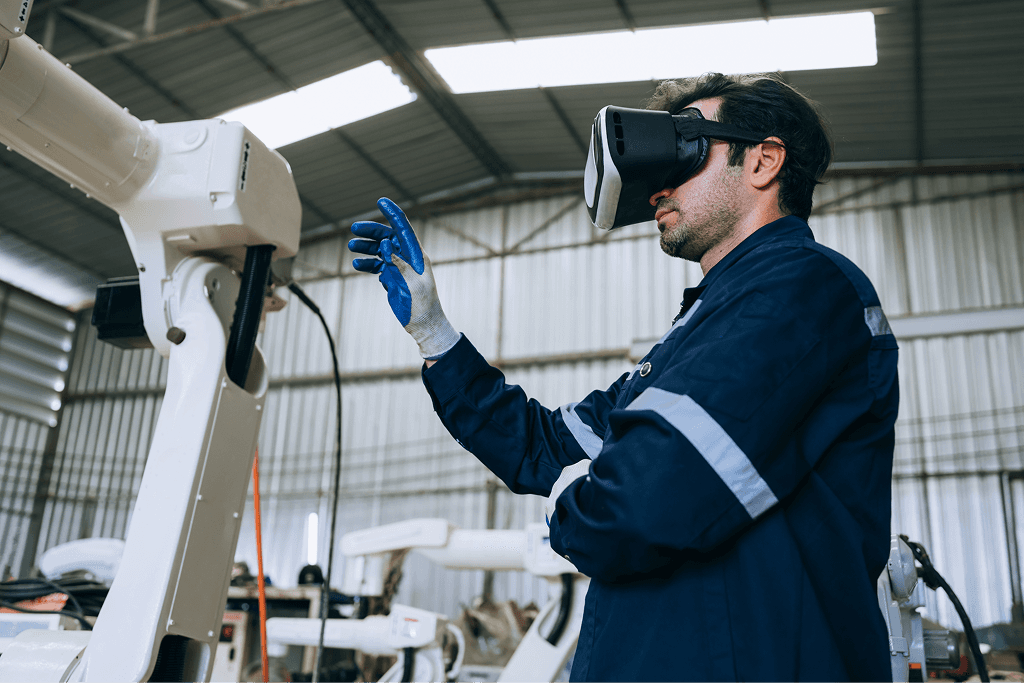
VR training addresses the experience gap by adding what traditional methods can't provide: realistic, repeatable practice in a completely safe environment.
Let’s have a look at how it works in practice:
Realistic practice without physical risk
Picture this: A worker puts on a VR headset and finds themselves on an elevated platform that looks and feels real. The ground is 30 feet below them. There is equipment surrounding them. The layout is a replica of their actual workplace facility.
In the experience, the worker feels the actual sensations of working at height: the vertigo, the need for spatial judgment, and minute physical maneuvers necessary to handle safety equipment. However, even if they make a mistake, like disconnecting at the wrong time or forgetting a crucial step, there's zero physical risk to them.
In short, in VR, they can fail safely. And that's where real learning happens.
Unlimited repetition builds muscle memory
With VR work at height training, a manufacturing worker can practice the same elevated platform traversal steps multiple times in a day.
They can repeat the ladder climbing sequence until the connection and disconnection of lifelines becomes automatic to them. They can cycle through emergency scenarios until their responses become instinctive to them.
Meaning, workers simply practice until the procedures become muscle memory.
All this with:
No equipment tied up.
No trainers required to supervise every repetition.
No production schedules impacted.
Facility-specific customization
For work at height training to be actually impactful, you need to let workers practice in conditions that match the ones they’ll encounter.
VR can recreate the exact layouts of your facilities, the specific equipment you have, and your site-specific procedures. Also, your workers don't train on a generic elevated platform, but on the virtual replica of the actual platform they'll be working on.
In the VR experience, they:
Learn where your anchor points are located.
Practice your specific barricading protocols.
Navigate your actual spatial constraints.
Post-training, when they finally step into your real environment for the first time, it's already familiar to them because they've already been there.
Consistent training at scale
If different facilities and trainers teach their own work at height procedures, it becomes hard to deliver the required results.
Implementing VR work at height training in manufacturing environments can ensure all your workers receive the same, high-quality training based on your specific standard operating procedures.
Their shift, facility, or joining date is irrelevant in this scenario. The training is the same.
VR training is also adaptable. Suppose you update your work-at-height training procedures. You can update the experiences and make them reflect across your entire training ecosystem. Everyone, regardless of location, trains on the updated procedures.
Measurable readiness and compliance
One benefit of implementing VR height safety training in manufacturing companies is that you can track everything. By everything, we mean metrics like:
The time each procedure took for completion
Location of errors within the training experience
Number of practice attempts needed
You can capture all this data (and more), and review it to identify areas of improvement. The data can help you track improvement over time and make decisions about the readiness of workers to use real equipment.
You can also document data on training on completion for regulatory compliance.