When most people hear "VR in business," they immediately think of training programs. Headsets in conference rooms, employees learning procedures, and some safety simulations.
And yes, VR works well for training. But that's not the entire story.
Top brands have figured out other interesting VR use cases in FMCG. They're using VR to increase sales in retail showrooms, create memorable brand experiences at trade events, prevent costly production downtime, and speed up warehouse operations during peak seasons.
They’re using VR for solving business problems that cost real money or generate real revenue.
This post walks you through seven of these use cases and a few real-world examples that show how FMCG companies use VR for business impact.
Use case 1: Virtual stores
Physical retail is facing real pressure from e-commerce. Foot traffic is dropping, showrooms are sitting empty, and the question now is: why maintain expensive retail spaces at all?
For some FMCG brands, the answer isn't to abandon physical retail entirely. It's to make the showrooms worth visiting. This is one of the most compelling virtual reality use cases in FMCG.
VR can turn a traditional showroom into an experience center. Instead of restricting themselves to displaying products that fit in the space, retailers can let customers explore entire product ranges. Customers can see different configurations and interact with features that would be impossible to demonstrate physically.
Let’s take the case of IFB. IFB saw the opportunity to reimagine their retail presence rather than shrink it. Working with us at AutoVRse, they deployed VR experiences for their showroom network. The experiences let customers explore product features and room setups that would never fit in a physical space.
The numbers revealed the impact: showrooms running VR saw sales climb 40% in a single quarter. Even more revealing, customers returned with loved ones to let them try the experience too.
In effect, the showroom became a destination, not just a transaction point. That's the kind of retail strategy that makes physical space an asset again rather than a liability.
Use case 3: Product prototyping and packaging visualization
Packaging decisions usually happen through a series of mockups, presentations, and eventually physical prototypes. Teams look at flat designs on screens, try to imagine how they'll look on shelves, and hope they've made the right call before committing to production.
However, this is an expensive process with limited ability to test real-world performance.
VR is now helping change this process. You can actually let your design teams place virtual products on virtual shelves at actual size, with real lighting and competitive products around them. Decision-makers can walk down a virtual aisle at customer height, see how the packaging performs from different angles, and test multiple variations.
The business case is straightforward. Each iteration adds weeks to the timeline and thousands to the budget. More importantly, teams often can't evaluate the most critical factor until it's too late: how the package actually performs on a retail shelf surrounded by competitors.
VR lets marketing, design, and sales teams align on packaging decisions while looking at the same spatial reality, not trying to imagine it from 2D renders. The result is better packaging decisions, fewer expensive do-overs, and products designed for shelf impact rather than conference room approval.
Use case 4: Production line training
Production lines don't stop for training. Every hour you spend teaching a new operator on actual equipment is an hour of lost output.
The current training approach creates a dilemma. You can either train people slowly and carefully while production suffers. Or you can rush them through and deal with mistakes, equipment damage, and safety incidents later on.
Leveraging VR for FMCG industry operations eliminates this headache by moving training off the production floor entirely. You can let workers learn machine operation, troubleshooting procedures, and complex sequences on virtual equipment. Through repeated practice, workers gain competency so that by the time they reach the actual production line, they've already done the work dozens of times.
ITC’s VR training deployment with us is a good example of this. ITC partnered with AutoVRse to build VR training for biscuit packer machine operators at their Bangalore facility. The packer machine handled two different types of biscuits: sandwich and shell. In VR, ITC operators learned procedures, including changing between the two biscuit types.
Such an approach helps you scale training across shifts and facilities without pulling your experienced operators away from their work. Most importantly, production keeps running while new people get up to speed.
Use case 5: Warehouse training
Warehouses operate under constant pressure. Orders need to ship on time, inventory needs to move efficiently, and equipment like conveyors and forklifts needs to keep running. During peak seasons like holidays, a single day of downtime can mean millions in lost revenue.
All this makes on-the-job training very risky.
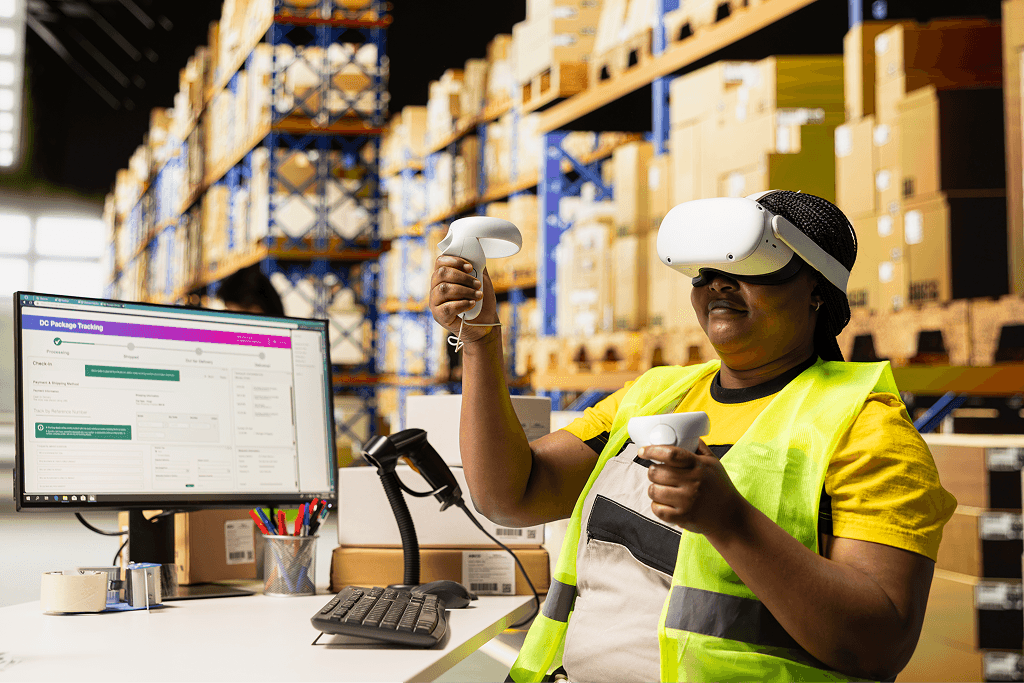
VR lets your warehouse staff practice equipment operation and emergency procedures without touching actual machinery. In a virtual warehouse that mirrors your actual one, your employees can practice and repeat procedures until they're automatic. However, unlike in the real one, the mistakes your employees make in the virtual warehouse are free of consequences.
This is best exemplified by our work with Amazon Air, Amazon Air operates warehouses that depend on conveyor belts running around the clock. When those belts go down, deliveries stop and costs pile up, especially during the holiday rush.
VRseBuilder helped them deploy a VR training module for conveyor belt replacement across four warehouses in Wilmington, Ohio. The results were notable: training time dropped 80% and 99.1% of trainees passed their assessments.
Use case 6: Food safety training
Food safety violations carry steep costs. A single contamination incident can destroy an entire batch, trigger recalls, damage brand reputation, and create regulatory problems.
One of the key benefits of VR in FMCG is making food safety training experiential rather than theoretical. You can let your workers practice proper sanitation techniques, show them how contamination actually spreads through a production environment. They experience the consequences of skipping steps or rushing through protocols in scenarios that feel real but carry no actual risk.
Most importantly, the brand stays protected because product integrity doesn't depend on workers remembering rules under pressure, but on habits they've built through practice.
VR as FMCG business infrastructure
VR solutions for FMCG work because they solve problems that share certain characteristics.
Involve physical space: Think retail layouts, production lines, and warehouse operations.
They're complex: Experiences work better than explanations.
Involve high stakes: Errors mean lost sales, production downtime, or safety incidents.
Needs scale: Requires scaling across many locations, shifts, or people.
So, the most successful VR implementations FMCG companies have launched are those that drive business outcomes.
Measurable. Business. Outcomes.
Such as:
40% sales increase in retail showrooms.
Preventing downtime during the holiday season.
80% reduction in training time
The FMCG companies that extract value from VR no longer restrict it to a training technology. For them, VR is infrastructure; vital for performance across sales, operations, marketing, and supply chain.
The question now isn't if VR is right for FMCG. The question now is which problems matter enough to solve first using VR.