Back to Blog List

GMP Food Safety Training: VR, AR, and MR Can Help the Broken System

GMP Food Safety Training: VR, AR, and MR Can Help the Broken System

The global food industry has spent decades perfecting its written standards. GMPs, SOPs, audit checklists. The documentation is thorough, well-intentioned, and almost always very detailed.

But here's the problem. Compliance on paper is one thing; Compliance on the production floor is completely different.

And the gap between them? That's almost always a people problem.

Ineffective Training is the Culprit

Here’s an uncomfortable truth: the most expensive training strategy is the one that keeps patching a broken system instead of replacing it. 

Unfortunately, a lot of food manufacturers are still doing exactly that.

Training is an afterthought

In most food plants, training happens once. Just once.

Here’s how it goes: A new hire joins, sits through an onboarding session, signs a form, and gets sent to the floor.

That's it. 

That is, until something goes wrong.

High staff turnover makes this even worse. It forces a significant portion of the workforce to operate on incomplete training. In plants with multilingual teams, written procedures are only useful to the few workers who can read and understand them.

The results of all these are predictable. Critical procedures get forgotten. Informal habits and half-baked knowledge get passed down through. Over time, the procedures people do drifts further and further from what the SOP says they should do.

The classroom isn't cutting it either

Long presentations. Printed manuals. Video lectures. 

All part of existing training methods. None that prepares anyone for the reality of a production floor.

Simply because none of these methods can simulate the pressure or environment of a production floor.

So workers complete their training and pass the knowledge check. But the actual job looks and feels nothing like what they just sat through. The knowledge they learned was never connected to experience in the first place.

When training fails, the cost is real

Food safety failures aren't just operational headaches. They can:

  • Damage consumer trust

  • Trigger legal fees

  • Halt production

Then there are the quieter costs like slowed output and time pulled away from growth to manage damage control. These add up really fast.

XR Is Rebuilding the 5 Ps of GMP From the Inside Out

In the food industry, Good Manufacturing Practices (GMP) run on five pillars: People, Products, Processes, Procedures, and Premises. 

A lot of food manufacturers have the last four reasonably covered. It's the first one, People, where things are shaky.

XR (Extended Reality) addresses that directly. And it doesn't stop at GMP food safety training in VR (Virtual Reality). It includes use cases with AR (Augmented Reality) and MR (Mixed Reality).

Let’s see how:

1. VR food safety training fixes how people learn

VR food safety training puts your workers inside a replica of the production environment before they ever set foot on the actual floor.

They can practice line cleaning, equipment handling, and emergency procedures as many times as they need to. 

You don’t:

  • Have to stop production

  • Waste any materials

  • Face any risk of injury

The difference from classroom training is evident. Because VR food safety training engages multiple senses. It simulates pressure. It makes mistakes possible and safe. 

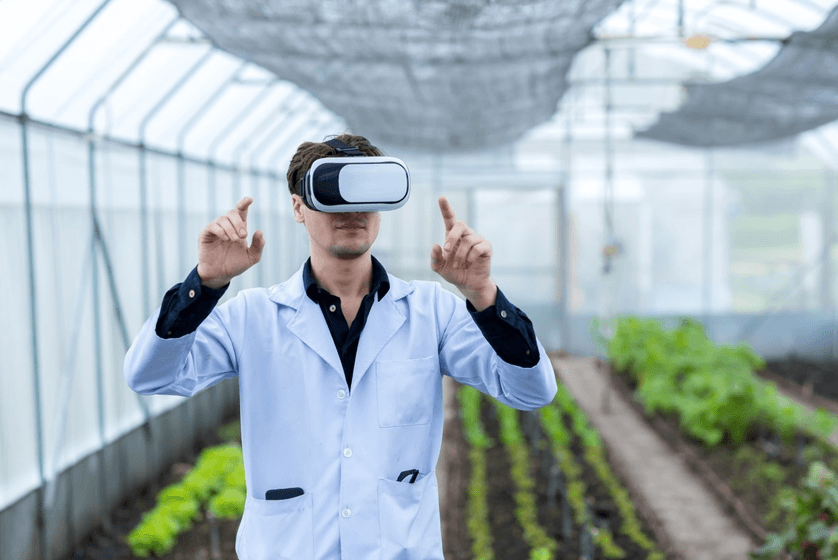
Instead of hearing about the hygiene procedures they have to follow, you can make your workers put on a VR headset and walk through your plant's GMP hygiene procedures. They discover the ins and outs of GMP food safety training in the VR experience, learning about handwashing stations, gowning sequence, restricted zone boundaries, contamination risks, etc., and doing the procedures firsthand when needed.

It also solves the language barrier problem more naturally than any written SOP can. Visual, step-by-step guidance works across languages in a way that text-heavy manuals simply don't. Also, implementing GMP food safety training in VR means you can create multilingual modules and cater to the needs of workers from different linguistic backgrounds.

Once a VR food safety training module is built, it can be deployed across every site in your network. A plant in one country runs the same training as a plant in another. 

Same standard, same sequence, same assessment. No dependency on a good trainer being available on the right day.

And because implementing GMP food safety training in VR leads to every session being logged automatically, you always have in-depth performance data. You know who has been trained, when they were trained, and how they performed. That data sits in your system ready for you to pull, whether you need it for an internal review or an unannounced audit.

2. AR fixes how people work

Once your worker is trained, AR takes over on the floor.

AR smart glasses or even smartphones overlay real-time instructions directly onto the task at hand. During line changeovers, sanitation runs, or equipment setup, workers follow the exact steps without having to hunt for a printed procedure.

However, AR doesn't just guide. It also verifies. Platforms can use AI-powered visual recognition to confirm each step is completed correctly before the worker moves on. 

Workers can also receive assistance from experts in remote locations when they’re stuck. Think of an operator who’s unable to figure out the issue with a machine that has just stopped working. The operators can connect with experts who can guide them through the procedure, even creating virtual markers that supplement the information they receive on call.

3. MR fixes how hygiene gets inspected

Mixed Reality goes a step further in high-care environments.

Let’s take a GMP hygiene simulation that covers the sanitation cycle. MR devices can visually highlight every surface zone that needs to be cleaned. A worker can't skip a zone or move to the next step until the current one is verified. Also, every action can be recorded as further evidence.

This matters a lot as hygiene failures are rarely intentional. Workers miss spots due to ambiguous standards of cleaning or physical constraints like tiredness. MR removes that ambiguity entirely and allows them to do and verify the steps they’re supposed to take.
Additional Considerations Before You Deploy XR

XR can fix a lot of problems in food manufacturing. But before rolling anything out, there are a few things worth thinking through.

1. The deployment cost

An initial investment for implementing GMP food safety training in VR, AR, or MR includes hardware, content development, software licensing, etc. If not careful, it can add up quickly.

That cost does come down over time and even starts paying dividends. Once a training module is built, you can reuse it across every cohort, every site, every new hire. The per-person cost drops significantly the more you use it.

2. Your existing processes

VR, AR, and MR digitize your existing procedures. But if those procedures are outdated or inconsistent, deploying food safety XR training won’t be of much help. You might end up scaling the wrong thing.

So, before building a single module, audit what you actually do on the floor. Build SOPs around the correct process, with no gaps. Then build the XR eco-system, be it a GMP hygiene simulation or a VR food safety training module.

3. Tech comfort level of workers

Most workers adapt to food safety XR training and other XR use cases quickly. But a few may find it disorienting. Especially VR training.

But this isn't a reason to avoid XR. It's just a reason to build in proper onboarding time for the technology itself, separate from the actual training content. You have to make workers comfortable with the tech before you train them using it.

Note that a bad first experience can colour someone's perception of the whole programme. A good one usually converts even the biggest skeptics and those who have no idea what XR is.

Conclusion: Should You Implement GMP Food Safety Training in VR, AR, or MR?

The food industry has always had high stakes. 

For a long time, the answer was more documentation. Better checklists. Stricter sign-off processes. 

These things matter, but only work if the people executing the procedures actually know what they're doing. And actually do it consistently, every single time.

That's the problem XR solves. By changing how workers learn, how they execute, and how that execution gets recorded. 

Training becomes something people retain. Procedures become instinct.

The technology is ready. The ROI case is solid. The only real question is how long it takes your organisation to move from "we're looking into it" to actually running a pilot.

FAQ

1. How is VR used in food manufacturing GMP training?

VR creates a virtual replica of the production environment that lets workers practice real procedures before touching anything live. They can run through line cleaning, equipment handling, sanitation checks, and emergency scenarios as many times as needed. No production downtime, no risk of injury, no wasted materials.

1. How is VR used in food manufacturing GMP training?

VR creates a virtual replica of the production environment that lets workers practice real procedures before touching anything live. They can run through line cleaning, equipment handling, sanitation checks, and emergency scenarios as many times as needed. No production downtime, no risk of injury, no wasted materials.

1. How is VR used in food manufacturing GMP training?

VR creates a virtual replica of the production environment that lets workers practice real procedures before touching anything live. They can run through line cleaning, equipment handling, sanitation checks, and emergency scenarios as many times as needed. No production downtime, no risk of injury, no wasted materials.

2. Can VR GMP training satisfy the documentation requirements of BRC and FSSC 22000?

2. Can VR GMP training satisfy the documentation requirements of BRC and FSSC 22000?

2. Can VR GMP training satisfy the documentation requirements of BRC and FSSC 22000?

Let’s talk about

Let’s talk about

Let’s talk about

your training

your training

your training

Talk to our team to learn how to implement VR training at scale

Talk to our team to learn how to implement VR training at scale

Talk to our team to learn how to implement VR training at scale