
AR has changed from a simple novelty to a useful tool for businesses in many areas. AR content, like 3D product displays, interactive training guides, or location-specific experiences, is helping companies connect with consumers in ways that can be measured. As we approach 2025, the need to develop AR content is growing because companies want adaptable ways to improve education, increase customer trust, and make operations simpler. This article looks at how to create AR content, the tools you can use, some examples, and what trends will affect the widespread acceptance of AR content.
What Is AR Content and Why It Matters in 2025?
AR content includes 3D models and interactive animations which when added to the real world, can improve experience for a user. Companies are also beginning to change how they interact with both employees and customers by using AR content creation for things like product demonstrations and training.
In 2025, there are many AR use cases. Stores are using AR for virtual try-ons, factories are using it for assembly, and doctors for training. By mixing the real and digital worlds, AR content makes sure people are more involved. It helps them with retention and also has a clear impact on business.
The 4 Main Types of AR Content You Can Create
AR content comes in several forms, depending on the specific application. Each form provides a distinct advantage for companies that implement augmented reality on a large scale.
3D Models & Product Visualizations
AR 3D models let customers and employees check out products in a virtual setting. In stores, AR can be used by people to try on outfits or imagine how furniture will look at home before purchasing. Engineers can use these images to check prototypes without making a physical version, before manufacturing. For this to be useful, the models must appear realistic, so accuracy is very important when considering how to create AR experiences.
AR Animations & Interactive Overlays
AR is an instance of how interactive visuals can be implemented. AR applications can overlay digital information onto physical objects, which makes it simpler to understand assembly processes, machine operations, or even medical procedures. AR can show assembly instructions right on a machine, walking a technician through each step. They can see exactly where each part goes and how it should fit. Hence, they don't have to look at a separate manual, reducing mistakes and speeding up assembly.
Location-Based AR Content
The way AR uses location data is becoming quite common. GPS, AR applications can show content that relates to the user's surroundings. Location-based AR offers real-time tips. It uses location data to make sure that tourists, retail customers, and logistics teams all have better experiences (Source). In addition, location-based AR is useful for field training. New workers can use AR navigation to learn about the jobsite.
Marker-Based AR
Marker-based AR works by using visual markers like images or QR codes to start the presentation of digital content. This is frequently seen on product packaging, where scanning a label may show extra product details, or in compliance checklists, where a marker can open instructions. Companies also apply it to quick-start employee guides, making step-by-step training simpler.
In short, the variety of AR content ensures that every industry can find a format that aligns with its goals and workflows.
How to Create AR Content: Two Clear Paths
Organizations today can pursue AR content creation via two primary methods. Each comes with distinct advantages depending on scale, budget, and customization needs.
The Quick & Easy Route (No-Code AR Tools)
No-code AR tools such as ZapWorks, Overly, and BlippAR allow companies to build AR experiences without coding expertise. These platforms provide templates, drag-and-drop interfaces, and rapid deployment capabilities. Businesses use them to quickly test AR prototypes, launch small-scale campaigns, or deliver training with minimal investment. For enterprises exploring how to make AR content affordably, no-code AR tools are often the starting point.
The Professional Route (Custom AR Development)
Custom AR development leverages engines such as Unity, Unreal Engine, or Vuforia Studio. This path is suited for enterprises requiring complex, scalable AR experiences—like field service workflows, enterprise-scale training, or advanced product configurators. While it demands higher investment and technical expertise, professional AR development delivers unmatched flexibility and control.
The decision to use either no-code AR tools or custom development hinges on whether you value a quick turnaround or the ability to scale your project.
Step-by-Step Guide to Building AR Content
To ensure effective implementation, it is ideal to follow a structured approach towards AR content creation. If you use a system, things will be more steady; you won't waste time, and you can grow your AR projects past just trying them out once.
Define Your AR Goal
clarify the specific reason your organization wants to use AR. This could mean a few things, such as training staff in a hands-on way, making marketing efforts more interesting, letting customers see how products might look in use before they buy them, or adhering to industry rules using new technology.
Choose AR Type
The selection of AR content involves carefully thinking about how you plan to use it and where it will be used. Each type like marker-based, markerless, projection-based, and location-based has certain advantages and works best for certain uses.
Create or Source 3D/2D Assets
For AR and VR content to feel believable and be practical to use, the digital objects within them must appear very real, almost like photographs. Because of this demand for extremely realistic visuals, a lot of companies have started looking into methods that combine artificial intelligence with 3D modelling techniques. The goal of this combination is to make the process of producing these digital assets quicker and less difficult.
Build Using AR Platforms or Dev Kits
For projects that have a lot of moving parts, you should think about using Unity, Unreal Engine, or software development kits made just for AR. If you want to put something together fast, you may want to go with a no-code AR platform. You need to confirm that the platform you pick can work alongside the enterprise systems you already have.
Test on Different Devices
For AR applications to be widely accepted, they should work well on different devices like phones, tablets, and smart glasses. Making sure they are compatible is important for AR technology to become popular because people have different devices and use them in different ways. If AR experiences only work on a few devices, fewer people will be able to use them.
Deploy & Measure Engagement
Deploy content through apps, web-based AR, or integrated business platforms. To gauge return on investment, keep track of user adoption speed, engagement length, and completion rates. If the data shows a beneficial influence on business objectives, like increased sales or happier clients, the investment is justified. If not, this data tells us how to refine the content for a stronger return.
Following these steps ensures that AR experiences are impactful, scalable, and aligned with enterprise goals.
Real-World Examples of AR Content That Work
Global enterprises already showcase the value of AR content. Boeing uses AR wiring guidance that has reduced technician errors by 40% (Source). DHL uses AR smart glasses for picking in warehouses, increasing efficiency by 25% (Source). Shops are using AR try-ons for clothes and home decorations, which helps people feel more sure about buying and results in things not being returned as often.
These AR content examples demonstrate how enterprises achieve tangible ROI from immersive solutions.
Best Tools & Platforms for AR Content in 2025
The AR ecosystem in 2025 offers tools for both beginners and experts. No-code AR platforms provide ease of use, while professional SDKs unlock enterprise-scale customization.
Comparison of no-code vs professional AR development:
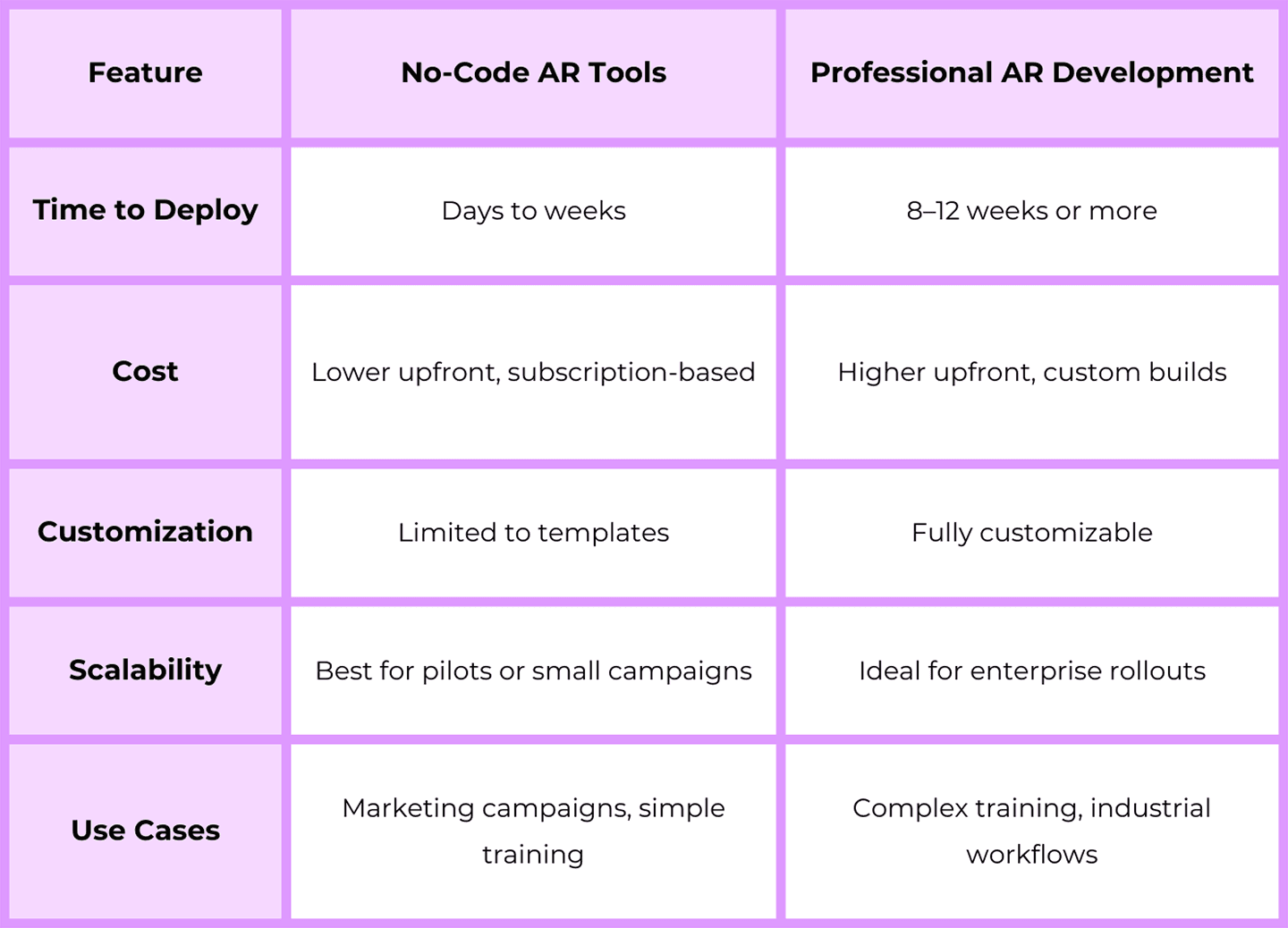
For enterprises seeking long-term adoption, combining no-code for experimentation with professional AR development for scaling is often the optimal strategy.
Measuring the ROI of AR Content
Investing in AR content makes sense if it shows real business gains. While these experiences can grab people's attention, companies require solid numbers to show that AR is boosting engagement, cutting expenses, or increasing sales. Measuring ROI not only justifies the initial spending but also helps guide choices about growing in the future, making sure AR becomes a lasting plan instead of just a test.
Engagement Rates
When people engage with AR, it's a good sign it's doing its job. Usage data, like how long someone spends in an AR environment, how they interact with 3D images, and if they use it more than once, can show how interesting and useful the material is to them. If people engage a lot, they usually learn more when it's used for teaching, or they remember what they saw better if it's used in ads.
Conversions
In sales and marketing, AR directly affects conversions. Stores that let shoppers preview products using AR see buyers who are more sure about what they're buying. This leads to fewer returns and more sales. In training, conversion can be how well someone completes a task or the rate at which they get certified after learning with AR.
Cost Savings
AR offers a clear return on investment because it can lower expenses. Companies can save money on materials by using AR models instead of making prototypes. Also, they can save on travel and instructor time by using AR for employee teaching, which reduces work delays. These savings build up, especially when used across a company's locations, which creates important financial benefits.
Brand Recall & User Experience Improvement
AR content is distinct because it tends to create a stronger impression compared to something static. Staff who get training through AR tend to keep that knowledge longer. Customers who see AR campaigns tend to remember the items featured better. When folks remember things better, it can really make a brand stronger and help employees do their jobs better. This alone can make AR a differentiator in competitive markets for the long run.
Measuring ROI ensures stakeholders see the true value of AR investments.
Challenges in Creating AR Content (And How to Overcome Them)
Even though AR is quite powerful, companies meet challenges that can slow its acceptance or limit its influence. These problems often show up when AR is first used, but they can be handled with the correct plans.
High Cost of 3D Asset Creation
If you want to know how to create augmented reality 3D models, you need to understand that it takes time, specific skills, and a lot of resources. If a company wants to use augmented reality a lot, this process can slow things down. But, new AI tools and model libraries help to lower expenses. They allow for fast creation or adjustment of models, which gives easier access to high-quality AR.
Device Compatibility Issues
AR is often accessed by both workers and customers on various devices like phones, tablets, and smart glasses. If it is not tested well, the experience could be inconsistent or not even function. To fix this, companies should create AR content that works on different platforms and use AR platforms that can easily adjust to multiple devices.
Scalability for Enterprises
One usual problem is expanding pilot projects to company-wide use. Apps made for special uses often need a lot of upkeep, which makes it hard to grow them. WebXR and AR delivery through the cloud are fixing this by allowing access from any device. This lets AR run right in web browsers without needing big downloads or setups.
User Adoption Hurdles
Even the most advanced AR tech can fail if people do not want to change. Staff might not know how to use AR, and customers may not see what makes it useful right away. To fix this, groups should put money into training, simple designs, and telling everyone about the good things it brings. If you focus on running changes well, people will use it easily for a long time.
Proper preparation turns difficulties into chances for growing AR gains.
Future Trends in AR Content Creation
As AR technology improves, the emphasis is moving from tests to practical business solutions. Advances in artificial intelligence, web standards, and devices are making AR easier to expand, access, and use. These changes will shape how groups make and use AR content from 2025 on.
AI-assisted 3D Modeling
Producing good 3D models has been a major barrier to entry in AR. It takes a lot of money and time. Tools using AI are changing things by automating steps like scanning objects, creating textures, and adjusting models for different devices. This speeds up production and lets smaller companies get involved in AR content creation.
WebXR and Lightweight AR Apps
In the past, using AR meant installing specific programs or sizeable apps, which limited its reach. Now, WebXR lets people access AR through standard browsers on any device with internet, like phones, tablets, or VR headsets. This shift makes AR simpler to share and implement in fields like education, marketing, and customer service.
AR in Education & Workplace Training
AR is finding applications in workforce training, not just product demos. AR helps people learn by doing through the addition of info to physical settings across manufacturing, aviation, healthcare, and other sectors. In educational institutions, AR is making lessons interactive via a mix of academic concepts with real-world application. This is particularly helpful for institutions that need flexible, engaging training to comply with regulations and safety protocols.
AR + Wearables
AR wearables, like Microsoft HoloLens, Magic Leap 2, and smaller smart glasses, are opening doors for hands-free operation in the workplace. Technicians can use these devices to view instructions when fixing machines, and retail staff can quickly get product details. As AR wearables become more widespread, constant AR access will likely become the norm.
These trends indicate that AR content will only become more seamless, scalable, and impactful in the years ahead.
Conclusion
In 2025, AR content has moved beyond the experimental stage to become a key business tool for improved user connection, productivity, and expansion. Companies can take a gradual approach by starting with simple, code-free tools or expand their scope on a global scale through the use of custom AR creation. Now is the time for organizations to devote resources to AR content creation.